D'Mello-Guyett Lauren, Greenland Katie, Bonneville Sharla, D'hondt Rob, Mashako Maria, Gorski Alexandre, Verheyen Dorien, Van den Bergh Rafael, Maes Peter, Checchi Francesco, Cumming Oliver
Faculty of Infectious and Tropical Diseases, London School of Hygiene and Tropical Medicine, London, UK.
Environmental Health Unit, Médecins Sans Frontières, Brussels, Belgium.
Confl Health. 2020 Jul 24;14:51. doi: 10.1186/s13031-020-00294-w. eCollection 2020.
Cholera remains a leading cause of infectious disease outbreaks globally, and a major public health threat in complex emergencies. Hygiene kits distributed to cholera case-households have previously shown an effect in reducing cholera incidence and are recommended by Médecins Sans Frontières (MSF) for distribution to admitted patients and accompanying household members upon admission to health care facilities (HCFs).
This process evaluation documented the implementation, participant response and context of hygiene kit distribution by MSF during a 2018 cholera outbreak in Kasaï-Oriental, Democratic Republic of Congo (DRC). The study population comprised key informant interviews with seven MSF staff, 17 staff from other organisations and a random sample of 27 hygiene kit recipients. Structured observations were conducted of hygiene kit demonstrations and health promotion, and programme reports were analysed to triangulate data.
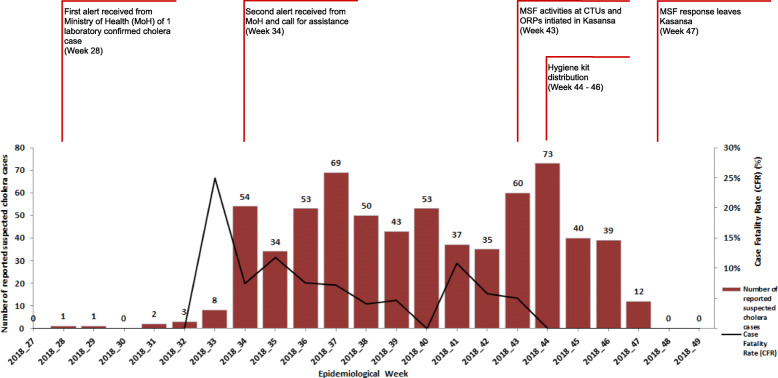
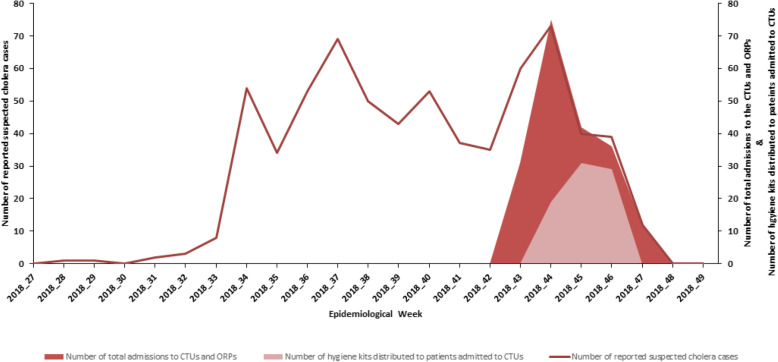
Between Week (W) 28-48 of the 2018 cholera outbreak in Kasaï-Oriental, there were 667 suspected cholera cases with a 5% case fatality rate (CFR). Across seven HCFs supported by MSF, 196 patients were admitted with suspected cholera between W43-W47 and hygiene kit were provided to patients upon admission and health promotion at the HCF was conducted to accompanying household contacts 5-6 times per day. Distribution of hygiene kits was limited and only 52% of admitted suspected cholera cases received a hygiene kit. The delay of the overall response, delayed supply and insufficient quantities of hygiene kits available limited the coverage and utility of the hygiene kits, and may have diminished the effectiveness of the intervention. The integration of a WASH intervention for cholera control at the point of patient admission is a growing trend and promising intervention for case-targeted cholera responses. However, the barriers identified in this study warrant consideration in subsequent cholera responses and further research is required to identify ways to improve implementation and delivery of this intervention.
霍乱仍然是全球传染病暴发的主要原因,也是复杂紧急情况下的重大公共卫生威胁。此前向霍乱病例家庭分发卫生用品包已显示出降低霍乱发病率的效果,无国界医生组织(MSF)建议在医疗保健机构(HCF)收治患者及陪同家庭成员时进行分发。
本过程评估记录了无国界医生组织在2018年刚果民主共和国(DRC)东开赛省霍乱疫情期间分发卫生用品包的实施情况、参与者反应及背景。研究人群包括对7名无国界医生组织工作人员、17名其他组织工作人员的关键 informant 访谈以及27名卫生用品包接收者的随机样本。对卫生用品包示范和健康促进进行了结构化观察,并分析了项目报告以对数据进行三角验证。
在2018年东开赛省霍乱疫情的第28 - 48周,有667例疑似霍乱病例,病死率(CFR)为5%。在无国界医生组织支持的7个医疗保健机构中,在第43 - 47周期间有196例疑似霍乱患者入院,入院时向患者提供了卫生用品包,并每天对陪同的家庭接触者进行5 - 6次健康促进。卫生用品包的分发有限,只有52%的入院疑似霍乱病例收到了卫生用品包。整体应对行动的延迟、供应延迟以及可用卫生用品包数量不足限制了卫生用品包的覆盖范围和效用,可能削弱了干预措施的有效性。在患者入院时整合用于霍乱控制的水、卫生和个人卫生(WASH)干预措施是一种日益增长的趋势,也是针对病例的霍乱应对措施中很有前景的干预手段。然而,本研究中确定的障碍在后续霍乱应对中值得考虑,需要进一步研究以确定改善该干预措施实施和提供方式的方法。