Nakata Yusuke, Kanahara Nobuhisa, Kimura Atsushi, Niitsu Tomihisa, Komatsu Hideki, Oda Yasunori, Ishikawa Masatomo, Hasegawa Tadashi, Kamata Yu, Yamauchi Atsushi, Inazumi Kazuhiko, Kimura Hiroshi, Iyo Masaomi
Department of Psychiatry, Chiba University Graduate School of Medicine, Chiba, Japan.
Division of Medical Treatment and Rehabilitation, Center for Forensic Mental Health, Chiba University, Chiba, Japan.
Schizophr Res Cogn. 2020 Jul 27;22:100186. doi: 10.1016/j.scog.2020.100186. eCollection 2020 Dec.
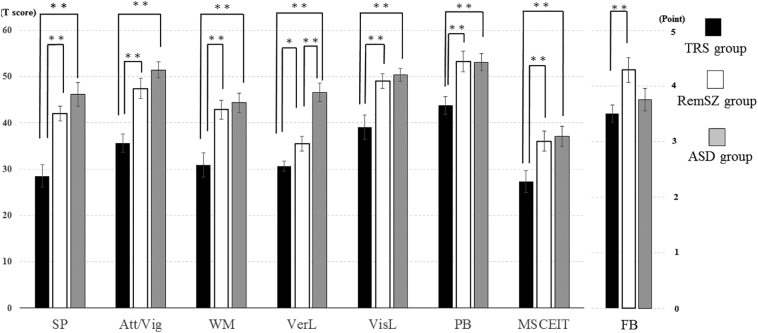
The complex pathophysiology of treatment-resistant schizophrenia (TRS) includes severe positive symptoms but also other symptom domains. The overlapping psychological profiles of schizophrenia and autistic spectrum disorder (ASD) are not established. We compared TRS patients (n = 30) with schizophrenia patients in remission (RemSZ, n = 28) and ASD patients (n = 28), focusing on both neurodevelopmental aspects and general and social cognitive impairments. The TRS group performed the worst on general neurocognition (measured by the MATRICS Consensus Cognitive Battery) and social cognition (measured by the theory of mind and emotional expression). The RemSZ group performed the best among the three groups. Regarding autistic traits, all measurements by the Autism-Spectrum Quotient/Autism Screening Questionnaire/Pervasive Developmental Disorder Assessment Rating Scale showed that (1) the ASD patients had the highest autistic traits (2) the TRS patients' scores were less severe than the ASD group's, but (3) the overall trends placed the TRS group between the ASD and the RemSZ group. These findings indicate that TRS patients and remitted patients could have distinctive neurodevelopmental and cognitive profiles. Further, the degrees of social cognitive dysfunction and autistic traits in TRS patients could be close to those of ASD patients, suggesting similarities between TRS and ASD.
难治性精神分裂症(TRS)复杂的病理生理学不仅包括严重的阳性症状,还涉及其他症状领域。精神分裂症与自闭症谱系障碍(ASD)重叠的心理特征尚未明确。我们将TRS患者(n = 30)与缓解期精神分裂症患者(RemSZ,n = 28)及ASD患者(n = 28)进行比较,重点关注神经发育方面以及一般认知和社会认知障碍。TRS组在一般神经认知(通过MATRICS共识认知成套测验测量)和社会认知(通过心理理论和情感表达测量)方面表现最差。RemSZ组在三组中表现最佳。关于自闭症特征,自闭症谱系商数/自闭症筛查问卷/广泛性发育障碍评估量表的所有测量结果显示:(1)ASD患者的自闭症特征最高;(2)TRS患者的得分比ASD组轻,但(3)总体趋势表明TRS组介于ASD组和RemSZ组之间。这些发现表明,TRS患者和缓解期患者可能具有独特的神经发育和认知特征。此外,TRS患者的社会认知功能障碍程度和自闭症特征可能与ASD患者相近,提示TRS与ASD之间存在相似之处。