Stöcker Juliane K, Vonk Madelon C, van den Hoogen Frank H J, Nijhuis-van der Sanden Maria W G, Spierings Julia, Staal J Bart, Satink Ton, van den Ende Cornelia H M
Department of Rheumatology, Sint Maartenskliniek, Nijmegen, The Netherlands.
Musculoskeletal Rehabilitation Research Group, HAN University of Applied Sciences, Nijmegen, The Netherlands.
BMC Rheumatol. 2020 Jul 31;4:43. doi: 10.1186/s41927-020-00142-7. eCollection 2020.
BACKGROUND/ OBJECTIVE: To gain insight in the use of current systemic sclerosis (SSc) care provided by health professionals from the patient perspective. We focused on referral reasons, treatment goals, the alignment with unmet care needs, and outcome satisfaction.
Dutch SSc patients from 13 participating rheumatology departments were invited to complete an online survey. Descriptive statistics were used to describe current use of non-pharmacological care and outcome satisfaction. Reasons for referral and treatment goals were encoded in International Classification of Function and Disability (ICF) terms.
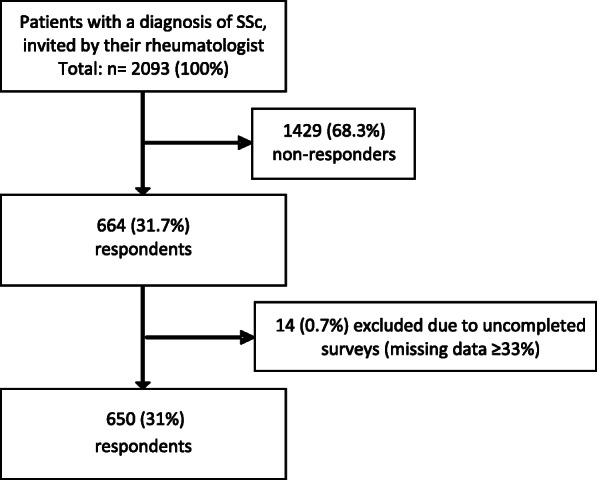
We included 650 patients (mean (standard deviation [SD]) age, 59.4 (11.4) years. 50% had contact with a health professional in the past year; 76.3% since disease onset. Physiotherapists were the most frequently visited in the past year (40.0%), followed by dental hygienists (11.4%) and podiatrists (9.2%). The three most common referral reasons were pain, joint mobility and cardiovascular functions. Fatigue, Raynaud's phenomenon, physical limitations, reduced hand function and joint problems were mentioned by more than 25% of all respondents as unmet needs. The proportion of patients treated in the past year by a health professional who were satisfied with knowledge and expertise of their health professionals was 74.4%; 73% reported improved daily activities and better coping with complaints. However, 48.9% perceived that the collaboration between rheumatologist and health professional was never or only sometimes sufficient.
Despite the high outcome satisfaction and good accessibility of health professionals, there are obstacles in the access to non-pharmacological care and communication barriers between health professionals and rheumatologists.
背景/目的:从患者角度深入了解医疗专业人员提供的当前系统性硬化症(SSc)护理的使用情况。我们重点关注转诊原因、治疗目标、与未满足的护理需求的匹配情况以及结果满意度。
邀请来自13个参与研究的风湿病科的荷兰SSc患者完成一项在线调查。使用描述性统计来描述当前非药物护理的使用情况和结果满意度。转诊原因和治疗目标按照国际功能、残疾和健康分类(ICF)术语进行编码。
我们纳入了650名患者(平均(标准差[SD])年龄为59.4(11.4)岁)。50%的患者在过去一年中与医疗专业人员有过接触;自疾病发作以来,这一比例为76.3%。在过去一年中,物理治疗师是就诊最频繁的(40.0%),其次是口腔保健员(11.4%)和足病医生(9.2%)。三个最常见的转诊原因是疼痛、关节活动度和心血管功能。超过25%的受访者提到疲劳、雷诺现象、身体限制、手部功能减退和关节问题是未满足的需求。在过去一年中接受医疗专业人员治疗的患者中,对其医疗专业人员的知识和专业技能感到满意的比例为74.4%;73%的患者报告日常活动有所改善,对不适的应对能力更好。然而,48.9%的患者认为风湿病医生与医疗专业人员之间的协作从未或只是有时充分。
尽管结果满意度较高且医疗专业人员的可及性良好,但在获得非药物护理方面存在障碍,并且医疗专业人员与风湿病医生之间存在沟通障碍。