Moore Nathan, Yoo Soojeong, Poronnik Philip, Brown Martin, Ahmadpour Naseem
Research and Education Network, Western Sydney Local Health District, Westmead, Australia.
Design Lab, Sydney School of Architecture, Design and Planning, The University of Sydney, Sydney, Australia.
JMIR Serious Games. 2020 Aug 7;8(3):e20797. doi: 10.2196/20797.
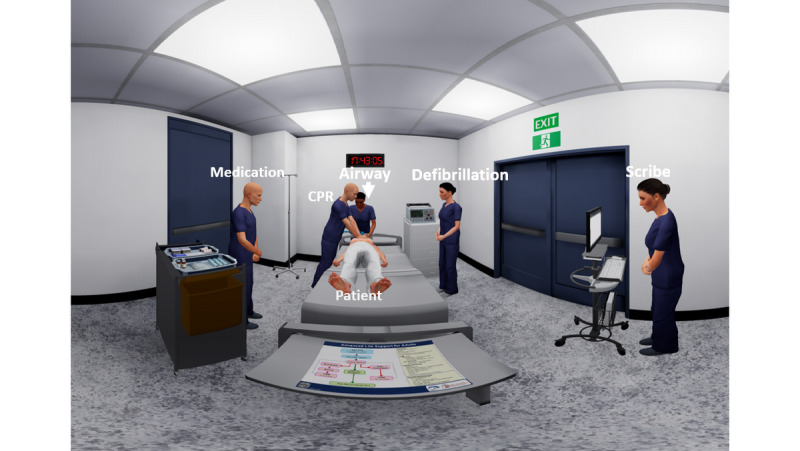
Traditional methods of delivering Advanced Life Support (ALS) training and reaccreditation are resource-intensive and costly. Interactive simulations and gameplay using virtual reality (VR) technology can complement traditional training processes as a cost-effective, engaging, and flexible training tool.
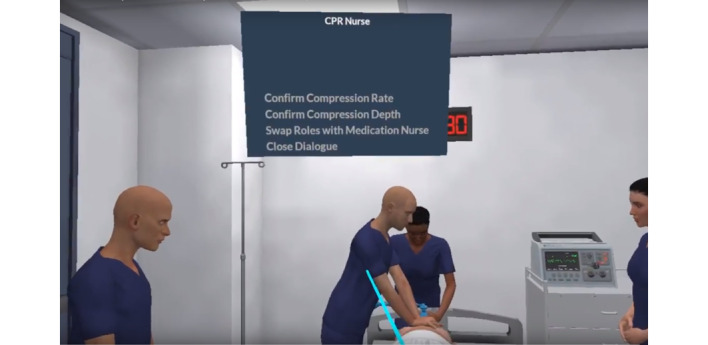
This exploratory study aimed to determine the specific user needs of clinicians engaging with a new interactive VR ALS simulation (ALS-SimVR) application to inform the ongoing development of such training platforms.
Semistructured interviews were conducted with experienced clinicians (n=10, median age=40.9 years) following a single playthrough of the application. All clinicians have been directly involved in the delivery of ALS training in both clinical and educational settings (median years of ALS experience=12.4; all had minimal or no VR experience). Interviews were supplemented with an assessment of usability (using heuristic evaluation) and presence.
The ALS-SimVR training app was well received. Thematic analysis of the interviews revealed five main areas of user needs that can inform future design efforts for creating engaging VR training apps: affordances, agency, diverse input modalities, mental models, and advanced roles.
This study was conducted to identify the needs of clinicians engaging with ALS-SimVR. However, our findings revealed broader design considerations that will be crucial in guiding future work in this area. Although aligning the training scenarios with accepted teaching algorithms is important, our findings reveal that improving user experience and engagement requires careful attention to technology-specific issues such as input modalities.
提供高级生命支持(ALS)培训和再认证的传统方法资源密集且成本高昂。使用虚拟现实(VR)技术的交互式模拟和游戏玩法可以作为一种经济高效、引人入胜且灵活的培训工具,补充传统培训流程。
这项探索性研究旨在确定使用新型交互式VR ALS模拟(ALS-SimVR)应用程序的临床医生的特定用户需求,以为此类培训平台的持续开发提供信息。
在应用程序单次播放后,对经验丰富的临床医生(n = 10,中位年龄 = 40.9岁)进行了半结构化访谈。所有临床医生都直接参与了临床和教育环境中的ALS培训(ALS经验的中位年限 = 12.4;所有人的VR经验最少或没有)。访谈还补充了可用性评估(使用启发式评估)和临场感评估。
ALS-SimVR培训应用程序受到好评。访谈的主题分析揭示了用户需求的五个主要领域,可为创建引人入胜的VR培训应用程序的未来设计工作提供信息:可供性、能动性、多样化输入方式、心智模型和高级角色。
进行这项研究是为了确定使用ALS-SimVR的临床医生的需求。然而,我们的研究结果揭示了更广泛的设计考虑因素,这些因素对于指导该领域的未来工作至关重要。虽然使培训场景与公认的教学算法保持一致很重要,但我们的研究结果表明,改善用户体验和参与度需要仔细关注特定于技术的问题,如输入方式。