Sadeghi Amir H, Peek Jette J, Max Samuel A, Smit Liselot L, Martina Bryan G, Rosalia Rodney A, Bakhuis Wouter, Bogers Ad Jjc, Mahtab Edris Af
Department of Cardiothoracic Surgery, Erasmus University Medical Center, Rotterdam, Netherlands.
Educational Program Technical Medicine, Leiden University Medical Center, Delft University of Technology, Erasmus University Medical Center Rotterdam, Leiden, Delft, Rotterdam, Netherlands.
JMIR Serious Games. 2022 Mar 2;10(1):e30456. doi: 10.2196/30456.
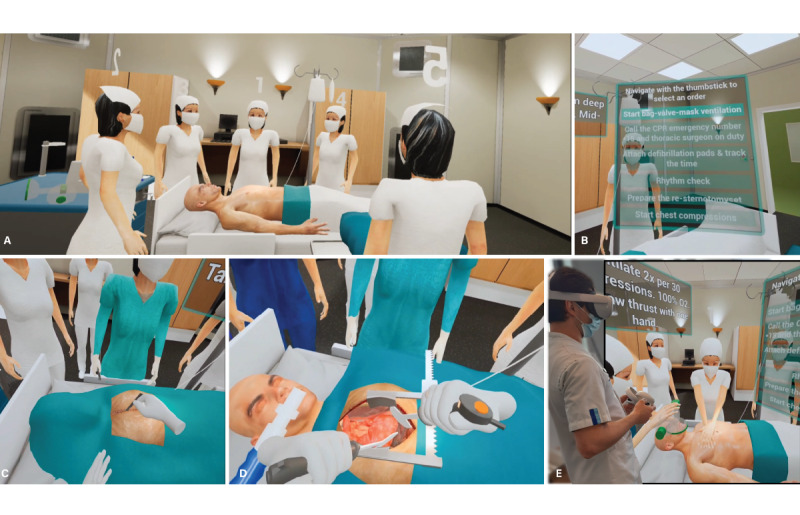
Cardiac arrest after cardiac surgery commonly has a reversible cause, where emergency resternotomy is often required for treatment, as recommended by international guidelines. We have developed a virtual reality (VR) simulation for training of cardiopulmonary resuscitation (CPR) and emergency resternotomy procedures after cardiac surgery, the Cardiopulmonary Resuscitation Virtual Reality Simulator (CPVR-sim). Two fictive clinical scenarios were used: one case of pulseless electrical activity (PEA) and a combined case of PEA and ventricular fibrillation. In this prospective study, we researched the face validity and content validity of the CPVR-sim.
We designed a prospective study to assess the feasibility and to establish the face and content validity of two clinical scenarios (shockable and nonshockable cardiac arrest) of the CPVR-sim partly divided into a group of novices and experts in performing CPR and emergency resternotomies in patients after cardiac surgery.
Clinicians (staff cardiothoracic surgeons, physicians, surgical residents, nurse practitioners, and medical students) participated in this study and performed two different scenarios, either PEA or combined PEA and ventricular fibrillation. All participants (N=41) performed a simulation and completed the questionnaire rating the simulator's usefulness, satisfaction, ease of use, effectiveness, and immersiveness to assess face validity and content validity.
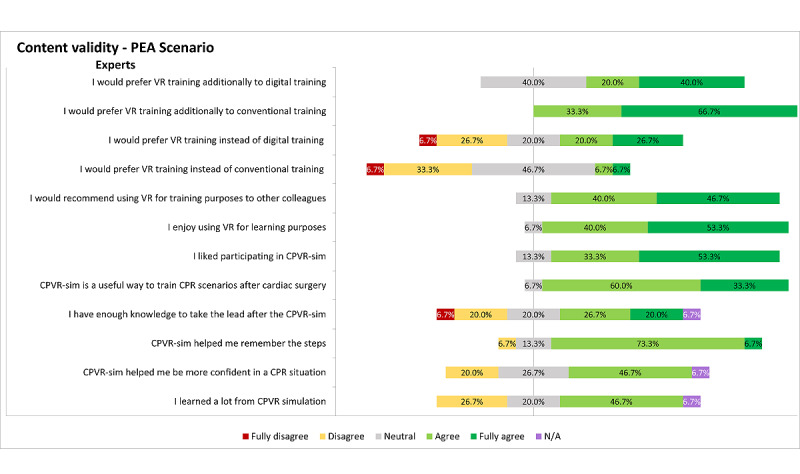
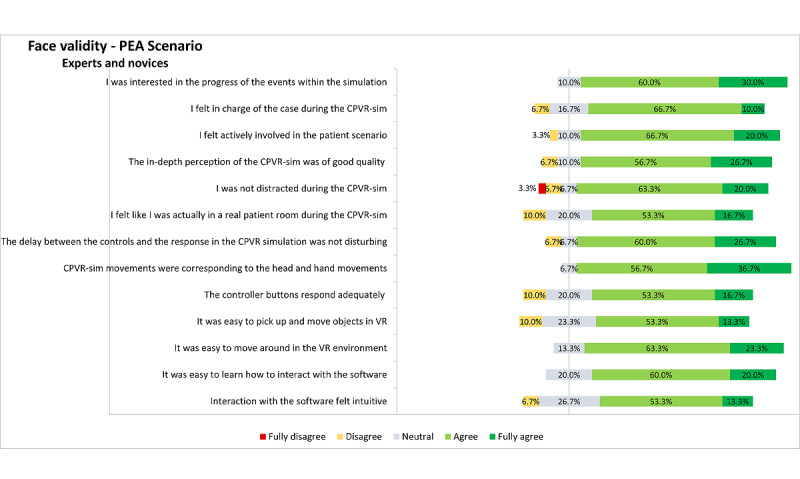
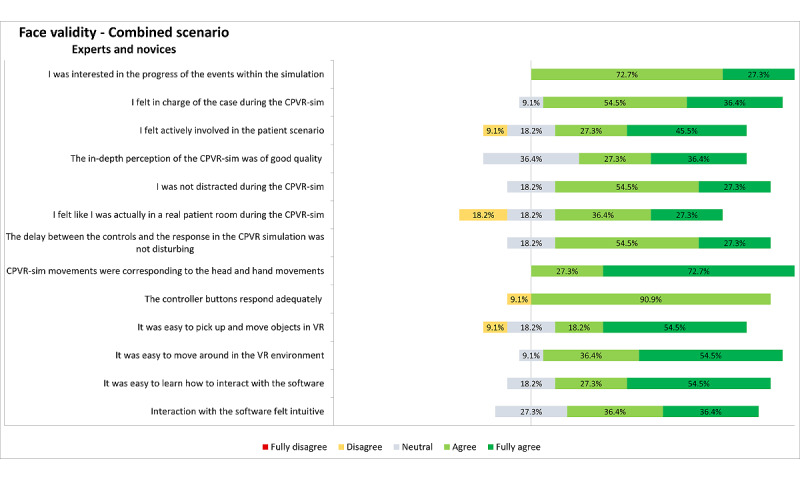
Responses toward face validity and content validity were predominantly positive in both groups. Most participants in the PEA scenario (n=26, 87%) felt actively involved in the simulation, and 23 (77%) participants felt in charge of the situation. The participants thought it was easy to learn how to interact with the software (n=24, 80%) and thought that the software responded adequately (n=21, 70%). All 15 (100%) expert participants preferred VR training as an addition to conventional training. Moreover, 13 (87%) of the expert participants would recommend VR training to other colleagues, and 14 (93%) of the expert participants thought the CPVR-sim was a useful method to train for infrequent post-cardiac surgery emergencies requiring CPR. Additionally, 10 (91%) of the participants thought it was easy to move in the VR environment, and that the CPVR-sim responded adequately in this scenario.
We developed a proof-of-concept VR simulation for CPR training with two scenarios of a patient after cardiac surgery, which participants found was immersive and useful. By proving the face validity and content validity of the CPVR-sim, we present the first step toward a cardiothoracic surgery VR training platform.
心脏手术后的心搏骤停通常有可逆转的病因,按照国际指南的建议,治疗时往往需要紧急再次开胸手术。我们开发了一种虚拟现实(VR)模拟,用于训练心脏手术后的心肺复苏(CPR)和紧急再次开胸手术操作,即心肺复苏虚拟现实模拟器(CPVR-sim)。使用了两种虚拟临床场景:一例无脉电活动(PEA)以及一例PEA合并心室颤动。在这项前瞻性研究中,我们研究了CPVR-sim的表面效度和内容效度。
我们设计了一项前瞻性研究,以评估CPVR-sim的两种临床场景(可电击和不可电击的心搏骤停)的可行性,并确立其表面效度和内容效度,该研究部分分为一组在心脏手术后患者中进行心肺复苏和紧急再次开胸手术的新手和专家。
临床医生(心胸外科医生、内科医生、外科住院医师、执业护士和医学生)参与了本研究,并进行两种不同的场景模拟,即PEA或PEA合并心室颤动。所有参与者(N = 41)进行了一次模拟,并完成了对模拟器的有用性、满意度、易用性、有效性和沉浸感进行评分的问卷,以评估表面效度和内容效度。
两组对表面效度和内容效度的反馈主要为积极。PEA场景中的大多数参与者(n = 26,87%)感觉积极参与了模拟,23名(77%)参与者感觉能掌控局面。参与者认为学习如何与软件交互很容易(n = 24,80%),并认为软件响应充分(n = 21,70%)。所有15名(100%)专家参与者都更喜欢将VR训练作为传统训练的补充。此外,13名(87%)专家参与者会向其他同事推荐VR训练,14名(93%)专家参与者认为CPVR-sim是一种训练心脏手术后罕见的需要心肺复苏的紧急情况的有用方法。此外,10名(91%)参与者认为在VR环境中移动很容易,并且CPVR-sim在这种场景中响应充分。
我们开发了一个概念验证的VR模拟,用于心脏手术后患者的心肺复苏训练,有两种场景,参与者发现该模拟具有沉浸感且有用。通过证明CPVR-sim的表面效度和内容效度,我们朝着心胸外科VR训练平台迈出了第一步