Division of Atmospheric Sciences, Desert Research Institute, Reno, NV 89512, USA.
Department of Environmental and Occupational Health, School of Public Health, Rutgers University, Piscataway, NJ 08854, USA.
Int J Environ Res Public Health. 2020 Aug 5;17(16):5650. doi: 10.3390/ijerph17165650.
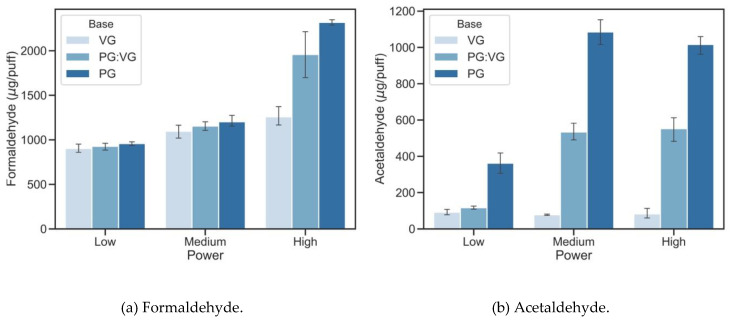
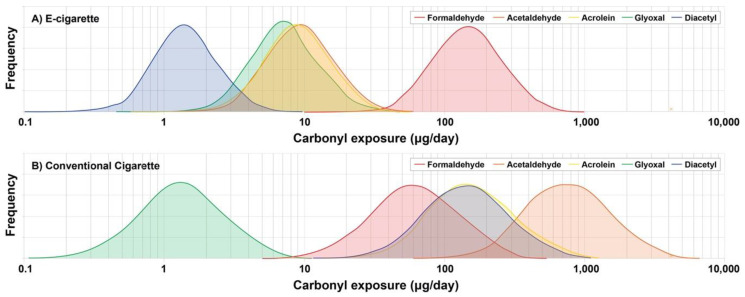
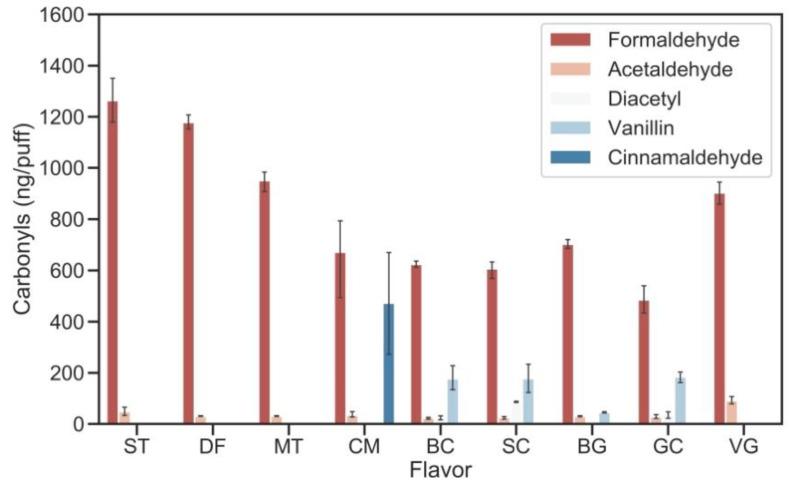
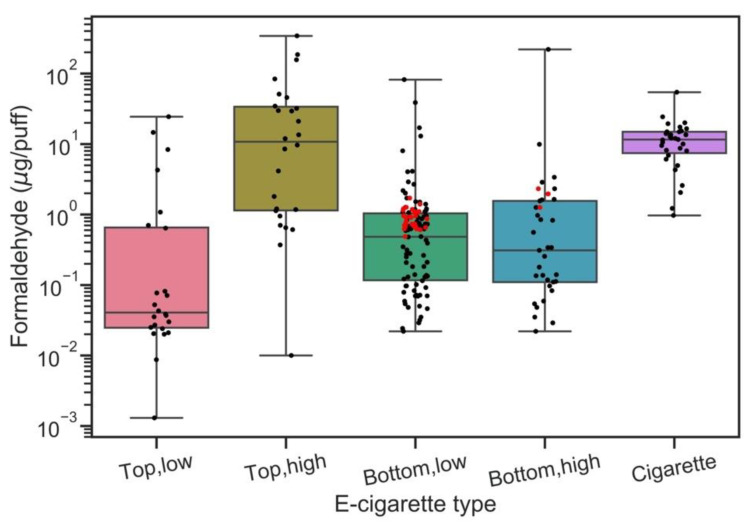
Health impacts of electronic cigarette (e-cigarette) vaping are associated with the harmful chemicals emitted from e-cigarettes such as carbonyls. However, the levels of various carbonyl compounds under real-world vaping conditions have been understudied. This study evaluated the levels of carbonyl compounds (e.g., formaldehyde, acetaldehyde, glyoxal, and diacetyl, etc.) under various device settings (i.e., power output), vaping topographies, and e-liquid compositions (i.e., base liquid, flavor types). The results showed that e-vapor carbonyl levels were the highest under higher power outputs. The propylene glycol (PG)-based e-liquids generated higher formaldehyde and acetaldehyde than vegetable glycerin (VG)-based e-liquids. In addition, fruit flavored e-liquids (i.e., strawberry and dragon fruit) generated higher formaldehyde emissions than mint/menthol and creamy/sweet flavored e-liquids. While single-top coils formed 3.5-fold more formaldehyde per puff than conventional cigarette smoking, bottom coils generated 10-10,000 times less formaldehyde per puff. In general, increases in puff volume and longer puff durations generated significantly higher amounts of formaldehyde. While e-cigarettes emitted much lower levels of carbonyl compounds compared to conventional cigarettes, the presence of several toxic carbonyl compounds in e-cigarette vapor may still pose potential health risks for users without smoking history, including youth. Therefore, the public health administrations need to consider the vaping conditions which generated higher carbonyls, such as higher power output with PG e-liquid, when developing e-cigarette product standards.
电子烟(e-cigarette)蒸气的健康影响与电子烟释放的有害化学物质有关,例如羰基化合物。然而,在实际蒸气条件下,各种羰基化合物的水平尚未得到充分研究。本研究评估了各种设备设置(即输出功率)、蒸气形貌和电子烟液成分(即基础液、口味类型)下的羰基化合物(例如甲醛、乙醛、乙二醛和双乙酰等)水平。结果表明,在较高的输出功率下,蒸气中的羰基化合物水平最高。基于丙二醇(PG)的电子烟液比基于蔬菜甘油(VG)的电子烟液产生的甲醛和乙醛更高。此外,水果口味的电子烟液(例如草莓和火龙果)比薄荷/薄荷醇和奶油/甜味电子烟液产生更高的甲醛排放量。虽然单线圈每口产生的甲醛比传统香烟多 3.5 倍,但底部线圈每口产生的甲醛少 10-10000 倍。总体而言,增加吸气量和延长吸气时间会产生显著更高量的甲醛。虽然电子烟释放的羰基化合物水平远低于传统香烟,但电子烟蒸气中存在几种有毒羰基化合物,仍可能对没有吸烟史的使用者(包括年轻人)构成潜在健康风险。因此,公共卫生管理部门在制定电子烟产品标准时,需要考虑产生更高羰基化合物的蒸气条件,例如使用 PG 电子烟液的高输出功率。