HRH Prince Alwaleed Bin Talal Bin Abdulaziz Alsaud Institute for Computational Biomedicine, Dept. of Physiology and Biophysics, Weill Cornell Medicine, New York, New York, United States of America.
Caryl and Israel Englander Institute for Precision Medicine, Weill Cornell Medicine, New York, New York, United States of America.
PLoS Comput Biol. 2020 Aug 7;16(8):e1008098. doi: 10.1371/journal.pcbi.1008098. eCollection 2020 Aug.
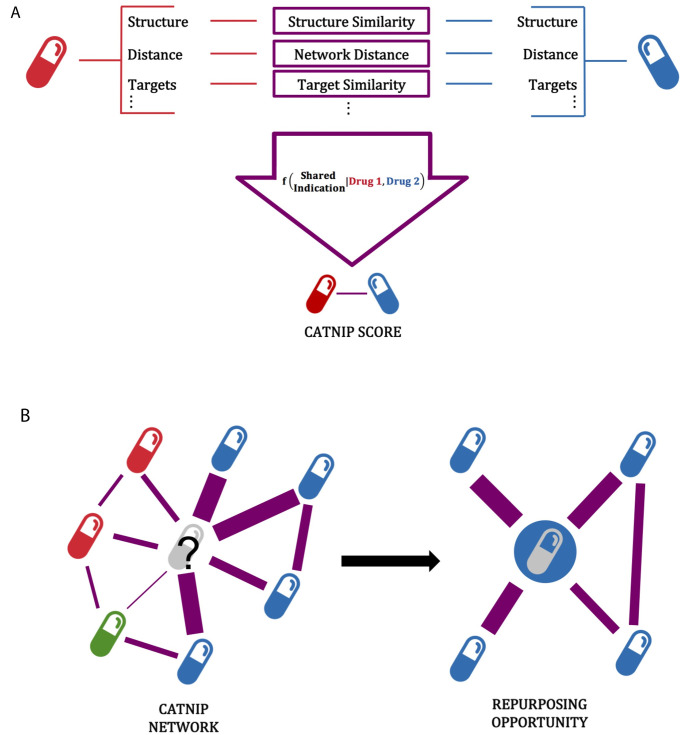
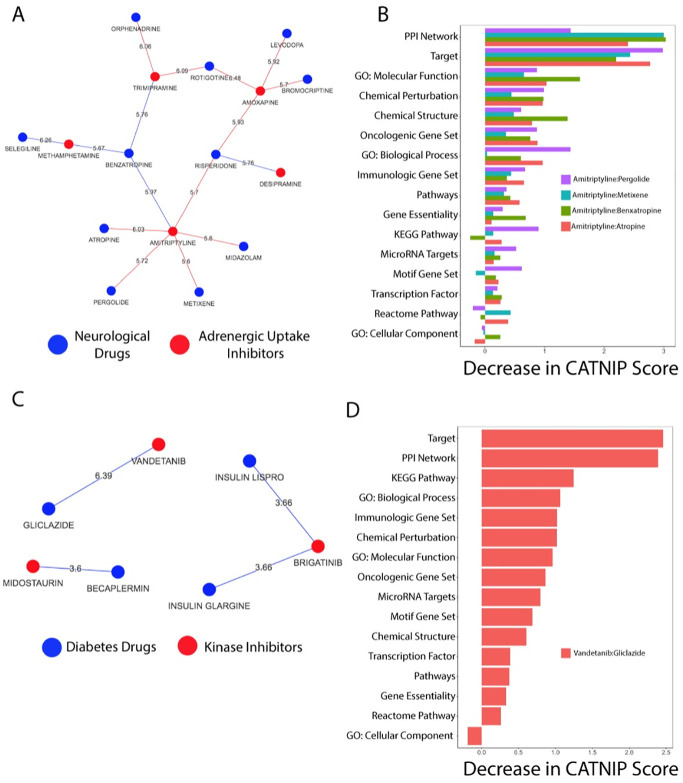
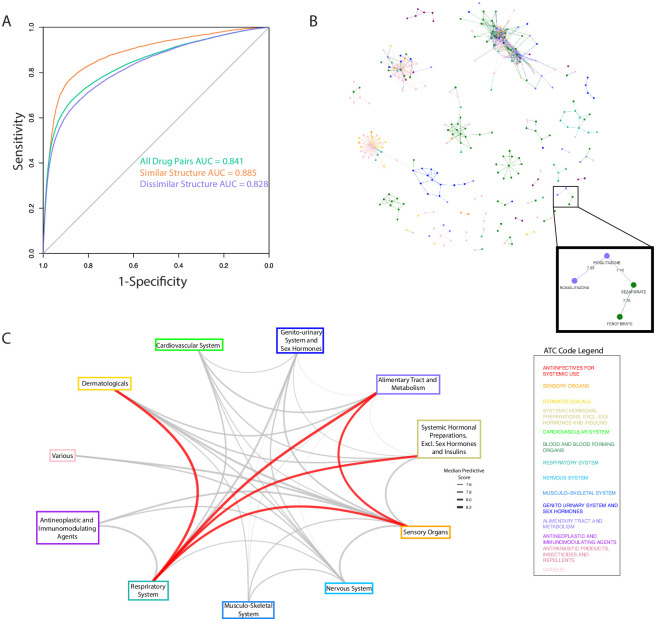
Drug repurposing, identifying novel indications for drugs, bypasses common drug development pitfalls to ultimately deliver therapies to patients faster. However, most repurposing discoveries have been led by anecdotal observations (e.g. Viagra) or experimental-based repurposing screens, which are costly, time-consuming, and imprecise. Recently, more systematic computational approaches have been proposed, however these rely on utilizing the information from the diseases a drug is already approved to treat. This inherently limits the algorithms, making them unusable for investigational molecules. Here, we present a computational approach to drug repurposing, CATNIP, that requires only biological and chemical information of a molecule. CATNIP is trained with 2,576 diverse small molecules and uses 16 different drug similarity features, such as structural, target, or pathway based similarity. This model obtains significant predictive power (AUC = 0.841). Using our model, we created a repurposing network to identify broad scale repurposing opportunities between drug types. By exploiting this network, we identified literature-supported repurposing candidates, such as the use of systemic hormonal preparations for the treatment of respiratory illnesses. Furthermore, we demonstrated that we can use our approach to identify novel uses for defined drug classes. We found that adrenergic uptake inhibitors, specifically amitriptyline and trimipramine, could be potential therapies for Parkinson's disease. Additionally, using CATNIP, we predicted the kinase inhibitor, vandetanib, as a possible treatment for Type 2 Diabetes. Overall, this systematic approach to drug repurposing lays the groundwork to streamline future drug development efforts.
药物重定位,即寻找药物的新用途,可以绕过常见的药物开发陷阱,最终更快地将疗法推向患者。然而,大多数药物重定位发现都是基于传闻观察(例如伟哥)或基于实验的重定位筛选,这些方法既昂贵又耗时,而且不够精确。最近,已经提出了更系统的计算方法,但这些方法依赖于利用药物已批准治疗的疾病的信息。这从根本上限制了算法,使其无法用于研究性分子。在这里,我们提出了一种名为 CATNIP 的药物重定位计算方法,该方法仅需要分子的生物学和化学信息。CATNIP 用 2576 种不同的小分子进行训练,并使用 16 种不同的药物相似性特征,如结构、靶点或途径相似性。该模型获得了显著的预测能力(AUC=0.841)。使用我们的模型,我们创建了一个重定位网络,以识别药物类型之间广泛的重定位机会。通过利用这个网络,我们确定了有文献支持的重定位候选药物,例如系统使用激素制剂治疗呼吸道疾病。此外,我们证明我们可以使用我们的方法来确定特定药物类别的新用途。我们发现肾上腺素摄取抑制剂,特别是阿米替林和曲米帕明,可能是治疗帕金森病的潜在疗法。此外,使用 CATNIP,我们预测激酶抑制剂凡德他尼可能是 2 型糖尿病的一种潜在治疗方法。总的来说,这种系统的药物重定位方法为简化未来的药物开发工作奠定了基础。