Department of Family Medicine, College of Medicine, Yonsei University, Seoul, Korea.
Department of Clinical Pharmacology, Severance Hospital, Yonsei University Health System, Seoul, Korea.
PLoS One. 2020 Aug 7;15(8):e0237149. doi: 10.1371/journal.pone.0237149. eCollection 2020.
To investigate the association between daily sunlight exposure duration and diabetic retinopathy in Korean adults with diabetes.
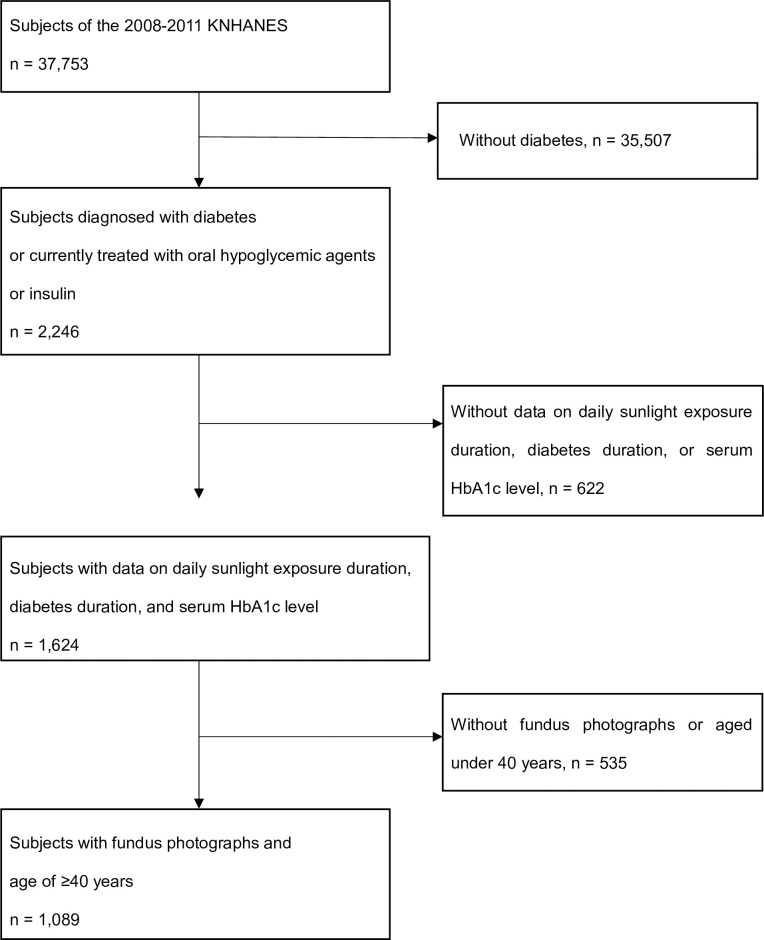
This study used data from the 2008-2011 Korea National Health and Nutrition Examination Survey. Overall, 1,089 patients with diabetes aged >40 years were included. The duration of daily sunlight exposure was assessed via health interviews. Comprehensive ophthalmic evaluations, including standard retinal fundus photography after pupil dilation, were conducted. Diabetic retinopathy was graded using the modified Airlie House Classification. Multivariate logistic regression analysis was performed to analyze the association between daily sunlight exposure duration and the diagnosis of diabetic retinopathy and non-proliferative diabetic retinopathy.
The risk of diabetic retinopathy was 2.66 times higher in the group with ≥5 h of daily sunlight exposure than in the group with less exposure after adjusting for risk factors such as duration of diabetes, serum hemoglobin A1c level, hypertension, and dyslipidemia (P = 0.023). Furthermore, the risk of non-proliferative diabetic retinopathy was 3.13 times higher in the group with ≥5 h of daily sunlight exposure than in the group with less exposure (P = 0.009). In patients with diabetes for <10 years, the risks of diabetic retinopathy and non-proliferative diabetic retinopathy were 4.26 and 4.82 times higher in the group with ≥5 h of daily sunlight exposure than the group with less exposure, respectively (P < 0.05).
This study revealed that sunlight exposure for ≥5 h a day was significantly associated with an increased risk of diabetic retinopathy and non-proliferative diabetic retinopathy in Korean patients with diabetes. The risks were significantly higher in patients with diabetes for <10 years. Therefore, reducing daily sunlight exposure could be an early preventive strategy against diabetic retinopathy in people with diabetes.
探讨韩国成年糖尿病患者每日日光暴露时间与糖尿病视网膜病变的相关性。
本研究使用了 2008-2011 年韩国国家健康和营养检查调查的数据。共纳入 1089 名年龄>40 岁的糖尿病患者。通过健康访谈评估每日日光暴露时间。所有患者均行全面眼科检查,包括瞳孔扩张后的标准眼底照相。采用改良 Airlie House 分类对糖尿病视网膜病变进行分级。采用多变量 logistic 回归分析评估每日日光暴露时间与糖尿病视网膜病变和非增生性糖尿病视网膜病变诊断之间的相关性。
校正糖尿病病程、血清糖化血红蛋白水平、高血压和血脂异常等危险因素后,每日日光暴露≥5 h 组发生糖尿病视网膜病变的风险是暴露时间较短组的 2.66 倍(P=0.023)。此外,每日日光暴露≥5 h 组发生非增生性糖尿病视网膜病变的风险是暴露时间较短组的 3.13 倍(P=0.009)。在糖尿病病程<10 年的患者中,每日日光暴露≥5 h 组发生糖尿病视网膜病变和非增生性糖尿病视网膜病变的风险分别是暴露时间较短组的 4.26 倍和 4.82 倍(P<0.05)。
本研究表明,每日日光暴露时间≥5 h 与韩国糖尿病患者糖尿病视网膜病变和非增生性糖尿病视网膜病变的风险增加显著相关。在糖尿病病程<10 年的患者中,这种相关性更为显著。因此,减少每日日光暴露可能是糖尿病患者预防糖尿病视网膜病变的早期策略。