Baba Masayuki, Takatsuna Hiroshi, Matsui Norimitsu, Ohwada Shoichi
Aomori Prefectural Central Hospital, Aomori, Japan.
Medical Science Department, Daiichi Sankyo Co., Ltd., Tokyo, Japan.
J Pain Res. 2020 Jul 17;13:1811-1821. doi: 10.2147/JPR.S255345. eCollection 2020.
Mirogabalin was recently approved in Japan for the treatment of peripheral neuropathic pain, based on data from clinical trials in diabetic peripheral neuropathic pain (DPNP) and post-herpetic neuralgia (PHN), common clinical conditions which cause intense distress for patients. We characterized the safety and tolerability of mirogabalin in Japanese patients with renal impairment.
This multicenter, open-label study (ClinicalTrials.gov identifier NCT02607280) enrolled renally impaired individuals aged ≥20 years diagnosed with DPNP or PHN, and with an average daily pain score (ADPS) of ≥4 over the 7 days prior to treatment initiation. Mirogabalin dosage was titrated for 2 weeks, followed by a fixed dose for 12 weeks according to degree of renal impairment: 7.5 mg twice daily for moderate impairment and 7.5 mg once daily for severe impairment. The primary endpoint was safety and tolerability of mirogabalin, evaluated via treatment-emergent adverse events (TEAEs). Secondary efficacy endpoints included change in ADPS from baseline to Week 14.
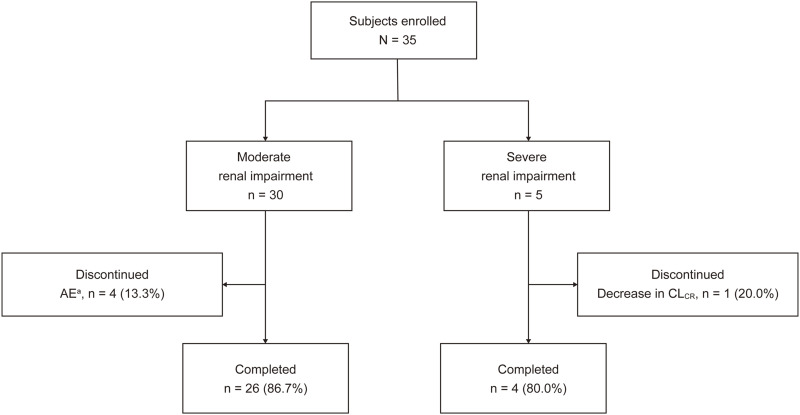
Overall, 35 patients were enrolled (30 with moderate and 5 with severe renal impairment). Most TEAEs were mild or moderate in severity; the most commonly reported were nasopharyngitis (22.9%) and somnolence (11.4%). Only 4 patients (11.4%) discontinued treatment due to TEAEs. Mirogabalin significantly decreased ADPS from baseline in patients with renal impairment; least squares mean change from baseline at Week 14 was -1.9 (95% confidence interval: -2.8, -1.0).
Mirogabalin was well tolerated and significantly reduced pain levels when used to treat DPNP/PHN at a fixed dose of 7.5 mg once or twice daily in patients with renal impairment.
基于糖尿病性周围神经病变(DPNP)和带状疱疹后神经痛(PHN)的临床试验数据,米罗加巴林最近在日本被批准用于治疗周围神经性疼痛,这两种常见的临床病症会给患者带来极大痛苦。我们对日本肾功能损害患者中米罗加巴林的安全性和耐受性进行了研究。
这项多中心、开放标签研究(ClinicalTrials.gov标识符NCT02607280)纳入了年龄≥20岁、被诊断为DPNP或PHN且在开始治疗前7天平均每日疼痛评分(ADPS)≥4的肾功能损害个体。米罗加巴林剂量滴定2周,然后根据肾功能损害程度给予固定剂量治疗12周:中度损害者每日两次,每次7.5mg;重度损害者每日一次,每次7.5mg。主要终点是通过治疗中出现的不良事件(TEAE)评估米罗加巴林的安全性和耐受性。次要疗效终点包括从基线到第14周ADPS的变化。
总共纳入了35例患者(30例中度肾功能损害和5例重度肾功能损害)。大多数TEAE的严重程度为轻度或中度;最常报告的是鼻咽炎(22.9%)和嗜睡(11.4%)。只有4例患者(11.4%)因TEAE停止治疗。米罗加巴林显著降低了肾功能损害患者的基线ADPS;第14周时从基线的最小二乘均值变化为-1.9(95%置信区间:-2.8,-1.0)。
在肾功能损害患者中,以每日一次或两次7.5mg的固定剂量使用米罗加巴林治疗DPNP/PHN时,耐受性良好且能显著降低疼痛水平。