Guo Xiaohui, Yu Yang, Zhang Yongbo, Sun Li, Li Yufeng, Song Bing, Hang Li, Baba Masayuki, Wasaki Yosuke, Kikumori Kunika, Murayama Emiko
Department of Endocrinology, Peking University First Hospital, No. 8 Xishiku Street, Xicheng District, Beijing, 100034, China.
Department of Neurology, Beijing Friendship Hospital, Capital Medical University, No. 95 Yongan Road, Beijing, 100050, China.
Pain Ther. 2024 Aug;13(4):937-952. doi: 10.1007/s40122-024-00617-2. Epub 2024 Jun 19.
There is no approved effective drug for diabetic peripheral neuropathic pain (DPNP) in China. Gabapentinoids including mirogabalin have shown promise, although data in Chinese patients are scarce.
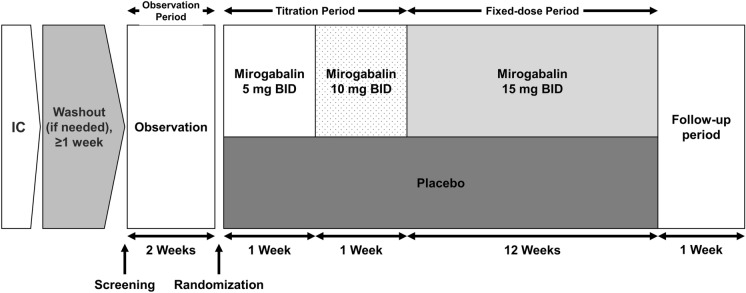
This phase 3, multicenter, randomized, double-blind, placebo-controlled trial investigated the efficacy and safety of mirogabalin for treating DPNP in China. Mirogabalin was administered at 5 mg twice daily for the first week and uptitrated to 15 mg twice daily for a total duration of 14 weeks. The primary efficacy endpoint was the change from baseline in weekly average daily pain score (ADPS) at week 14; secondary endpoints included the ADPS responder rate, Short-Form McGill Pain Questionnaire visual analogue scale score, patient global impression of change (PGIC), average daily sleep interference score (ADSIS), EuroQol 5-dimensions 5-levels (EQ-5D-5L), and incidence of treatment-emergent adverse events (TEAEs).
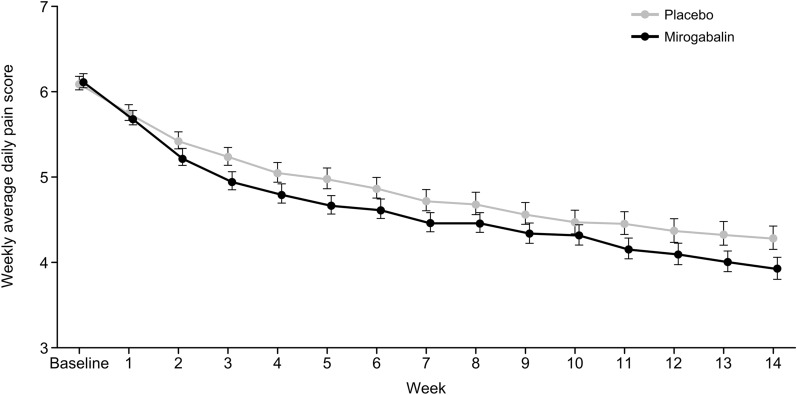
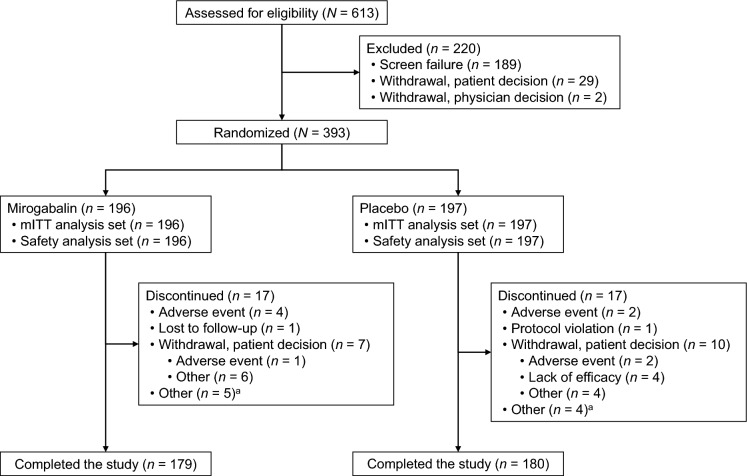
Of 393 patients (mirogabalin, n = 196; placebo n = 197), the mean age was 58.2 years (mirogabalin, 58.7 years; placebo, 57.7 years) and 54.2% were male (mirogabalin, 56.1%; placebo, 52.3%). Mirogabalin elicited a greater change from baseline in the weekly ADPS vs. placebo at week 14: least-squares mean difference (95% confidence interval) vs. placebo - 0.39 (- 0.74, - 0.04), p = 0.0301. PGIC, ADSIS, and EQ-5D-5L data reflected significantly better improvements for patients receiving mirogabalin vs. placebo. The incidence of TEAEs was 75.0% and 75.1% in the mirogabalin and placebo groups, respectively. Most TEAEs were mild or moderate, and the incidence of TEAEs leading to treatment discontinuation was 2.6% in the mirogabalin group and 1.5% in the placebo group.
Although the effect size of mirogabalin was reduced due to the placebo effect, mirogabalin is a safe and effective treatment option for Chinese patients with DPNP.
ClinicalTrials.gov identifier, NCT04094662.
在中国,尚无获批用于治疗糖尿病性周围神经病变性疼痛(DPNP)的有效药物。包括米罗加巴林在内的加巴喷丁类药物已显示出一定前景,不过中国患者的数据较少。
这项3期、多中心、随机、双盲、安慰剂对照试验在中国研究了米罗加巴林治疗DPNP的疗效和安全性。米罗加巴林在第1周每日两次,每次5毫克给药,之后上调至每日两次,每次15毫克,共给药14周。主要疗效终点是第14周每周平均每日疼痛评分(ADPS)相对于基线的变化;次要终点包括ADPS缓解率、简短麦吉尔疼痛问卷视觉模拟量表评分、患者总体变化印象(PGIC)、平均每日睡眠干扰评分(ADSIS)、欧洲五维健康量表(EQ-5D-5L)以及治疗中出现的不良事件(TEAE)的发生率。
393例患者(米罗加巴林组196例,安慰剂组197例),平均年龄为58.2岁(米罗加巴林组58.7岁,安慰剂组57.7岁),男性占54.2%(米罗加巴林组56.1%,安慰剂组52.3%)。在第14周时,米罗加巴林相对于安慰剂使每周ADPS从基线的变化更大:最小二乘均值差异(95%置信区间)相对于安慰剂为−0.39(−0.74,−0.04),p = 0.0301。PGIC、ADSIS和EQ-5D-量表数据显示,接受米罗加巴林治疗的患者相对于安慰剂有显著更好的改善。米罗加巴林组和安慰剂组TEAE的发生率分别为75.0%和75.1%。大多数TEAE为轻度或中度,导致治疗中断的TEAE发生率在米罗加巴林组为2.6%,在安慰剂组为1.5%。
尽管由于安慰剂效应,米罗加巴林的效应量有所降低,但对于中国DPNP患者而言,米罗加巴林是一种安全有效的治疗选择。
ClinicalTrials.gov标识符,NCT04094662。