Lautenschläger Nina, Popp Philipp F, Mascher Thorsten
Max Planck Unit for the Science of Pathogens, Berlin, Germany.
Institute of Microbiology, Technische Universität Dresden, Zellescher Weg 20b, 01217 Dresden, Germany.
J Biol Eng. 2020 Jul 31;14:21. doi: 10.1186/s13036-020-00243-4. eCollection 2020.
Whole-cell biosensors are a powerful and easy-to-use screening tool for the fast and sensitive detection of chemical compounds, such as antibiotics. β-Lactams still represent one of the most important antibiotic groups in therapeutic use. They interfere with late stages of the bacterial cell wall biosynthesis and result in irreversible perturbations of cell division and growth, ultimately leading to cell lysis. In order to simplify the detection of these antibiotics from solutions, solid media or directly from producing organisms, we aimed at developing a novel heterologous whole-cell biosensor in , based on the β-lactam-induced regulatory system BlaR1/BlaI from .
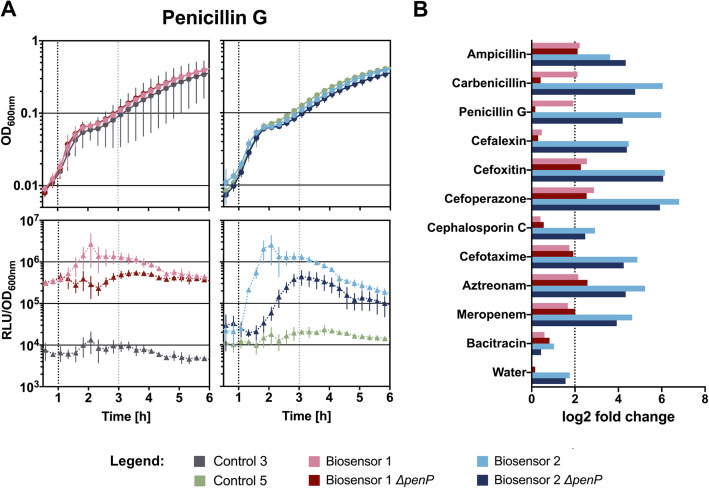
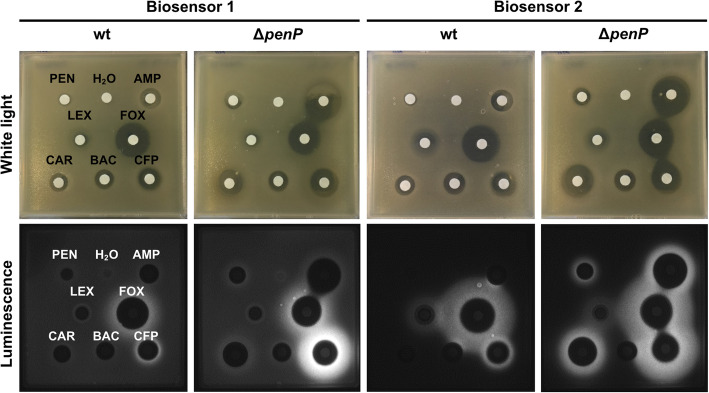
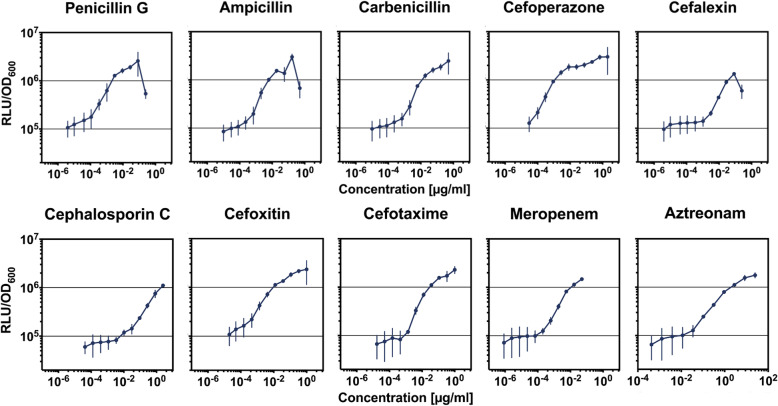
The BlaR1/BlaI system was heterologously expressed in and combined with the operon of under control of the BlaR1/BlaI target promoter to measure the output of the biosensor. A combination of codon adaptation, constitutive expression of and and the allelic replacement of increased the inducer spectrum and dynamic range of the biosensor. β-Lactams from all four classes induced the target promoter P in a concentration-dependent manner, with a dynamic range of 7- to 53-fold. We applied our biosensor to a set of soil isolates and demonstrated its potential to screen for the production of β-lactams. In addition to the successful implementation of a highly sensitive β-lactam biosensor, our results also provide the first experimental evidence to support previous suggestions that PenP functions as a β-lactamase in .
We have successfully established a novel heterologous whole-cell biosensor in that is highly sensitive for a broad spectrum of β-lactams from all four chemical classes. Therefore, it increases the detectable spectrum of compounds with respect to previous biosensor designs. Our biosensor can readily be applied for identifying β-lactams in liquid or on solid media, as well as for identifying potential β-lactam producers.
全细胞生物传感器是一种功能强大且易于使用的筛选工具,可用于快速、灵敏地检测化学化合物,如抗生素。β-内酰胺类药物仍是治疗中最重要的抗生素类别之一。它们干扰细菌细胞壁生物合成的后期阶段,导致细胞分裂和生长的不可逆扰动,最终导致细胞裂解。为了简化从溶液、固体培养基或直接从产生菌中检测这些抗生素的过程,我们旨在基于来自[具体来源]的β-内酰胺诱导调节系统BlaR1/BlaI,在[具体宿主菌]中开发一种新型异源全细胞生物传感器。
BlaR1/BlaI系统在[具体宿主菌]中异源表达,并与[具体基因]的[具体操纵子]在BlaR1/BlaI靶启动子的控制下相结合,以测量生物传感器的输出。密码子优化、[具体基因]的组成型表达以及[具体基因]的等位基因替换的组合增加了生物传感器的诱导物谱和动态范围。所有四类β-内酰胺类药物均以浓度依赖性方式诱导靶启动子P[具体启动子名称],动态范围为7至53倍。我们将我们的生物传感器应用于一组[具体数量]土壤分离株,并证明了其筛选β-内酰胺类药物产生的潜力。除了成功构建了一种高度灵敏的β-内酰胺生物传感器外,我们的结果还提供了首个实验证据,支持先前关于PenP在[具体物种]中作为β-内酰胺酶发挥作用的推测。
我们已成功在[具体宿主菌]中建立了一种新型异源全细胞生物传感器,该传感器对所有四类化学类别的广泛β-内酰胺类药物高度敏感。因此,相对于以前的生物传感器设计,它增加了可检测的化合物谱。我们的生物传感器可轻松应用于鉴定液体或固体培养基中的β-内酰胺类药物,以及鉴定潜在的β-内酰胺类药物产生菌。