Aliakbari Fatemeh, Alipour Forouzan Mohammad, Tavassoli Elahe, Sedehi Morteza
Community Oriented Nursing Midwifery Research Center, Shahrekord University of Medical Sciences, Shahrekord, Iran.
Health School, Shahrekord University of Medical Science, Shahrekord, Iran.
J Educ Health Promot. 2020 Jun 30;9:146. doi: 10.4103/jehp.jehp_752_19. eCollection 2020.
Chronic obstructive pulmonary disease (COPD) is one of the most common chronic diseases. The patient's fear and anxiety of shortness of breath and coughing during exercise may lead to a decrease in patients' daily activities. Therefore, the present study aimed to determine the effect of empowerment program based on the social cognitive theory (SCT) on the daily activity of patients with COPD.
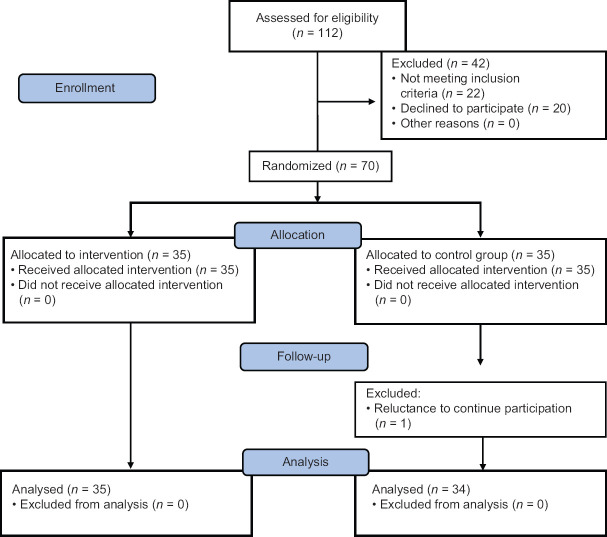
This quasi-experimental study was performed on 70 patients with COPD referred to Kashani and Hajar centers in 2019. Samples were randomly divided into two groups of experimental and control. Data collection tools included demographic information questionnaire and activity of daily living questionnaire, specific for COPD, and a researcher-made questionnaire for measuring SCT constructs. For the experimental group, the training program consisted of four theoretical and practical sessions of 40 min/week. The data were collected at three time points, before, immediately and 3 months after the training are 3 time. The data were analyzed by SPSS software using descriptive and inferential statistics.
The difference between the mean scores of behavioral ability, self-efficacy, and empowerment in the three stages was significant only in the experimental group ( < 0.001). The mean daily activity score of patients before, immediately, and 3 months after intervention showed a statistically significant difference between the two groups (52.46 ± 21.98, 63.36 ± 21.95, and 71.34 ± 19.02), respectively, in the intervention group, and (51.79 ± 19.29, 53.70 ± 19.28, and 53.82 ± 19.26), respectively, in the control group ( < 0.001).
The results of this study showed that empowerment of patients through interventions based on SCT can increase the daily activity of patients with COPD. Because nurses play an important role in patient education and improvement, it is hoped that the findings of this study will be used as a strategy to increase the daily activity and ultimately improve the quality of life in these patients.
慢性阻塞性肺疾病(COPD)是最常见的慢性病之一。患者在运动期间对呼吸急促和咳嗽的恐惧与焦虑可能导致其日常活动减少。因此,本研究旨在确定基于社会认知理论(SCT)的赋权计划对COPD患者日常活动的影响。
本准实验研究于2019年对转诊至卡沙尼和哈贾尔中心的70例COPD患者进行。样本被随机分为实验组和对照组。数据收集工具包括人口统计学信息问卷、针对COPD的日常生活活动问卷以及一份由研究者编制的用于测量SCT构念的问卷。对于实验组,培训计划包括每周4次、每次40分钟的理论和实践课程。在培训前、培训后即刻和培训后3个月这三个时间点收集数据。数据通过SPSS软件使用描述性和推断性统计进行分析。
仅在实验组中,行为能力、自我效能和赋权的平均得分在三个阶段之间的差异具有统计学意义(<0.001)。干预组患者在干预前、干预后即刻和干预后3个月的平均日常活动得分分别为(52.46±21.98)、(63.36±21.95)和(71.34±19.02),对照组分别为(51.79±19.29)、(53.70±19.28)和(53.82±19.26),两组之间差异具有统计学意义(<0.001)。
本研究结果表明,通过基于SCT的干预对患者进行赋权可增加COPD患者的日常活动。由于护士在患者教育和改善方面发挥着重要作用,希望本研究结果将作为一种策略,以增加日常活动并最终改善这些患者的生活质量。