Department of Women's and Children's Health, Neonatal Intensive Care Unit, Padova University Hospital, Padova, Italy.
Padova University Hospital, Padova, Italy.
Eur J Pediatr. 2020 Dec;179(12):1949-1955. doi: 10.1007/s00431-020-03765-7. Epub 2020 Aug 7.
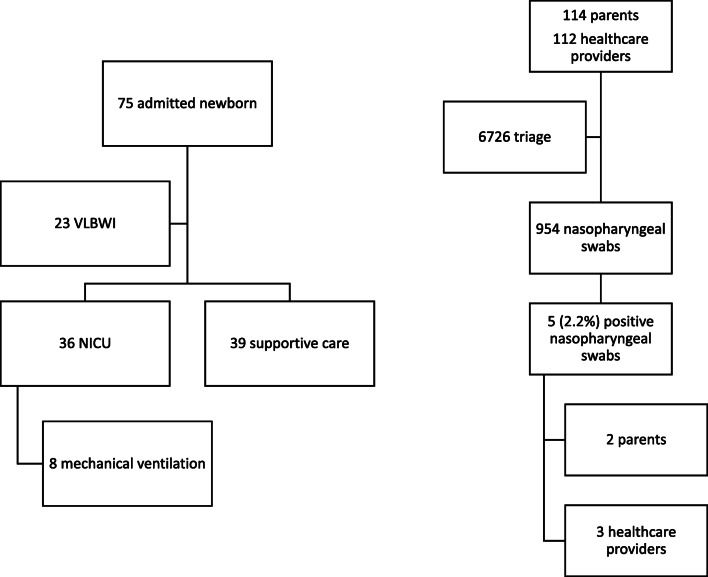
Since February 21, 2020, SARS-CoV-2 has spread exponentially worldwide. Neonatal patients needing intensive care are considered a vulnerable population. To report the results of a policy based on multi-timepoint surveillance for SARS-CoV-2 of all neonates admitted to the neonatal intensive care unit (NICU), their parents, and all healthcare providers in a part of Italy with a high prevalence of the infection. Observational study conducted from 21 February to 21 April 2020. Intervention consisted of (a) parental triage on arrival at the neonatal ward; (b) universal testing with nasopharyngeal swabs and blood testing for SARS-CoV-2 IgM and IgG antibodies; (c) use of continuous personal protective equipment at the NICU by parents and staff. A total of 6726 triage procedures were performed on 114 parents, and 954 nasopharyngeal swabs were collected from 226 individuals. Five (2.2%) asymptomatic individuals (2 parents and 3 healthcare providers) tested positive on nasopharyngeal swabs and were kept isolated for 14 days. Of 75 admitted newborn, no one tested positive on nasopharyngeal swabs or antibody tests. Three parents presented with fever or flu-like symptoms at triage; they tested negative on swabs.Conclusion: With universal screening of neonates, parents, and staff, there were no cases of SARS-CoV-2 infection among the neonates admitted to a NICU in an area with a high incidence of SARS-CoV-2. Our experience could be usefully compared with other strategies with a view to developing future evidence-based guidelines for managing high-risk neonates in case of new epidemics. What is Known: • The novel coronavirus named SARS-CoV-2 has since spread worldwide at a remarkable rate, with more than 2.5 million confirmed cases. • Pediatric population may be less affected from COVID-19 than adult population but infants and newborn babies seem to be more vulnerable to SARS-CoV-2 infection. What is New: • Using an approach based on triage; testing with nasopharyngeal swabs and serology; and use of personal protective equipment, there were no cases of SARS-CoV-2 infection among neonates in a NICU in a high incidence of SARS-CoV-2 area. • Positive and asymptomatic individuals were identified and isolated early allowing the containment of infection's spread among healthcare providers and parents.
自 2020 年 2 月 21 日以来,SARS-CoV-2 在全球范围内呈指数级传播。需要重症监护的新生儿患者被认为是弱势群体。本研究旨在报告一项基于对意大利某一高感染地区新生儿重症监护病房(NICU)所有新生儿、其父母和所有医护人员进行多次 SARS-CoV-2 监测的政策结果。该观察性研究于 2020 年 2 月 21 日至 4 月 21 日进行。干预措施包括:(a)新生儿病房到达时对父母进行分诊;(b)对鼻咽拭子和 SARS-CoV-2 IgM 和 IgG 抗体进行普遍检测;(c)父母和工作人员在 NICU 持续使用个人防护设备。对 114 名父母进行了 6726 次分诊程序,对 226 名个体采集了 954 个鼻咽拭子。5 名(2.2%)无症状个体(2 名父母和 3 名医护人员)鼻咽拭子检测呈阳性,隔离 14 天。在 75 名入院新生儿中,无人鼻咽拭子或抗体检测呈阳性。3 名父母在分诊时出现发热或流感样症状;拭子检测结果为阴性。结论:对 NICU 新生儿、父母和医护人员进行普遍筛查,在 SARS-CoV-2 发病率高的地区,NICU 收治的新生儿中未发现 SARS-CoV-2 感染病例。我们的经验可以与其他策略进行有益的比较,以便在发生新的疫情时为高危新生儿制定未来基于证据的管理指南。已知:• 新型冠状病毒命名为 SARS-CoV-2,自 2019 年底以来已在全球范围内以惊人的速度传播,确诊病例超过 250 万例。• 儿科人群受 COVID-19 影响可能比成人人群小,但婴儿和新生儿似乎更容易感染 SARS-CoV-2。新发现:• 使用分诊、鼻咽拭子和血清学检测以及个人防护设备的方法,在 SARS-CoV-2 发病率高的地区,NICU 中未发现 SARS-CoV-2 感染病例。• 早期发现阳性和无症状个体并进行隔离,可防止感染在医护人员和父母中传播。