Department of Physiology, Amsterdam Cardiovascular Science, VU University, Amsterdam UMC, Postbus 7057, 1007 MB, Amsterdam, The Netherlands.
Institute for Cardiovascular Regeneration, Centre for Molecular Medicine, Goethe University, Frankfurt am Main, Germany.
Curr Atheroscler Rep. 2020 Aug 9;22(10):55. doi: 10.1007/s11883-020-00872-6.
To summarize recent insights into long non-coding RNAs (lncRNAs) involved in atherosclerosis. Because atherosclerosis is the main underlying pathology of cardiovascular diseases (CVD), the world's deadliest disease, finding novel therapeutic strategies is of high interest.
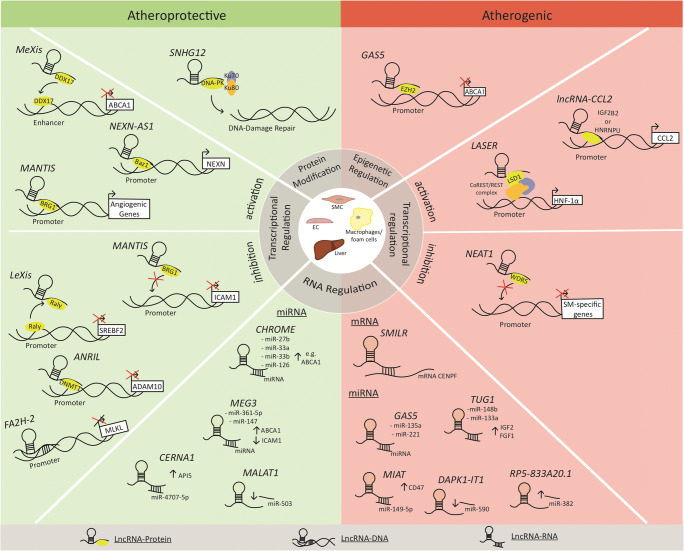
LncRNAs can bind to proteins, DNA, and RNA regulating disease initiation and plaque growth as well as plaque stability in different cell types such as endothelial cells (ECs), vascular smooth muscle cells (VSMCs), and macrophages. A number of lncRNAs have been implicated in cholesterol homeostasis and foam cell formation such as LASER, LeXis, and CHROME. Among others, MANTIS, lncRNA-CCL2, and MALAT1 were shown to be involved in vascular inflammation. Further regulations include, but are not limited to, DNA damage response in ECs, phenotypic switch of VSMCs, and various cell death mechanisms. Interestingly, some lncRNAs are closely correlated with response to statin treatment, such as NEXN-AS1 or LASER. Additionally, some lncRNAs may serve as CVD biomarkers. LncRNAs are a potential novel therapeutic target to treat CVD, but research of lncRNA in atherosclerosis is still in its infancy. With increasing knowledge of the complex and diverse regulations of lncRNAs in the heterogeneous environment of atherosclerotic plaques, lncRNAs hold promise for their clinical translation in the near future.
总结长链非编码 RNA(lncRNA)在动脉粥样硬化中的最新研究进展。由于动脉粥样硬化是心血管疾病(CVD)的主要潜在病理学基础,而 CVD 是世界上最致命的疾病,因此寻找新的治疗策略具有重要意义。
lncRNA 可以与蛋白质、DNA 和 RNA 结合,调节疾病的起始和斑块的生长以及不同细胞类型(如内皮细胞 [ECs]、血管平滑肌细胞 [VSMCs] 和巨噬细胞)中斑块的稳定性。许多 lncRNA 与胆固醇稳态和泡沫细胞形成有关,如 LASER、LeXis 和 CHROME。除此之外,MANTIS、lncRNA-CCL2 和 MALAT1 被证明参与血管炎症。进一步的调控包括但不限于 ECs 的 DNA 损伤反应、VSMCs 的表型转换和各种细胞死亡机制。有趣的是,一些 lncRNA 与他汀类药物治疗的反应密切相关,如 NEXN-AS1 或 LASER。此外,一些 lncRNA 可能作为 CVD 的生物标志物。lncRNA 是治疗 CVD 的一种潜在的新型治疗靶点,但 lncRNA 在动脉粥样硬化中的研究仍处于起步阶段。随着对 lncRNA 在动脉粥样硬化斑块异质性环境中复杂多样的调控的深入了解,lncRNA 有望在不久的将来在临床上得到转化。