Gut Microbes & Health, Quadram Institute Bioscience, Norwich Research Park, Norwich, UK.
Lydia Becker Institute for Immunology and Inflammation & Wellcome Trust Centre for Cell Matrix Research, Manchester Academic Health Science Centre, University of Manchester, Manchester, UK.
ISME J. 2020 Feb;14(2):635-648. doi: 10.1038/s41396-019-0553-2. Epub 2019 Nov 18.
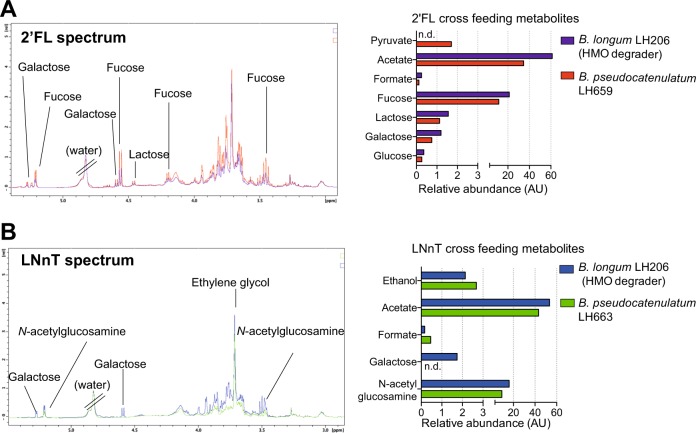
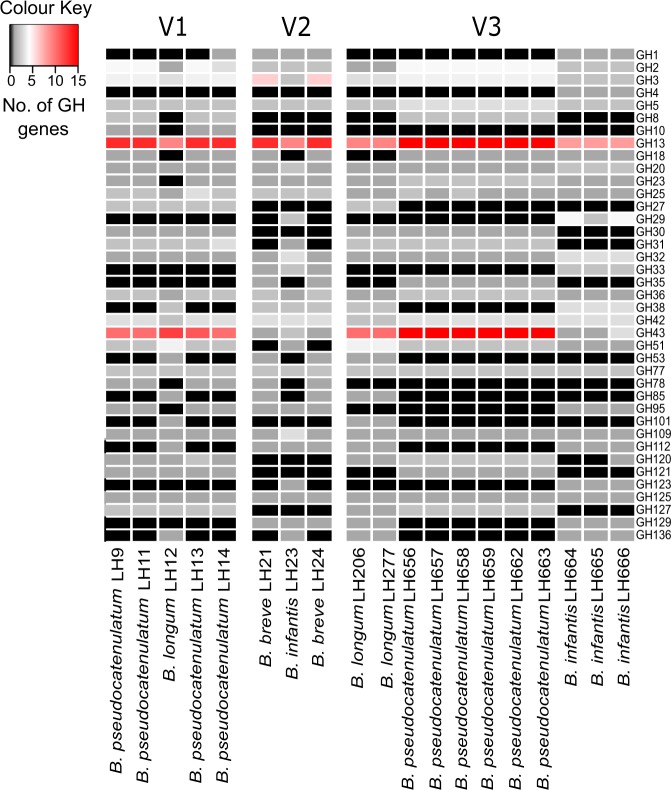
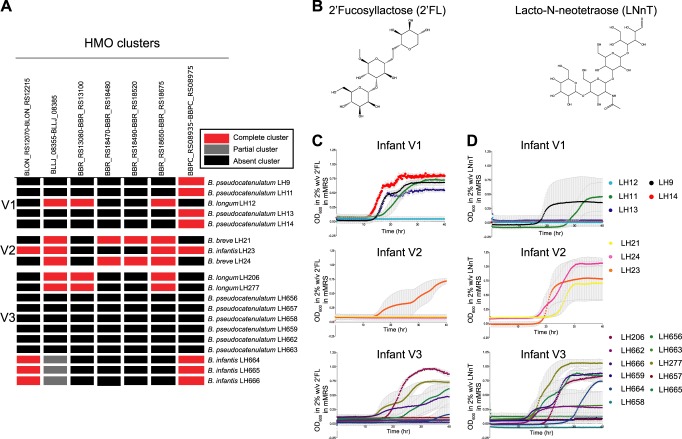
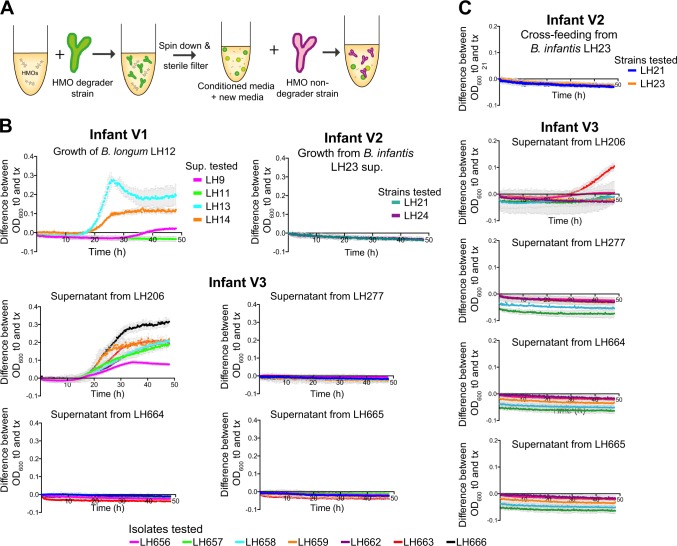
Diet-microbe interactions play an important role in modulating the early-life microbiota, with Bifidobacterium strains and species dominating the gut of breast-fed infants. Here, we sought to explore how infant diet drives distinct bifidobacterial community composition and dynamics within individual infant ecosystems. Genomic characterisation of 19 strains isolated from breast-fed infants revealed a diverse genomic architecture enriched in carbohydrate metabolism genes, which was distinct to each strain, but collectively formed a pangenome across infants. Presence of gene clusters implicated in digestion of human milk oligosaccharides (HMOs) varied between species, with growth studies indicating that within single infants there were differences in the ability to utilise 2'FL and LNnT HMOs between strains. Cross-feeding experiments were performed with HMO degraders and non-HMO users (using spent or 'conditioned' media and direct co-culture). Further H-NMR analysis identified fucose, galactose, acetate, and N-acetylglucosamine as key by-products of HMO metabolism; as demonstrated by modest growth of non-HMO users on spend media from HMO metabolism. These experiments indicate how HMO metabolism permits the sharing of resources to maximise nutrient consumption from the diet and highlights the cooperative nature of bifidobacterial strains and their role as 'foundation' species in the infant ecosystem. The intra- and inter-infant bifidobacterial community behaviour may contribute to the diversity and dominance of Bifidobacterium in early life and suggests avenues for future development of new diet and microbiota-based therapies to promote infant health.
饮食-微生物相互作用在调节早期微生物群中起着重要作用,双歧杆菌菌株和物种在母乳喂养婴儿的肠道中占主导地位。在这里,我们试图探索婴儿饮食如何在个体婴儿生态系统中驱动双歧杆菌群落组成和动态的差异。从母乳喂养婴儿中分离出的 19 株的基因组特征揭示了富含碳水化合物代谢基因的多样化基因组结构,这与每个菌株都不同,但在婴儿之间共同形成了一个泛基因组。消化人乳寡糖 (HMO) 的基因簇的存在在物种之间存在差异,生长研究表明,在单个婴儿中,菌株之间利用 2'FL 和 LNnT HMO 的能力存在差异。用 HMO 降解物和非 HMO 用户(使用用过的或“条件”培养基和直接共培养)进行了交叉喂养实验。进一步的 H-NMR 分析确定了岩藻糖、半乳糖、乙酸和 N-乙酰葡萄糖胺作为 HMO 代谢的关键副产物;非 HMO 用户在 HMO 代谢的废培养基上适度生长证明了这一点。这些实验表明 HMO 代谢如何允许资源共享,以最大限度地从饮食中消耗营养,并强调了双歧杆菌菌株的合作性质及其作为婴儿生态系统“基础”物种的作用。婴儿内和婴儿间双歧杆菌群落的行为可能有助于双歧杆菌在生命早期的多样性和主导地位,并为未来开发新的饮食和基于微生物群的疗法以促进婴儿健康提供了途径。