Aging Research Center, Department of Neurobiology, Care Sciences, and Society, Karolinska Institutet and Stockholm University, Stockholm, Sweden.
Department of Psychology, University of Gothenburg, Gothenburg, Sweden.
Psychol Sci Public Interest. 2020 Aug;21(1):6-41. doi: 10.1177/1529100620920576.
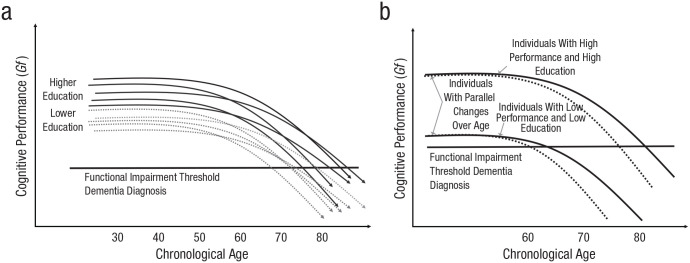
Cognitive abilities are important predictors of educational and occupational performance, socioeconomic attainment, health, and longevity. Declines in cognitive abilities are linked to impairments in older adults' everyday functions, but people differ from one another in their rates of cognitive decline over the course of adulthood and old age. Hence, identifying factors that protect against compromised late-life cognition is of great societal interest. The number of years of formal education completed by individuals is positively correlated with their cognitive function throughout adulthood and predicts lower risk of dementia late in life. These observations have led to the propositions that prolonging education might (a) affect cognitive ability and (b) attenuate aging-associated declines in cognition. We evaluate these propositions by reviewing the literature on educational attainment and cognitive aging, including recent analyses of data harmonized across multiple longitudinal cohort studies and related meta-analyses. In line with the first proposition, the evidence indicates that educational attainment has positive effects on cognitive function. We also find evidence that cognitive abilities are associated with selection into longer durations of education and that there are common factors (e.g., parental socioeconomic resources) that affect both educational attainment and cognitive development. There is likely reciprocal interplay among these factors, and among cognitive abilities, during development. Education-cognitive ability associations are apparent across the entire adult life span and across the full range of education levels, including (to some degree) tertiary education. However, contrary to the second proposition, we find that associations between education and aging-associated cognitive declines are negligible and that a threshold model of dementia can account for the association between educational attainment and late-life dementia risk. We conclude that educational attainment exerts its influences on late-life cognitive function primarily by contributing to individual differences in cognitive skills that emerge in early adulthood but persist into older age. We also note that the widespread absence of educational influences on rates of cognitive decline puts constraints on theoretical notions of cognitive aging, such as the concepts of cognitive reserve and brain maintenance. Improving the conditions that shape development during the first decades of life carries great potential for improving cognitive ability in early adulthood and for reducing public-health burdens related to cognitive aging and dementia.
认知能力是教育和职业表现、社会经济地位、健康和长寿的重要预测指标。认知能力的下降与老年人日常功能的损伤有关,但在成年和老年期间,人们的认知能力下降速度存在差异。因此,确定保护老年人认知能力不受损害的因素具有重要的社会意义。个人完成的正规教育年限与他们在整个成年期和老年期的认知功能呈正相关,并预测晚年痴呆的风险较低。这些观察结果导致了以下两种观点:(a)延长教育年限可能会影响认知能力;(b)减缓与衰老相关的认知能力下降。我们通过回顾关于教育程度和认知衰老的文献来评估这些观点,包括对多个纵向队列研究数据进行协调分析的最新分析以及相关的荟萃分析。根据第一个观点,证据表明教育程度对认知功能有积极影响。我们还发现证据表明,认知能力与选择接受更长时间的教育有关,并且存在共同的因素(例如,父母的社会经济资源)影响教育程度和认知发展。在发展过程中,这些因素之间以及认知能力之间可能存在相互作用。教育与认知能力的关联在整个成年期和整个教育水平范围内都很明显,包括(在某种程度上)高等教育。然而,与第二个观点相反,我们发现教育与衰老相关的认知衰退之间的关联可以忽略不计,痴呆的阈值模型可以解释教育程度与晚年痴呆风险之间的关联。我们的结论是,教育程度主要通过对在成年早期出现但持续到老年的认知技能的个体差异产生影响,从而对晚年认知功能产生影响。我们还注意到,教育对认知衰退速度的影响普遍不存在,这对认知衰老的理论概念(如认知储备和大脑维护的概念)构成了限制。改善塑造生命最初几十年发展的条件,对于提高成年早期的认知能力和减少与认知衰老和痴呆相关的公共卫生负担具有巨大潜力。