Zhang Liqun, Wang Zhuo, Xiao Jiawen, Zhang Zhiyan, Li Haijing, Wang Yuanhe, Dong Qian, Piao Haiyan, Wang Qiwei, Bi Feifei, Li Fang, Zhang Jingdong
Medical Oncology Department of Gastrointestinal Cancer, Liaoning Cancer Hospital and Institute, Cancer Hospital of China Medical University, Shenyang, Liaoning 110042, P.R. China.
Department of Medical Oncology, Shenyang Fifth People's Hospital, Shenyang, Liaoning 110020, P.R. China.
Oncol Lett. 2020 Oct;20(4):10. doi: 10.3892/ol.2020.11871. Epub 2020 Jul 15.
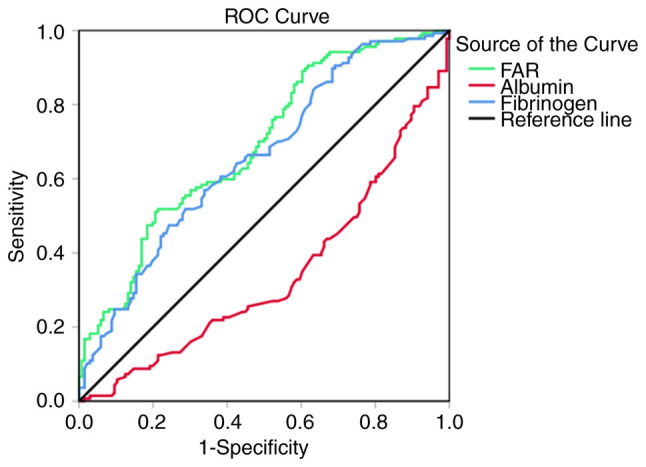
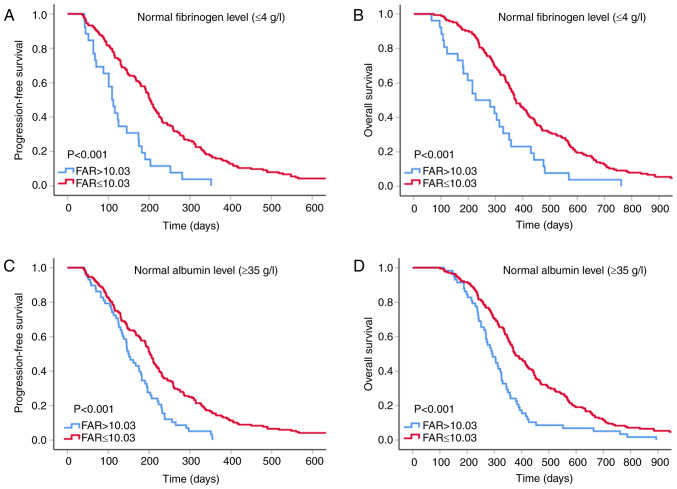
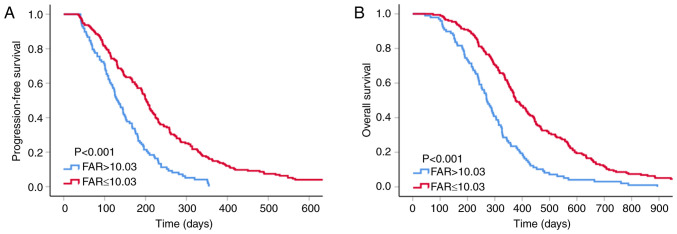
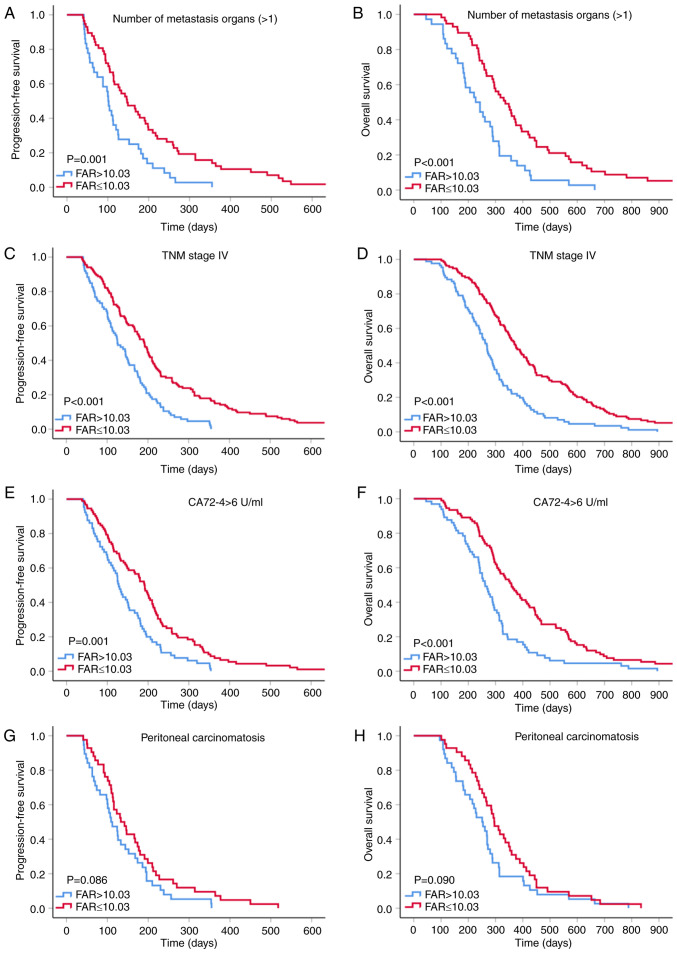
The fibrinogen-to-albumin ratio (FAR), reflecting the systemic coagulation, nutritional and inflammation status of patients, has matured into a prognostic marker for several tumor types. However, only a few studies have assessed the utility of the FAR as a prognostic indicator in patients with advanced gastric cancer (GC) receiving first-line chemotherapy. In the present study, 273 patients with advanced GC who received first-line chemotherapy between January 2014 and January 2019 at the Cancer Hospital of China Medical University (Shenyang, China) were retrospectively analyzed. Using the cut-off values determined by receiver operating characteristic (ROC) analysis, the patients were divided into low-FAR (≤10.03) and high-FAR (>10.03), low-fibrinogen (<3.8 g/l) and high-fibrinogen (≥3.8 g/l), and low-albumin (<40.55 g/l) and high-albumin (≥40.55 g/l) groups. The associations of the pretreatment FAR and clinicopathological characteristics with progression-free survival (PFS) and overall survival (OS) were evaluated. In order to estimate the prognostic value of the FAR for patients with poor prognosis or normal fibrinogen and albumin levels, subgroup analyses were performed. The FAR had a higher area under the ROC curve (0.690; 95% CI: 0.628-0.752; P<0.001) compared with either fibrinogen or albumin alone, which are common indicators of coagulation, nutritional and inflammatory indices. A high FAR was significantly associated with a more advanced stage, peritoneal metastasis, increased CA72-4 levels and anemia (all P<0.05). On survival analysis, a low FAR was associated with a longer PFS and OS compared with a high FAR (202 vs. 130 days and 376 vs. 270 days, respectively; both P<0.001), while the hazard ratio (HR) and P-values of the FAR were lower compared with those of fibrinogen and albumin alone on multivariate analysis (PFS: HR=0.638, 95% CI: 0.436-0.932, P=0.020; OS: HR=0.568, 95% CI: 0.394-0.819, P=0.002). Subgroup analysis indicated that among patients with poor prognosis, including multiple metastases, TNM stage IV and abnormal CA72-4 levels, the FAR may be used as an accurate prognostic marker (all P<0.05), and may also reliably identify patients with poor prognosis among those with normal fibrinogen and albumin levels (all P<0.001). The FAR was indicated to be a valuable marker for predicting PFS and OS in patients with advanced GC receiving first-line chemotherapy and is superior to either fibrinogen or albumin alone.
纤维蛋白原与白蛋白比值(FAR)反映患者的全身凝血、营养和炎症状态,已成为多种肿瘤类型的预后标志物。然而,仅有少数研究评估了FAR作为接受一线化疗的晚期胃癌(GC)患者预后指标的效用。在本研究中,对2014年1月至2019年1月在中国医科大学附属肿瘤医院(中国沈阳)接受一线化疗的273例晚期GC患者进行了回顾性分析。利用通过受试者工作特征(ROC)分析确定的临界值,将患者分为低FAR(≤10.03)和高FAR(>10.03)、低纤维蛋白原(<3.8 g/l)和高纤维蛋白原(≥3.8 g/l)以及低白蛋白(<40.55 g/l)和高白蛋白(≥40.55 g/l)组。评估了治疗前FAR及临床病理特征与无进展生存期(PFS)和总生存期(OS)的相关性。为了评估FAR对预后不良或纤维蛋白原和白蛋白水平正常患者的预后价值,进行了亚组分析。与单独的纤维蛋白原或白蛋白(凝血、营养和炎症指标的常见指标)相比,FAR的ROC曲线下面积更高(0.690;95%CI:0.628 - 0.752;P<0.001)。高FAR与更晚期别、腹膜转移、CA72 - 4水平升高和贫血显著相关(均P<0.05)。生存分析显示,与高FAR相比,低FAR与更长的PFS和OS相关(分别为202天对130天和376天对270天;均P<0.001),而在多变量分析中,FAR的风险比(HR)和P值低于单独的纤维蛋白原和白蛋白(PFS:HR = 0.638,95%CI:0.436 - 0.932,P = 0.020;OS:HR = 0.568,95%CI:0.394 - 0.819,P = 0.002)。亚组分析表明,在预后不良的患者中,包括多处转移、TNM分期IV期和CA72 - 4水平异常的患者,FAR可作为准确的预后标志物(均P<0.05),并且在纤维蛋白原和白蛋白水平正常的患者中也可可靠地识别出预后不良的患者(均P<0.001)。FAR被认为是预测接受一线化疗的晚期GC患者PFS和OS的有价值标志物,且优于单独的纤维蛋白原或白蛋白。