Yu Huan, Fu Fangda, Yao Sai, Luo Huan, Xu Taotao, Jin Hongting, Tong Peijian, Chen Di, Wu Chengliang, Ruan Hongfeng
Institute of Orthopaedics and Traumatology, The First Affiliated Hospital of Zhejiang Chinese Medical University, Hangzhou 310053, Zhejiang Province, China.
First Clinical College of Zhejiang Chinese Medical University, Hangzhou 310053, Zhejiang Province, China.
J Orthop Translat. 2020 Jun 2;24:103-111. doi: 10.1016/j.jot.2020.05.004. eCollection 2020 Sep.
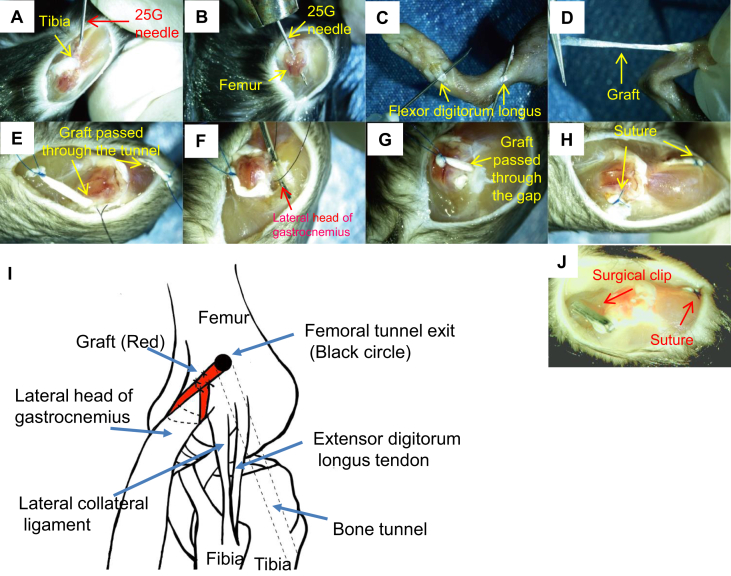
The purpose of our study was to introduce and validate a metal-free, reproducible and reliable mouse model of anterior cruciate ligament (ACL) reconstruction (ACLR) surgery as an effective tool for a better understanding of molecular mechanisms of graft-tunnel healing after ACLR.
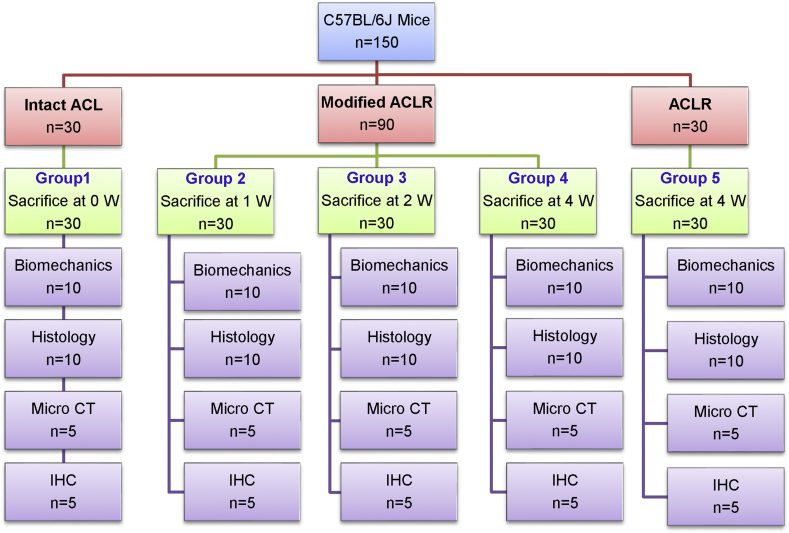
A total of 150 C57BL/6 mice were randomly allocated into five Groups: Group 1 (mice with intact ACL), Group 2-4 (mice underwent modified ACLR surgery and sacrificed 1-, 2-, and 4-weeks after surgery), and Group 5 (mice underwent unmodified ACLR surgery and sacrificed 4 weeks after surgery). Micro-computed tomography (CT), biomechanical histological as well as immunohistochemical (IHC) analyses were performed to characterize the modified ACLR.
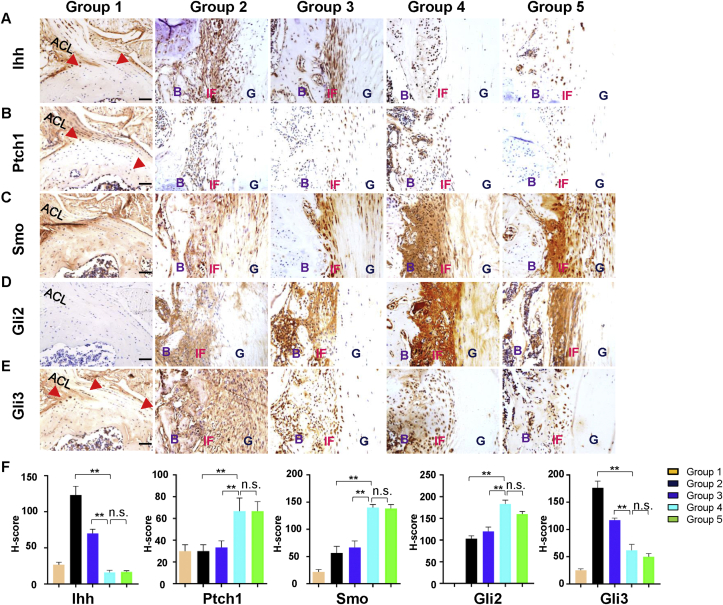
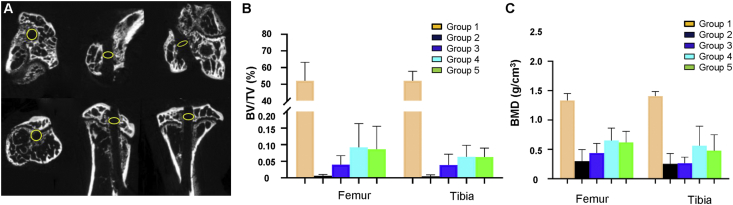
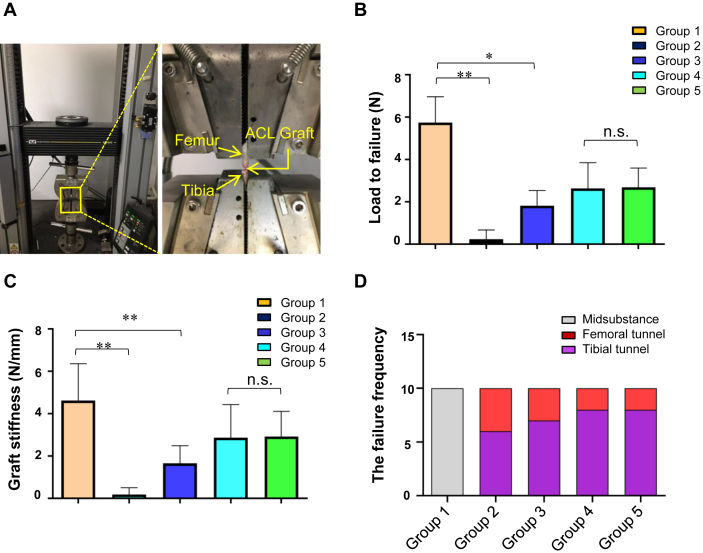
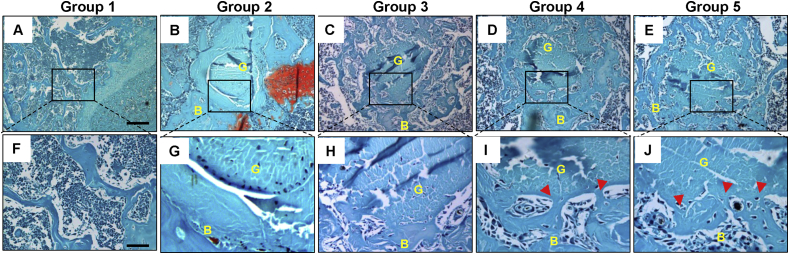
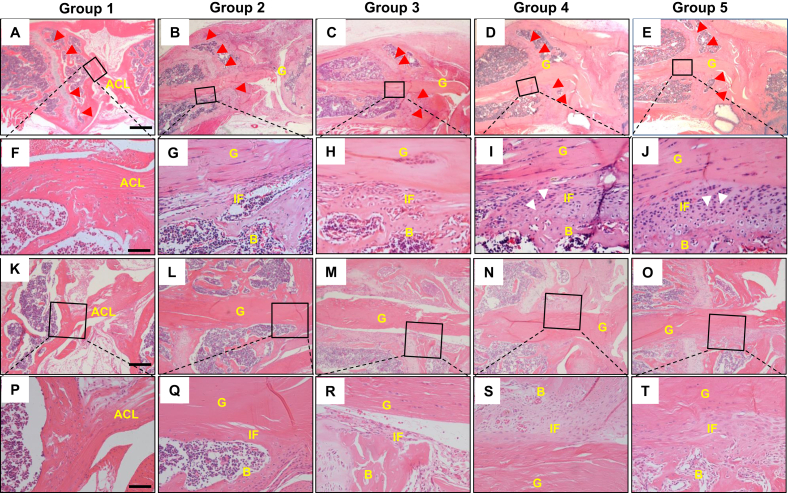
Micro-CT analysis demonstrated there is a non-significant increase in BV/TV and BMD of the bone tunnel during the tendon-to-bone healing following ACLR. Biomechanical tests showed that the mean load-to-failure forces of Group 3 and 4 are equal to 31.7% and 46.0% of that in Group 1, while the stiffness was 33.1% and 57.2% of that of Group 1, respectively. And no obvious difference in biomechanical parameters was found between Group 4 and 5. Histological analysis demonstrated that formation of fibrovascular tissue in the tibial tunnel and aperture in Groups 4 and 5 and direct junction appeared between tendon graft and tunnel both in Groups 4 and 5. IHC results showed that there are gradually enhanced expression of Patched1, Smoothened and Gli2 concomitant with decreased Gli3 protein in the tendon-bone interface during the tendon-bone healing process.
We introduced a metal-free, reproducible and reliable mouse model of ACLR compared to the unmodified ACLR procedure, and characterized the expression pattern of key molecules in Ihh signaling during the graft healing process.
In the present study we introduced and validated, for the first time, a metal-free, reproducible and reliable ACLR mouse model, which could be used to investigate the detailed molecular mechanisms of graft-tunnel healing after ACLR. We also explored new strategies to promote the healing of tendon-to-bone integration.
本研究的目的是引入并验证一种无金属、可重复且可靠的前交叉韧带(ACL)重建(ACLR)手术小鼠模型,作为一种有效工具,以更好地理解ACLR后移植物-骨隧道愈合的分子机制。
总共150只C57BL/6小鼠被随机分为五组:第1组(ACL完整的小鼠),第2 - 4组(接受改良ACLR手术并在术后1、2和4周处死的小鼠),以及第5组(接受未改良ACLR手术并在术后4周处死的小鼠)。进行了微型计算机断层扫描(CT)、生物力学、组织学以及免疫组织化学(IHC)分析以表征改良的ACLR。
微型CT分析表明,在ACLR后的腱-骨愈合过程中,骨隧道的骨体积分数(BV/TV)和骨密度(BMD)有不显著的增加。生物力学测试表明,第3组和第4组的平均破坏载荷力分别等于第1组的31.7%和46.0%,而刚度分别为第1组的33.1%和57.2%。并且第4组和第5组之间在生物力学参数上未发现明显差异。组织学分析表明,第4组和第5组的胫骨隧道和开口处形成了纤维血管组织,且第4组和第5组的肌腱移植物与隧道之间均出现了直接连接。IHC结果表明,在腱-骨愈合过程中,腱-骨界面处的Patched1、Smoothened和Gli2的表达逐渐增强,同时Gli3蛋白减少。
与未改良的ACLR手术相比,我们引入了一种无金属、可重复且可靠的ACLR小鼠模型,并表征了移植物愈合过程中Ihh信号通路关键分子的表达模式。
在本研究中,我们首次引入并验证了一种无金属、可重复且可靠的ACLR小鼠模型,该模型可用于研究ACLR后移植物-骨隧道愈合的详细分子机制。我们还探索了促进腱-骨整合愈合的新策略。