School of Nursing, Guangzhou University of Chinese Medicine, Guangzhou, 510006 Guangzhou, China.
School of Chemical Engineering, Dalian University of Technology, Dalian, 116024 Liaoning, China.
Biomed Res Int. 2020 Jul 20;2020:4748264. doi: 10.1155/2020/4748264. eCollection 2020.
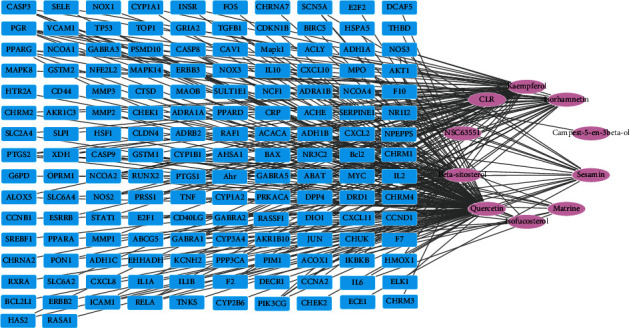
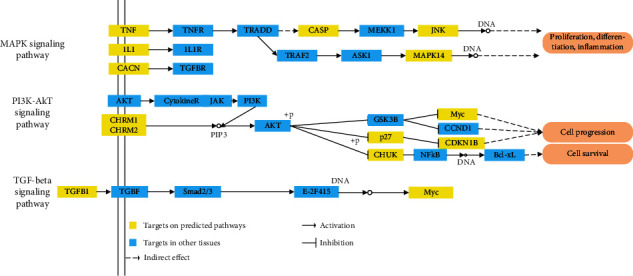
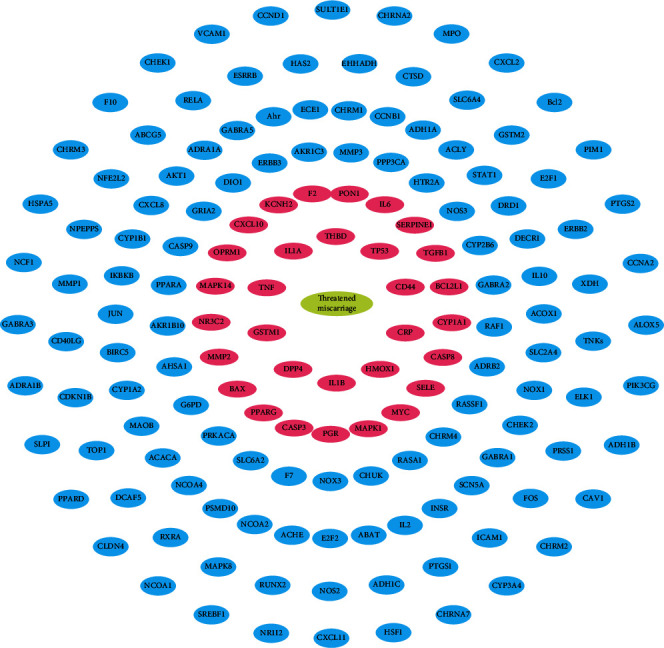
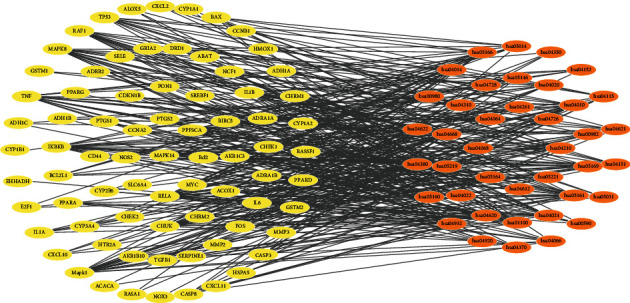
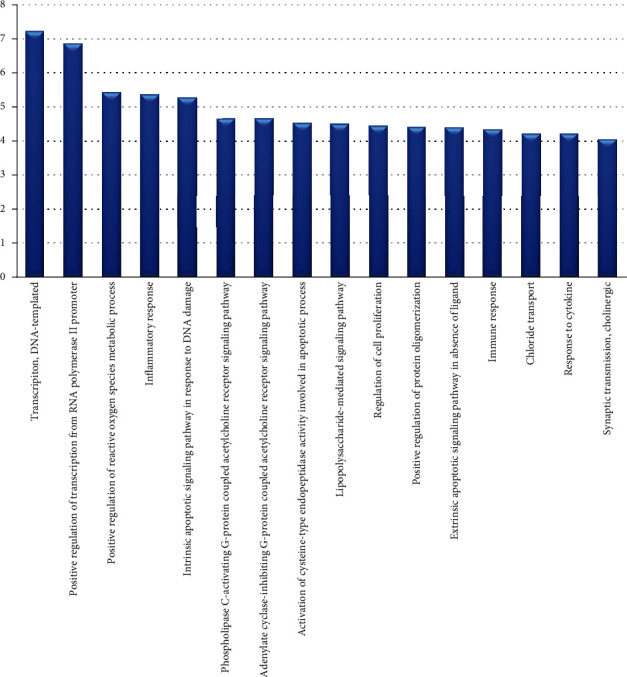
Threatened abortion (TA) is a common complication with high incidence in the first trimester of pregnancy, which will end in miscarriage if not treated properly. The Chinese herbs Cuscutae Semen (Tusizi in Chinese) and Herba Taxilli (Sangjisheng in Chinese) first recorded in the ancient classic medical book are effective and widely used as an herb pair for the treatment of TA, while the active ingredients and the functional mechanism of Tusizi-Sangjisheng herb pair treating TA are still unknown. In order to exploit the relationship between those two herbs and TA, systems pharmacology analysis was carried out in this study. A total of 75 ingredients of Tusizi-Sangjisheng were collected from Traditional Chinese Medicine System Pharmacology Database and Analysis Platform (TCMSP). 12 bioactive compounds were screened, and 153 directly related targets were predicted by systematic models. Besides, Gene Ontology (GO) enrichment analysis and Kyoto Encyclopedia of Genes and Genomes (KEGG) pathway enrichment analysis were used to systematically explore the potential mechanisms of Tusizi-Sangjisheng treating TA. Meanwhile, Compound-Target (C-T), Target-Disease (T-D), and Target-Pathway (T-P) networks were constructed to further quest the underlying functional mechanisms of Tusizi-Sangjisheng. As a result, 31 targets and 3 key pathways were found to be directly related to TA that includes mitogen-activated protein kinases (MAPKs), phosphatidylinositol-3-kinase/protein kinase B (PI3K-Akt), and transforming growth factor- (TGF-) signaling pathways. The results in this study may provide some valuable clues about the molecular mechanisms of the efficient Chinese herb pair Tusizi-Sangjisheng in the treatment of TA.
先兆流产(threatened abortion,TA)是妊娠早期常见的并发症,发病率较高,如果治疗不当,最终会导致流产。菟丝子(tusizi)和桑寄生(sangjisheng)这两味中药最早记载于古代经典医学著作中,被广泛用于治疗 TA,是一种有效的药对。然而,菟丝子-桑寄生药对治疗 TA 的活性成分和功能机制仍不清楚。为了揭示这两味中药与 TA 之间的关系,本研究采用系统药理学分析方法。从中药系统药理学数据库和分析平台(TCMSP)中收集了菟丝子-桑寄生的 75 种成分,筛选出 12 种生物活性化合物,并通过系统模型预测了 153 个直接相关的靶点。此外,还进行了基因本体(GO)富集分析和京都基因与基因组百科全书(KEGG)通路富集分析,系统探讨了菟丝子-桑寄生治疗 TA 的潜在机制。同时,构建了化合物-靶点(C-T)、靶点-疾病(T-D)和靶点-通路(T-P)网络,进一步探讨了菟丝子-桑寄生治疗 TA 的潜在功能机制。结果发现,有 31 个靶点和 3 条关键通路与 TA 直接相关,包括丝裂原活化蛋白激酶(mitogen-activated protein kinases,MAPKs)、磷脂酰肌醇-3-激酶/蛋白激酶 B(phosphatidylinositol-3-kinase/protein kinase B,PI3K-Akt)和转化生长因子-β(transforming growth factor-β,TGF-β)信号通路。本研究结果可能为菟丝子-桑寄生这一中草药有效治疗 TA 的分子机制提供一些有价值的线索。