Guangdong Engineering Research Center for Translation of Medical 3D Printing Application, Guangdong Provincial Key Laboratory of Medical Biomechanics, School of Basic Medical Sciences, Southern Medical University, Guangzhou, China.
Guangdong Innovation Platform for Translation of 3D Printing Application, The Third Affiliated Hospital of Southern Medical University, Southern Medical University, Guangzhou, China.
Biomed Res Int. 2020 Jul 25;2020:9569530. doi: 10.1155/2020/9569530. eCollection 2020.
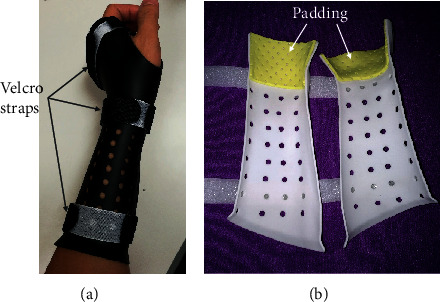
This pilot study is aimed at investigating the mechanical characteristics of a cast-wrapped fractured forearm and performing a clinical comparative study of our own developed 3D-printed orthopedic cast.
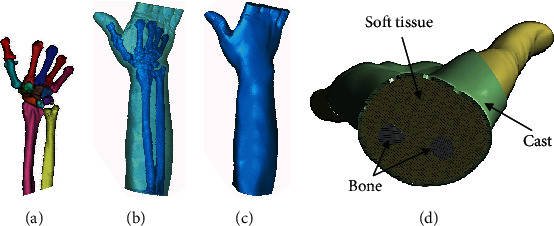
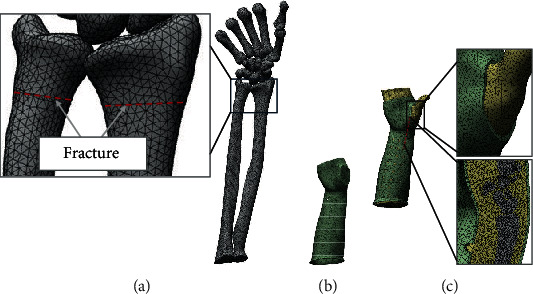
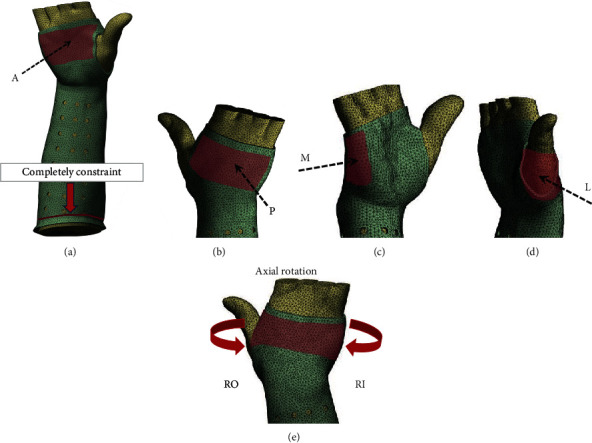
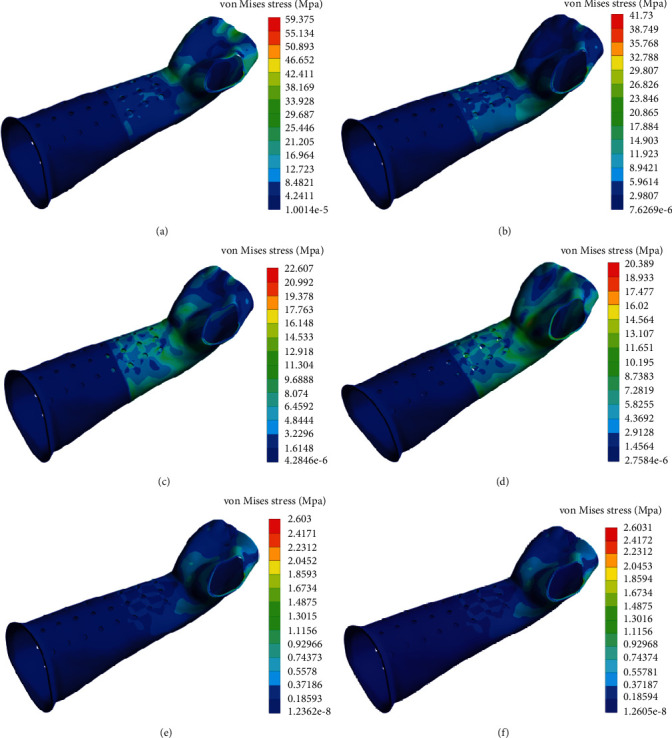
An integrated finite element (FE) model including a forearm and a 3D-printed cast wrapping the forearm was created. The distal radial ulna in this model was cut through to mimic the bone fracture. A 400 N force and 1 Nm rotation moment, which were much larger than the loading conditions encountered in daily life for a human being, were applied on the palm. We conducted a comparative clinical study by using statistical assessment. 60 patients with forearm fractures were selected and treated with manual reduction and external fixation cast. All patients were divided into three groups with equal members (20): (a) 3D-printed external cast group, (b) traditional plaster external fixation group, and (c) splint external fixation group. The clinical efficacy, wrist function, and patient satisfaction were scored and compared.
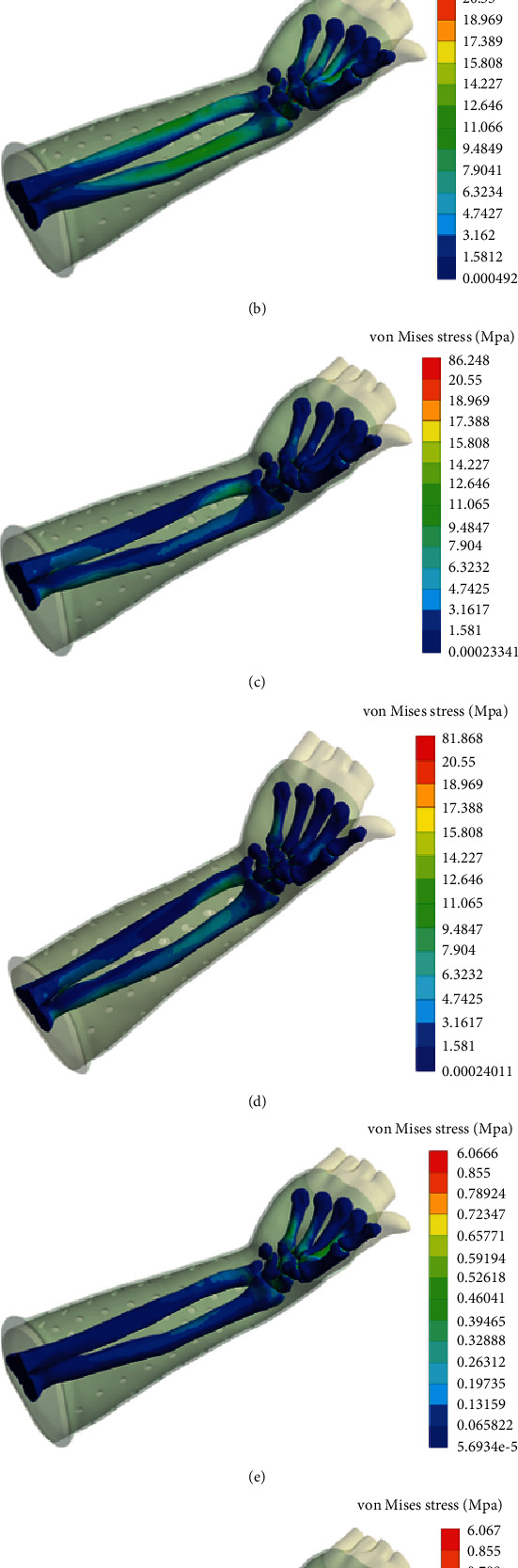
In the condition of 400 N loading, the fracture displacements in anterior-posterior (AP), posterior-anterior (PA), medial to lateral (ML), and lateral to medial (LM) compression directions were 1.2648, 1.3253, 0.8503, and 0.8957 (mm), respectively, and the corresponding fracture stresses were 4.5986, 3.9129, and 5.0334, 7.9197 (MPa), respectively. In the inward (IR) and outward (OR) rotations, the fracture displacements were both 0.02628 (mm), and the corresponding fracture surface stresses were 0.1733 and 0.1723 (MPa), respectively. In the clinical efficacy, wrist function, and patient comfort evaluation, the total scores of group A were both higher than those in groups B and C ( < 0.05).
A 3D-printed orthopedic cast was capable of exerting appropriate mechanical correction loads on specific areas to maintain optimal alignment of a fractured forearm and thus could achieve the favorable clinical efficacy and patient comfort.
本研究旨在探讨包裹性骨折前臂的力学特性,并对我们自主研发的 3D 打印骨科外固定器进行临床对比研究。
建立包含前臂和包裹前臂的 3D 打印外固定器的整体有限元模型。模型中通过切断尺桡骨远端来模拟骨折。在手掌上施加远大于人体日常生活中遇到的载荷条件的 400N 力和 1Nm 旋转力矩。我们通过统计评估进行了对比临床研究。选择 60 例前臂骨折患者,采用手法复位和外固定器固定。所有患者分为三组,每组 20 例:(a)3D 打印外固定器组,(b)传统石膏外固定组,(c)夹板外固定组。对临床疗效、腕关节功能和患者满意度进行评分并比较。
在 400N 载荷下,前-后(AP)、后-前(PA)、内-外(ML)和外-内(LM)压缩方向的骨折位移分别为 1.2648、1.3253、0.8503 和 0.8957(mm),相应的骨折应力分别为 4.5986、3.9129 和 5.0334、7.9197(MPa)。在向内(IR)和向外(OR)旋转时,骨折位移均为 0.02628(mm),相应的骨折面应力分别为 0.1733 和 0.1723(MPa)。在临床疗效、腕关节功能和患者舒适度评价中,A 组的总评分均高于 B 组和 C 组(<0.05)。
3D 打印骨科外固定器能够对特定区域施加适当的机械矫正载荷,保持骨折前臂的最佳对线,从而获得良好的临床疗效和患者舒适度。