Wang Qingnan, Zhong Xiaomei, Li Qian, Su Jing, Liu Yi, Mo Li, Deng Hongxin, Yang Yang
State Key Laboratory of Biotherapy and Cancer Center, West China Hospital, Sichuan University and Collaborative Innovation Center, Chengdu 610041, China.
Mol Ther Methods Clin Dev. 2020 Jun 30;18:520-531. doi: 10.1016/j.omtm.2020.06.025. eCollection 2020 Sep 11.
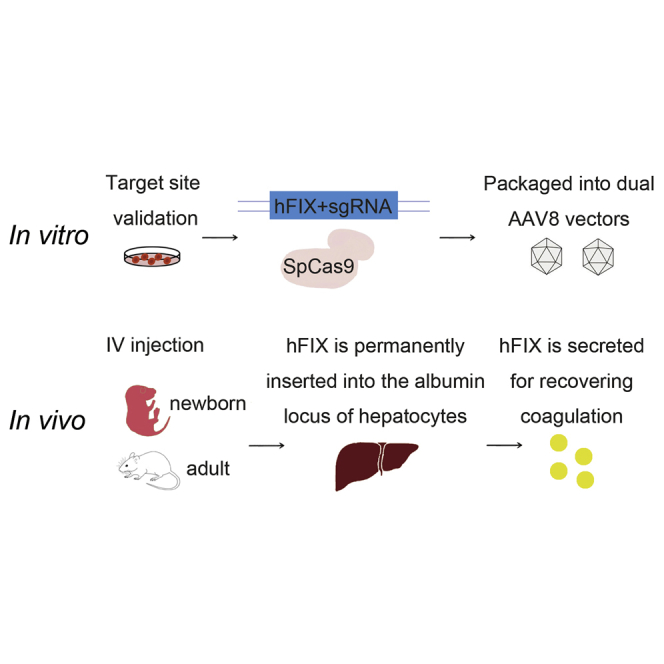
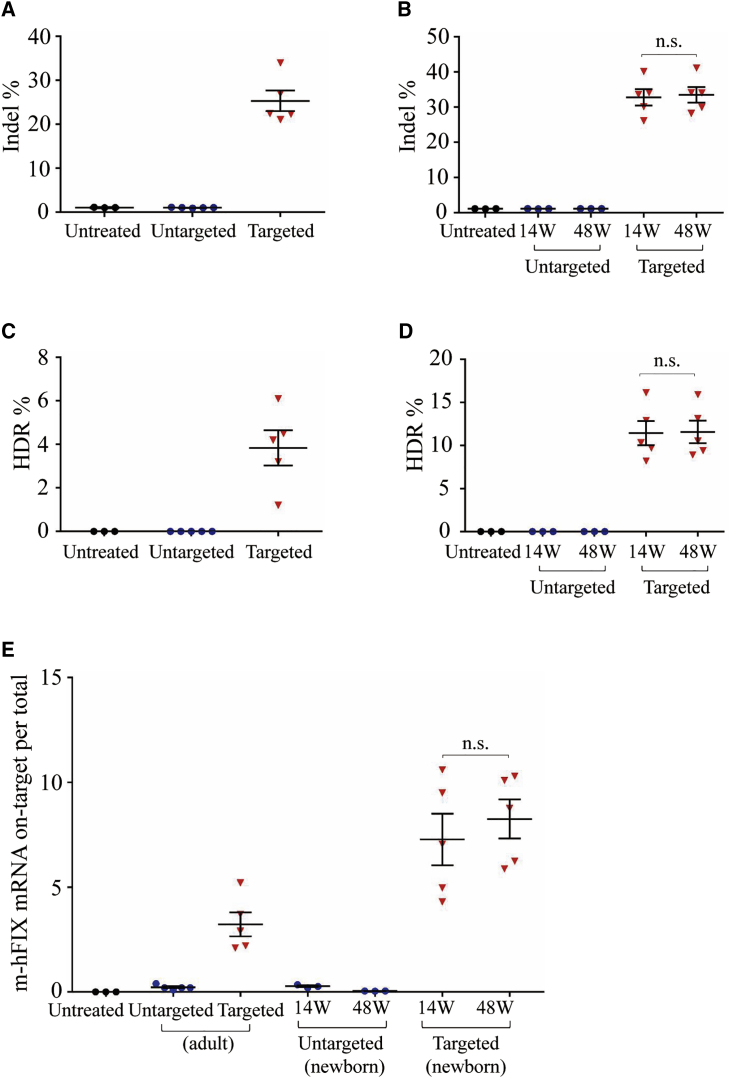
Clustered regularly interspaced short palindromic repeats (CRISPR)-Cas9 loaded by vectors could induce high rates of specific site genome editing and correct disease-causing mutations. However, most monogenic genetic diseases such as hemophilia are caused by different mutations dispersed in one gene, instead of an accordant mutation. Vectors developed for correcting specific mutations may not be suited to different mutations at other positions. Site-specific gene addition provides an ideal solution for long-term, stable gene therapy. We have demonstrated SaCas9-mediated homology-directed factor IX (FIX) targeting for sustained treatment of hemophilia B. In this study, we tested a more efficient dual adeno-associated virus (AAV) strategy with lower vector dose for liver-directed genome editing that enables CRISPR-Cas9-mediated site-specific integration of therapeutic transgene within the albumin gene, and we aimed to develop a more universal gene-targeting approach. We successfully achieved coagulation function in newborn and adult hemophilia B mice by a single injection of dual AAV vectors. FIX levels in treated mice persisted even after a two-thirds partial hepatectomy, indicating stable gene integration. Our results suggest that this CRISPR-Cas9-mediated site-specific gene integration in hepatocytes could transform into a common clinical therapeutic method for hemophilia B and other genetic diseases.
通过载体加载的成簇规律间隔短回文重复序列(CRISPR)-Cas9能够诱导高频率的特定位点基因组编辑并纠正致病突变。然而,大多数单基因遗传病,如血友病,是由分散在一个基因中的不同突变引起的,而非一致的突变。为纠正特定突变而开发的载体可能不适用于其他位置的不同突变。位点特异性基因添加为长期、稳定的基因治疗提供了理想的解决方案。我们已经证明了SaCas9介导的同源性定向因子IX(FIX)靶向用于血友病B的持续治疗。在本研究中,我们测试了一种更有效的双腺相关病毒(AAV)策略,该策略使用较低的载体剂量进行肝脏定向基因组编辑,可实现CRISPR-Cas9介导的治疗性转基因在白蛋白基因内的位点特异性整合,并且我们旨在开发一种更通用的基因靶向方法。通过单次注射双AAV载体,我们成功在新生和成年血友病B小鼠中实现了凝血功能。即使在三分之二部分肝切除术后,治疗小鼠中的FIX水平仍持续存在,表明基因整合稳定。我们的结果表明,这种CRISPR-Cas9介导的肝细胞位点特异性基因整合可能转化为血友病B和其他遗传病的一种通用临床治疗方法。