Gao Jian, Bergmann Thorsten, Zhang Wenli, Schiwon Maren, Ehrke-Schulz Eric, Ehrhardt Anja
Institute for Virology and Microbiology, Center for Biomedical Education and Research (ZBAF), Department of Human Medicine, Faculty of Health, Witten/Herdecke University, 58453 Witten, Germany.
Institute for Virology and Microbiology, Center for Biomedical Education and Research (ZBAF), Department of Human Medicine, Faculty of Health, Witten/Herdecke University, 58453 Witten, Germany.
Mol Ther Nucleic Acids. 2019 Mar 1;14:364-376. doi: 10.1016/j.omtn.2018.12.008. Epub 2018 Dec 20.
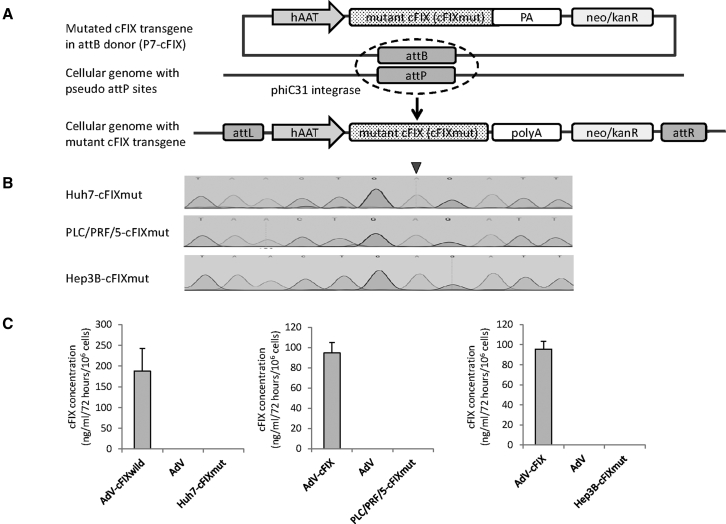
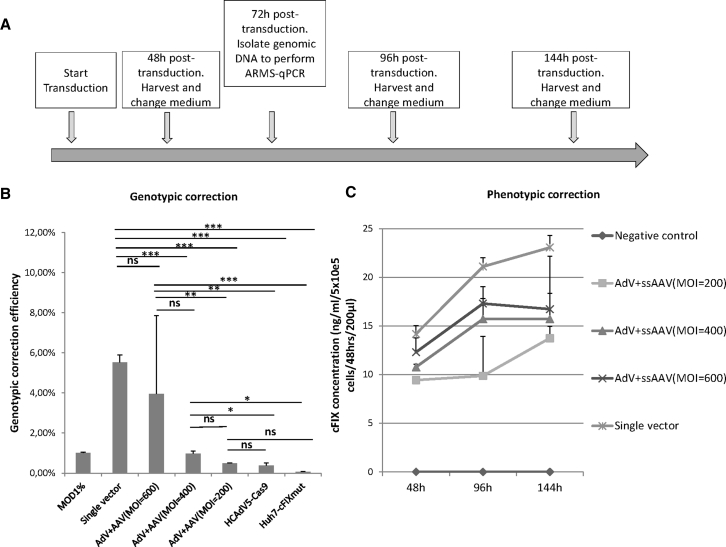
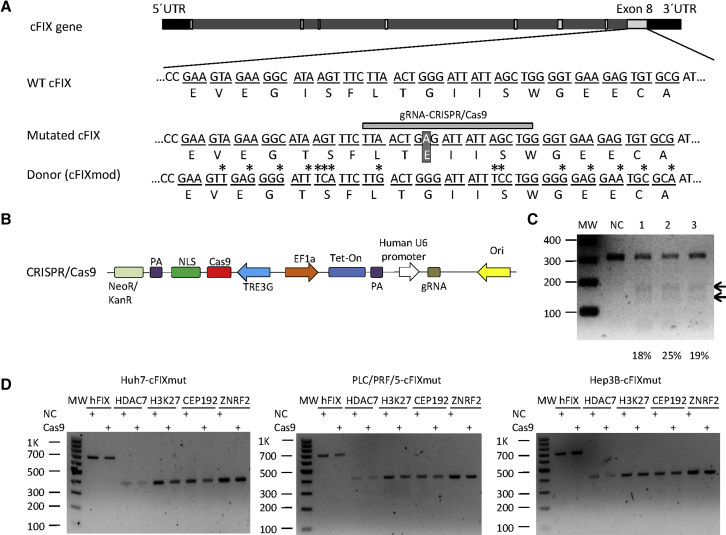
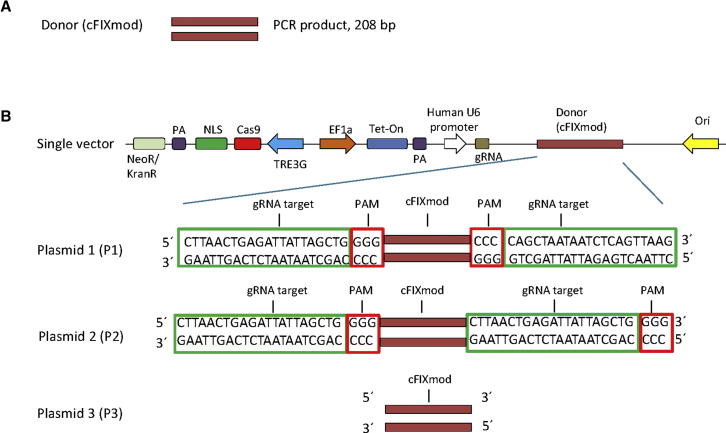
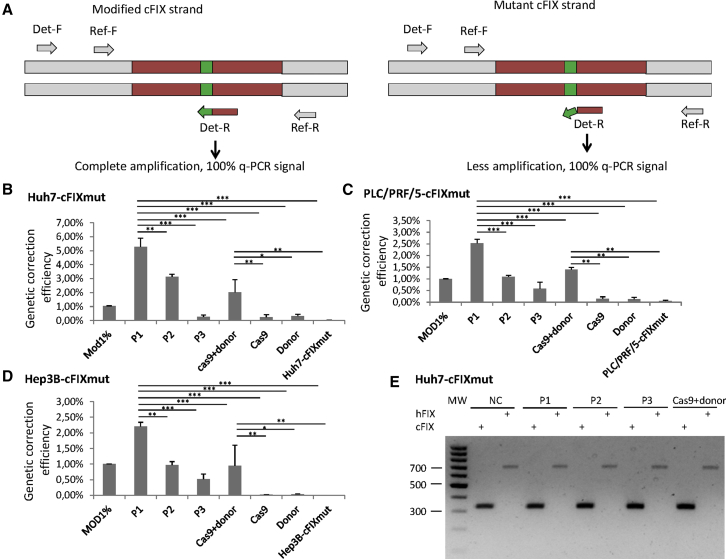
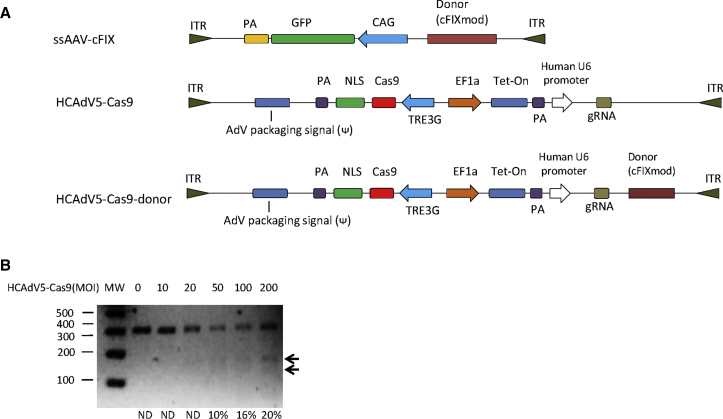
Gene therapy represents an attractive alternative to treat hemophilia B. Here we established three hepatocyte-derived cell lines based on Huh7, PLC/PRF/5, and Hep3B cells stably carrying a mutated canine FIX (cFIXmut) transgene containing a single point mutation in the catalytic domain. Based on these in vitro models resembling a commonly used canine large animal model, the tetracycline-controlled transcriptional activator (Tet-on)-inducible CRISPR/Cas9 system and an optimized donor were used to correct mutated cFIX gene through homology-directed repair (HDR). For efficient delivery of designer nuclease and donor DNA, we produced a high-capacity adenovirus vector type 5 (HCAdV5) containing the Tet-on-inducible cFIX-specific CRISPR/Cas9 system and a single-stranded adeno-associated virus type 2 vector (ssAAV2) containing the modified donor. Moreover, we designed a single HCAdV5 delivering all components for HDR. Our amplification-refractory mutation system based on qPCR analysis (ARMS-qPCR) revealed that the single vector application in Huh7-cFIXmut cells resulted in up to 5.52% HDR efficiencies, which was superior to the two-vector strategy. Furthermore the single vector also resulted in increased phenotypic correction efficiencies assayed by ELISA. We conclude that HDR in combination with viral vector delivery holds great promise for the correction of mutated FIX in disease models.
基因治疗是治疗B型血友病的一种颇具吸引力的替代方法。在此,我们基于Huh7、PLC/PRF/5和Hep3B细胞建立了三种肝细胞衍生细胞系,这些细胞系稳定携带一种突变的犬源FIX(cFIXmut)转基因,该转基因在催化结构域含有一个单点突变。基于这些类似于常用犬类大动物模型的体外模型,利用四环素控制的转录激活因子(Tet-on)诱导型CRISPR/Cas9系统和优化的供体,通过同源定向修复(HDR)来校正突变的cFIX基因。为了有效递送设计核酸酶和供体DNA,我们制备了一种含有Tet-on诱导型cFIX特异性CRISPR/Cas9系统的高容量5型腺病毒载体(HCAdV5)和一种含有修饰供体的单链2型腺相关病毒载体(ssAAV2)。此外,我们设计了一种递送所有HDR组件的单一HCAdV5。我们基于qPCR分析的扩增不应性突变系统(ARMS-qPCR)显示,在Huh7-cFIXmut细胞中应用单一载体可产生高达5.52%的HDR效率,这优于双载体策略。此外,通过ELISA检测,单一载体还提高了表型校正效率。我们得出结论,HDR与病毒载体递送相结合在疾病模型中校正突变FIX方面具有巨大潜力。