Kliger Amrani Anat, Zion Golumbic Elana
The Gonda Brain Research Center, Bar Ilan University, Ramat Gan, Israel.
Data Brief. 2020 Jul 20;32:106044. doi: 10.1016/j.dib.2020.106044. eCollection 2020 Oct.
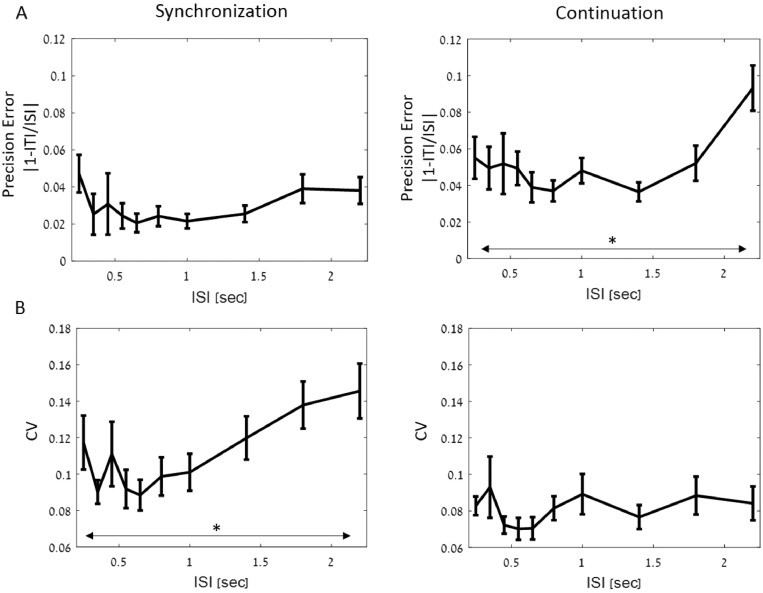
Several studies have found that the motor rhythms that individuals produce spontaneously, for example during finger tapping, clapping or walking, are also rated perceptually as 'very comfortable' to listen to. This motivated proposal of the , suggesting that individuals have a characteristic preferred rhythm, that generalizes across perception and production. However, some of the experimental procedures used previously raise two methodological concerns: First, in many of these studies, the rhythms used for assessment of participants' Perceptual Preferred Tempo (PPT) were tailored specifically around each participant's personal Spontaneous Motor Tempo (SMT). This may have biased results toward the central rhythm used, artificially increasing the similarity between spontaneous motor and auditory perceptual preferences. Second, a key prediction of the is that the same default rhythms are repeatedly found within-subject. However, measures of consistency are seldom reported, and increased within-subject variability has sometimes been used to exclude participants. The current study was an attempt to replicate reports of a correspondence between motor and perceptual rhythms, and closely followed previous experimental protocols by conducting three tasks: SMT was evaluated by instructing participants to tap 'at their most comfortable rate'; PPT was assessed by asking participants to rate a 10 different rhythms according to how 'comfortable' they were; and motor-replication of rhythms was assessed using a Synchronization-Continuation task, over a wide range of rhythms. However, in contrast to previous studies, for all participants we use the same 10 perceptual rhythms in both the PPT and Synchronization-Continuation task, irrespective of their SMT. Moreover, we assessed and report measures of within- and between-trial consistency, in order to evaluate whether participants gave similar rating and produced similar motor rhythms across multiple sessions throughout the experiment. The data presented here fail to show any correlation between motor and perceptual preferences, nor do they support improved synchronization-continuation performance near an individual's so-called SMT or PPT. Rather, they demonstrate substantial within-subject variability in the spontaneous motor rhythms produced across repeated sessions, as well as their subjective rating of perceived rhythms. This report accompanies our article [1], and provided motivation and insight for modifying the procedures used for SMT and PPT evaluation, and their interpretation.
多项研究发现,个体自发产生的运动节奏,比如在手指敲击、鼓掌或行走时的节奏,在感知上也被评为“非常舒适”的聆听节奏。这促使了[具体理论名称]的提出,表明个体具有一种特征性的偏好节奏,这种节奏在感知和产生过程中具有普遍性。然而,先前使用的一些实验程序引发了两个方法学上的问题:首先,在许多这些研究中,用于评估参与者感知偏好节奏(PPT)的节奏是专门围绕每个参与者的个人自发运动节奏(SMT)量身定制的。这可能使结果偏向所使用的中心节奏,人为地增加了自发运动和听觉感知偏好之间的相似性。其次,[具体理论名称]的一个关键预测是在个体内部反复发现相同的默认节奏。然而,很少报告一致性的测量结果,并且个体内部变异性的增加有时被用来排除参与者。当前的研究试图复制关于运动和感知节奏之间对应关系的报告,并通过进行三项任务紧密遵循先前的实验方案:通过指示参与者以“最舒适的速度”敲击来评估SMT;通过要求参与者根据10种不同节奏的“舒适”程度进行评分来评估PPT;并使用同步 - 延续任务在广泛的节奏范围内评估节奏的运动复制。然而,与先前的研究不同,对于所有参与者,我们在PPT和同步 - 延续任务中都使用相同的10种感知节奏,而不考虑他们的SMT。此外,我们评估并报告了试验内和试验间一致性的测量结果,以便评估参与者在整个实验的多个阶段是否给出相似的评分并产生相似的运动节奏。这里呈现的数据未能显示运动和感知偏好之间的任何相关性,也不支持在个体所谓的SMT或PPT附近同步 - 延续性能的改善。相反,它们表明在重复试验中产生的自发运动节奏以及他们对感知节奏的主观评分存在大量个体内部变异性。本报告伴随我们的文章[1],并为修改用于SMT和PPT评估及其解释的程序提供了动机和见解。