Division of Infectious Disease, Key Laboratory of Surveillance and Early Warning on Infectious Disease, Chinese Centre for Disease Control and Prevention, Beijing, China.
Division of Infectious Disease, Qingdao City Centre for Disease Control and Prevention, Qingdao, China.
PLoS Negl Trop Dis. 2020 Aug 10;14(8):e0008540. doi: 10.1371/journal.pntd.0008540. eCollection 2020 Aug.
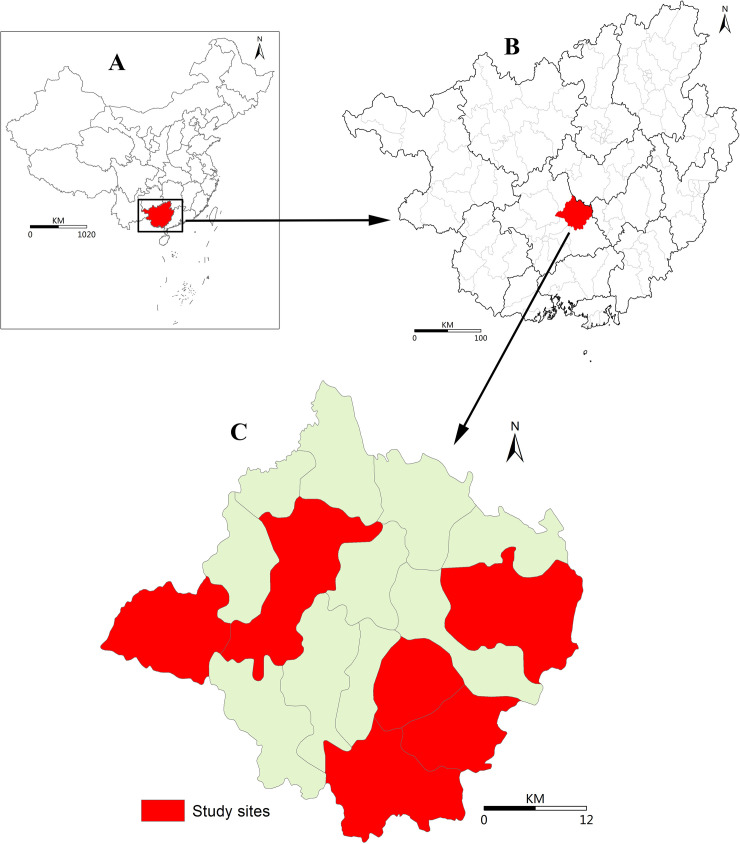
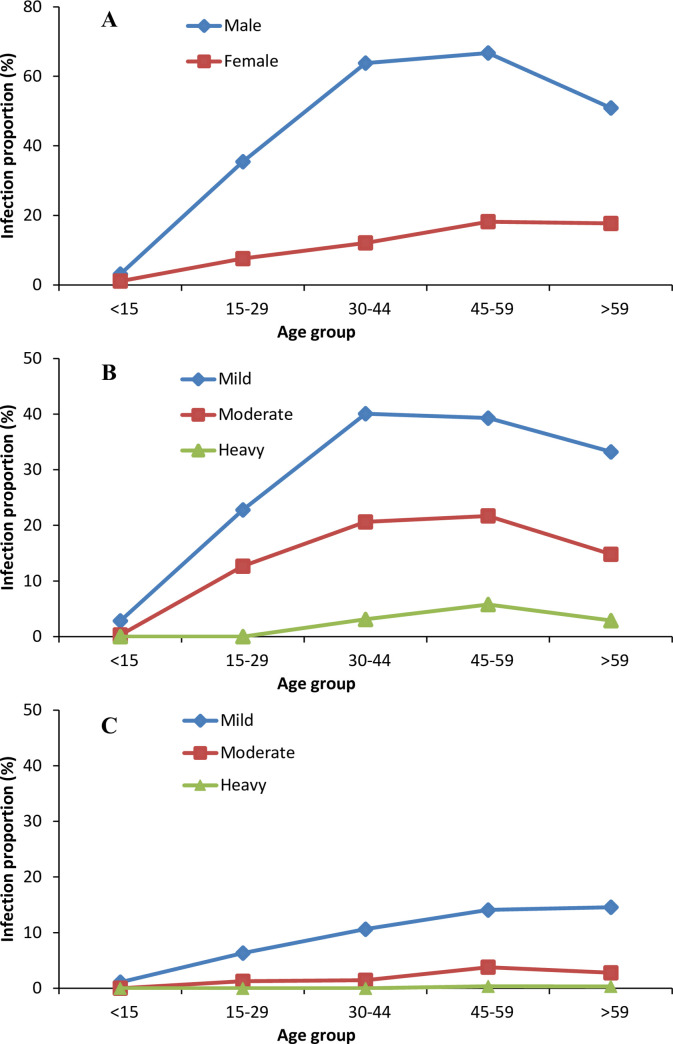
High-intensity clonorchiasis infection is associated with serious outcomes, including cancer. Understanding the infection intensity of Clonorchis sinensis and its risk factors in local endemic regions could facilitate effective control measures. In a county located in a highly endemic area in Guangxi Province, P. R. China, local residents were randomly enrolled in the study; helminth egg examinations were performed with the Kato-Katz method, and the intensity of infection was identified as mild, moderate or heavy. Knowledge, attitudes, and high-risk behaviours were investigated among those infected with Clonorchis sinensis. A total of 2521 local residents participated in this study, and the Clonorchis sinensis-positive proportion was 28.9% (728 persons). Among the infected persons, the percentages of mild, moderate and heavy infections were 66.2%, 28.4% and 5.4%, respectively. Males experienced a higher proportion of moderate and heavy infections (37.5%) than females (18.1%) (p<0.05). The highest infection proportion among the different levels of infection intensity was identified among persons aged 30-59 years (15.7% for moderate and heavy infections). Among the 509 persons who reported eating raw fish, 302 persons (59.3%) had eaten raw fresh fish for more than 10 years, and 131 (25.7%) persons ate raw fish ≥12 times a year. Multivariate logistic regression revealed that eating raw fish 12-50 times in the last year (adjusted odds ratio [aOR] = 1.74, 95%CI: 1.09-2.80) and eating raw fish >50 times in the last year (aOR = 2.89, 95%CI: 1.20-7.50) were risk factors for high-intensity infections (moderate and heavy). The overall infection proportion was high in the study area, with a large group of residents experiencing high-intensity infections. High frequency of raw fish consumption was associated with high-intensity infections. Intervention strategies targeting people with a high frequency of raw fish consumption should be implemented to reduce the probability of severe consequences.
高强度华支睾吸虫感染与严重后果相关,包括癌症。了解当地流行地区华支睾吸虫的感染强度及其危险因素有助于实施有效的控制措施。在中国广西一个高度流行地区的一个县,随机招募当地居民参加研究;采用加藤厚涂片法进行寄生虫卵检查,将感染强度确定为轻度、中度或重度。调查感染华支睾吸虫的居民的知识、态度和高危行为。共有 2521 名当地居民参加了这项研究,华支睾吸虫阳性率为 28.9%(728 人)。在感染者中,轻度、中度和重度感染的比例分别为 66.2%、28.4%和 5.4%。男性中度和重度感染的比例(37.5%)高于女性(18.1%)(p<0.05)。不同感染强度水平的最高感染比例出现在 30-59 岁人群中(中度和重度感染分别为 15.7%)。在报告食用生鱼的 509 人中,302 人(59.3%)食用生鲜鱼超过 10 年,131 人(25.7%)每年食用生鱼≥12 次。多因素 logistic 回归显示,去年食用生鱼 12-50 次(调整后的比值比[aOR] = 1.74,95%CI:1.09-2.80)和去年食用生鱼>50 次(aOR = 2.89,95%CI:1.20-7.50)是高强度感染(中度和重度)的危险因素。研究地区的总体感染率较高,有很大一部分居民感染强度较高。食用生鱼的频率较高与高强度感染有关。应针对高频率食用生鱼的人群实施干预策略,以降低发生严重后果的概率。