Division of Pulmonology, Department of Internal Medicine, Medical University of Graz, Austria.
Institute of Pathology, Asklepios Clinic München-Gauting, Germany.
Mol Oncol. 2020 Nov;14(11):2853-2867. doi: 10.1002/1878-0261.12780. Epub 2020 Sep 1.
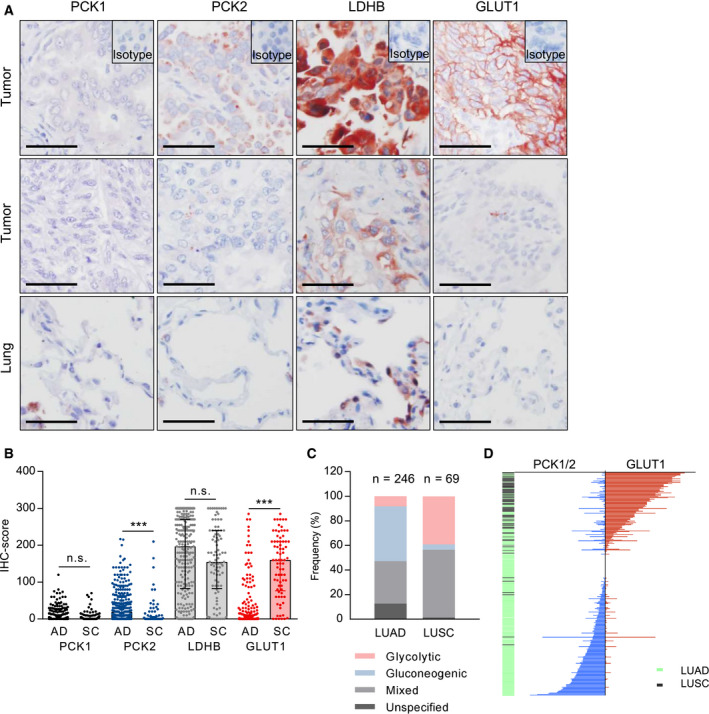
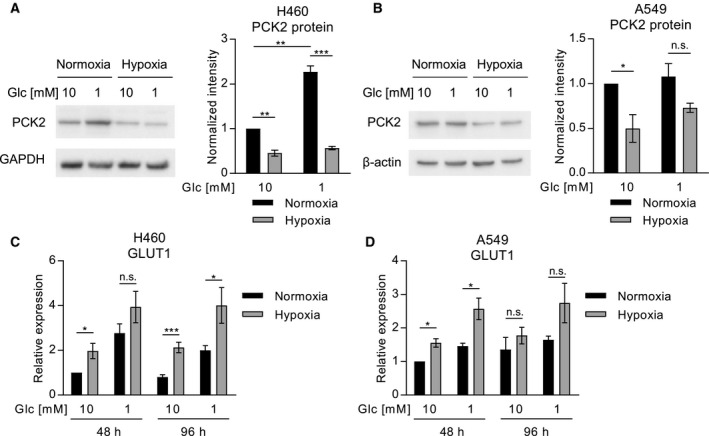
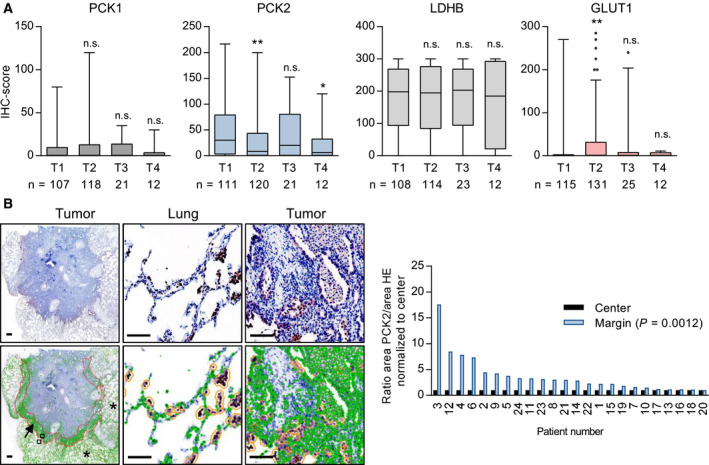
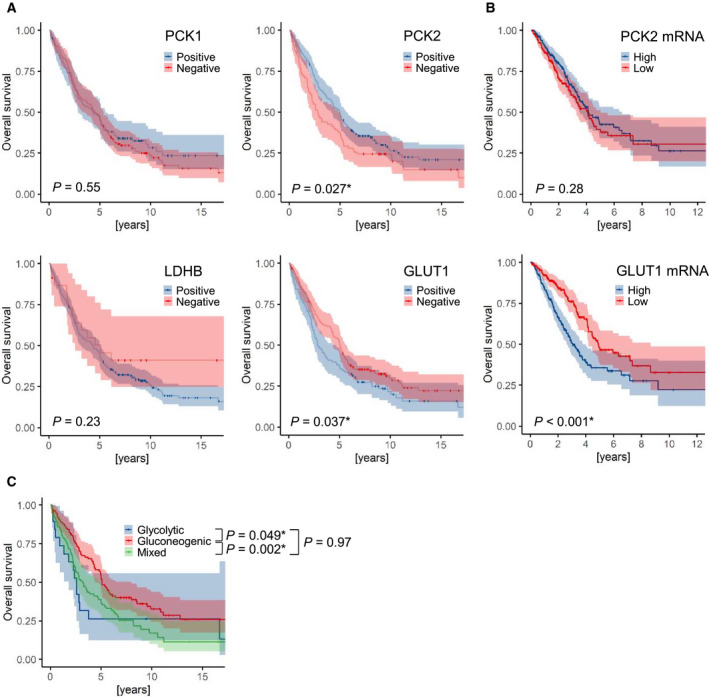
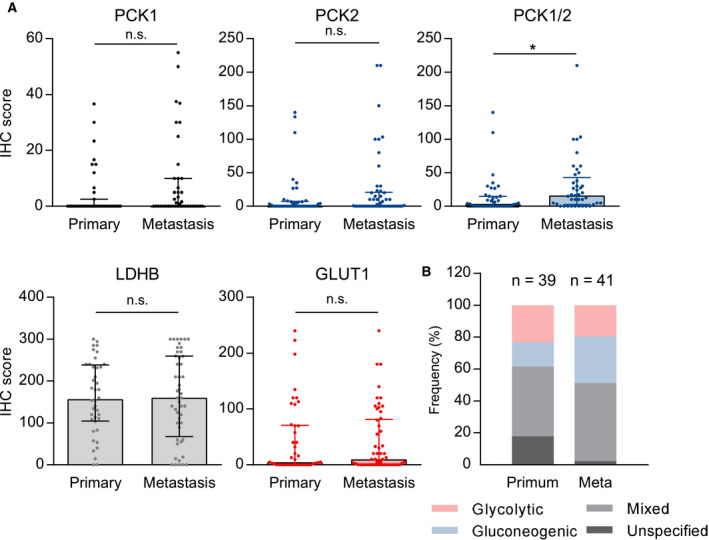
Inhibition of glycolysis has been considered as a therapeutic approach in aggressive cancers including lung cancer. Abbreviated gluconeogenesis, mediated by phosphoenolpyruvate carboxykinase (PEPCK), was recently discovered to partially circumvent the need for glycolysis in lung cancer cells. However, the interplay of glycolysis and gluconeogenesis in lung cancer is still poorly understood. Here, we analyzed the expression of GLUT1, the prime glucose transporter, and of PCK1 and PCK2, the cytoplasmic and mitochondrial isoforms of PEPCK, in 450 samples of non-small cell lung cancer (NSCLC) and in 54 NSCLC metastases using tissue microarrays and whole tumor sections. Spatial distribution was assessed by automated image analysis. Additionally, glycolytic and gluconeogenic gene expression was inferred from The Cancer Genome Atlas (TCGA) datasets. We found that PCK2 was preferentially expressed in the lung adenocarcinoma subtype, while GLUT1 expression was higher in squamous cell carcinoma. GLUT1 and PCK2 were inversely correlated, GLUT1 showing elevated expression in larger tumors while PCK2 was highest in smaller tumors. However, a mixed phenotype showing the presence of both, glycolytic and gluconeogenic cancer cells was frequent. In lung adenocarcinoma, PCK2 expression was associated with significantly improved overall survival, while the opposite was found for GLUT1. The metabolic tumor microenvironment and the 3-dimensional context play an important role in modulating both pathways, since PCK2 expression preferentially occurred at the tumor margin and hypoxia regulated both, glycolysis and gluconeogenesis, in NSCLC cells in vitro, albeit in opposite directions. PCK1/2 expression was enhanced in metastases compared to primary tumors, possibly related to the different environment. The results of this study show that glycolysis and gluconeogenesis are activated in NSCLC in a tumor size and oxygenation modulated manner and differentially correlate with outcome. The frequent co-activation of gluconeogenesis and glycolysis in NSCLC should be considered in potential future therapeutic strategies targeting cancer cell metabolism.
糖酵解抑制已被认为是包括肺癌在内的侵袭性癌症的一种治疗方法。最近发现,通过磷酸烯醇丙酮酸羧激酶(PEPCK)介导的短链糖异生,部分绕过了肺癌细胞对糖酵解的需求。然而,肺癌中糖酵解和糖异生的相互作用仍知之甚少。在这里,我们使用组织微阵列和全肿瘤切片分析了 450 个非小细胞肺癌(NSCLC)样本和 54 个 NSCLC 转移瘤中 GLUT1(主要葡萄糖转运蛋白)、PCK1 和 PCK2(PEPCK 的细胞质和线粒体同工酶)的表达。通过自动图像分析评估空间分布。此外,从癌症基因组图谱(TCGA)数据集推断出糖酵解和糖异生基因的表达。我们发现 PCK2 在肺腺癌亚型中优先表达,而 GLUT1 在鳞状细胞癌中表达更高。GLUT1 和 PCK2 呈负相关,GLUT1 在较大的肿瘤中表达升高,而 PCK2 在较小的肿瘤中表达最高。然而,存在既有糖酵解又有糖异生癌细胞的混合表型很常见。在肺腺癌中,PCK2 表达与总生存率显著提高相关,而 GLUT1 则相反。代谢肿瘤微环境和三维结构在调节这两条途径方面起着重要作用,因为 PCK2 表达优先发生在肿瘤边缘,并且缺氧在体外调节 NSCLC 细胞中的糖酵解和糖异生,尽管方向相反。与原发肿瘤相比,转移瘤中 PCK1/2 的表达增强,可能与环境不同有关。本研究结果表明,NSCLC 中的糖酵解和糖异生以肿瘤大小和氧合调节的方式激活,并与预后相关。在 NSCLC 中,糖异生和糖酵解的频繁共激活应在潜在的针对癌细胞代谢的未来治疗策略中加以考虑。