Department of Breast Imaging, Tianjin Medical University Cancer Institute and Hospital, Tianjin, China (mainland).
Department of Bone and Soft Tissue Tumors, Tianjin Medical University Cancer Institute and Hospital, Tianjin, China (mainland).
Med Sci Monit. 2020 Aug 11;26:e924858. doi: 10.12659/MSM.924858.
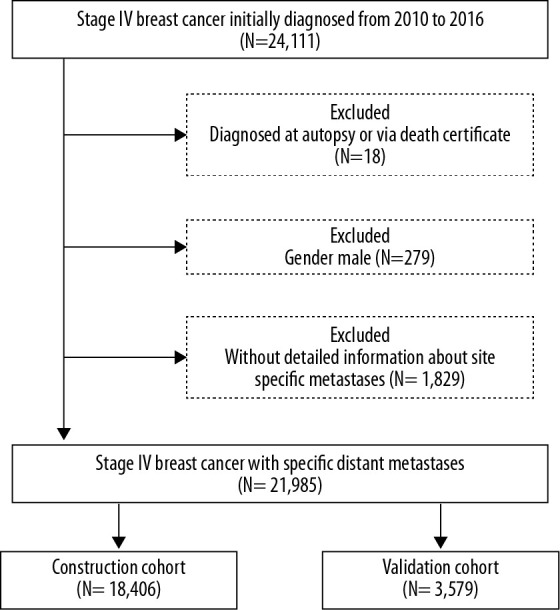
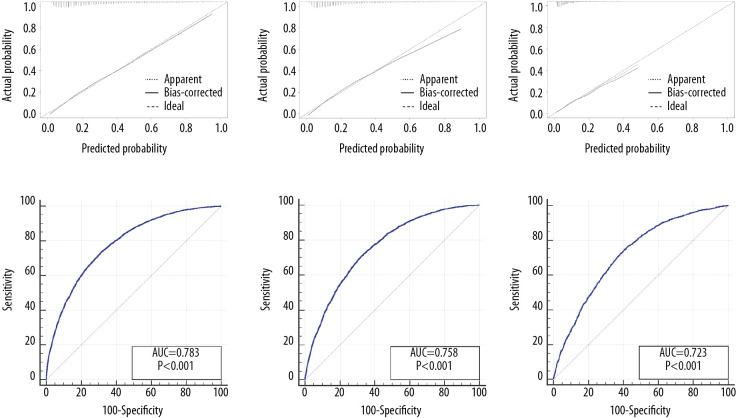
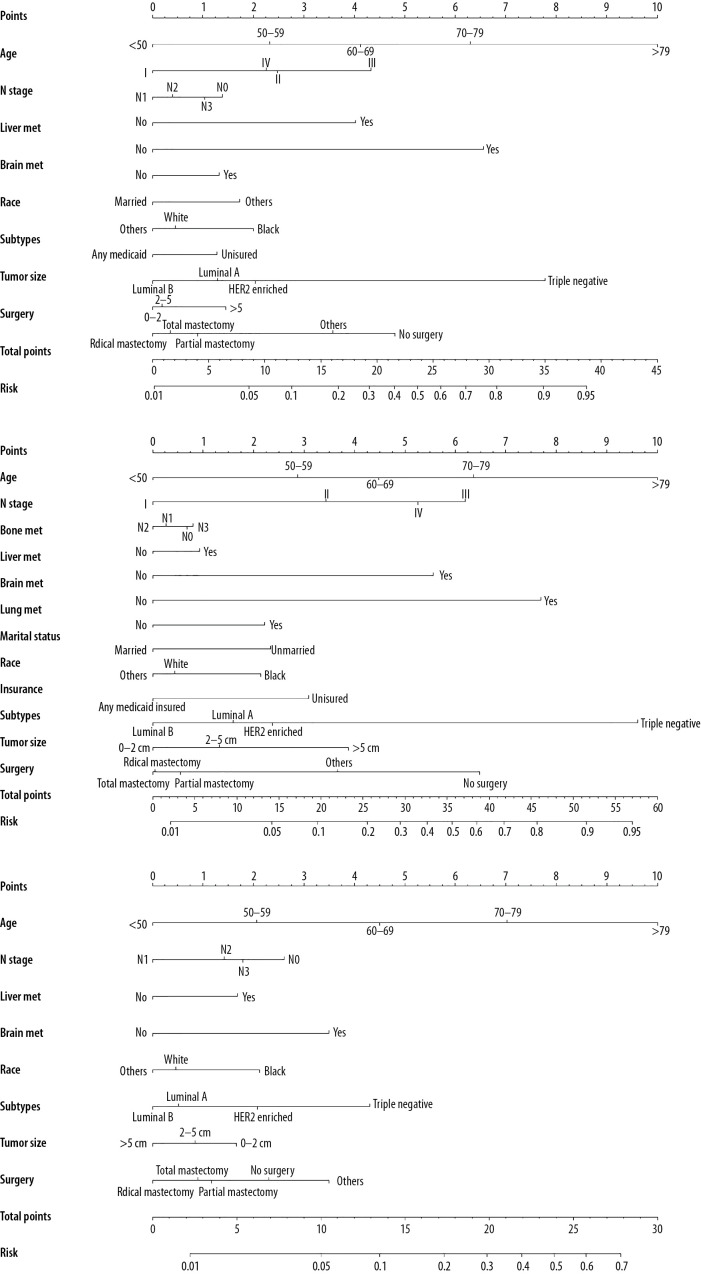
BACKGROUND The early death of patients is a global cancer issue. We aimed to identify the risk factors for early death in stage IV breast cancer. Predictive nomograms for early death evaluation were generated based on the risk factors. MATERIAL AND METHODS Based on the Surveillance, Epidemiology, and End Results (SEER) database, patients diagnosed with IV breast cancer were selected. The risk factors for early death (survival time ≤1 year) were identified using logistic regression model analysis. Predictive nomograms were constructed and internal validation was performed. RESULTS A total of 5998 (32.6%) breast cancer patients were diagnosed as early death in the construction cohort. Age older than 50 years, unmarried status, black race, uninsured status, triple-negative type, grade (II and III), tumor size >5 cm, and metastasis to lung, liver, and brain were risk factors for total early death, while Luminal B subtype, N1 stage, and surgical interventions were associated with lower risk of early death. As for cancer-specific and non-cancer-specific early death, several factors were not consistent between the 2 groups. Nomograms for all-cause, cancer-specific, and non-cancer-specific early death were constructed. The calibration curve showed satisfactory agreement. The areas under the ROC curve (AUC) were 78.3% (95% CI: 77.7-78.9%), 75.8% (75.1-76.4%), and 72.3% (71.6-72.9%), respectively. In the validation cohort, a total of 689 (19.3%) patients were diagnosed as early death and the calibration curve showed satisfactory agreement. The AUCs of the all-cause, cancer-specific, and non-cancer-specific early death prediction were 74.0% (95% CI: 72.5-75.4%), 73.5% (72.0-74.9%), and 68.6% (67.0-70.1%), respectively. CONCLUSIONS Nomograms were generated to predict early death, with good calibration and discrimination. The predictive model can provide a reference for identifying cases with high risk of early death among stage IV breast cancer patients and play an auxiliary role in guiding individual treatment.
患者的早期死亡是一个全球性的癌症问题。本研究旨在确定 IV 期乳腺癌患者早期死亡的风险因素,并基于这些风险因素生成用于评估早期死亡的预测列线图。
基于监测、流行病学和最终结果(SEER)数据库,选择诊断为 IV 期乳腺癌的患者。使用逻辑回归模型分析确定早期死亡(生存时间≤1 年)的风险因素。构建预测列线图并进行内部验证。
在构建队列中,共有 5998 例(32.6%)乳腺癌患者被诊断为早期死亡。年龄>50 岁、未婚、黑种人、无保险、三阴性、分级(II 和 III)、肿瘤直径>5cm 以及肺、肝和脑转移是总早期死亡的风险因素,而 Luminal B 亚型、N1 期和手术干预与较低的早期死亡风险相关。对于癌症特异性和非癌症特异性早期死亡,两组之间的一些因素并不一致。构建了全因、癌症特异性和非癌症特异性早期死亡的列线图。校准曲线显示出较好的一致性。ROC 曲线下面积(AUC)分别为 78.3%(95%CI:77.7-78.9%)、75.8%(75.1-76.4%)和 72.3%(71.6-72.9%)。在验证队列中,共有 689 例(19.3%)患者被诊断为早期死亡,校准曲线显示出较好的一致性。全因、癌症特异性和非癌症特异性早期死亡预测的 AUC 分别为 74.0%(95%CI:72.5-75.4%)、73.5%(72.0-74.9%)和 68.6%(67.0-70.1%)。
本研究生成了预测早期死亡的列线图,具有良好的校准度和区分度。该预测模型可以为识别 IV 期乳腺癌患者中早期死亡风险较高的病例提供参考,并在指导个体化治疗方面发挥辅助作用。