Department of Orthopaedic Surgery, The Second Affiliated Hospital and Yuying Children's Hospital of Wenzhou Medical University, 109 Xueyuanxi Road, Wenzhou, 325000, Zhejiang, China.
BMC Musculoskelet Disord. 2020 Aug 11;21(1):536. doi: 10.1186/s12891-020-03535-4.
Previous studies have confirmed the feasibility of the cortical bone trajectory (CBT) technique. However, there are few reports on spinous process violation and screw penetration during the screw insertion. The purpose of this study was to evaluate the incidence of spinous process violation and screw penetration through the pedicle during CBT screw insertion.
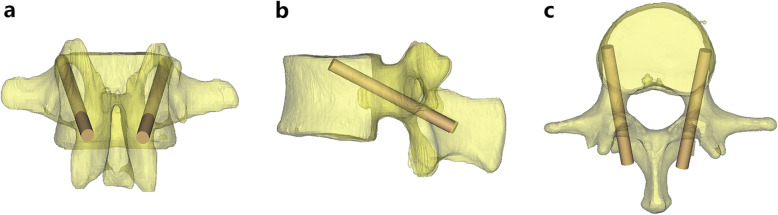
Computed tomography (CT) scans with normal lumbar structures were consecutively obtained and three-dimensional (3D) reconstructions of the lumbar spine were created. Bilateral CBT screw placement was simulated on each segment using a screw diameter of 4.5 mm, 5.0 mm, or 5.5 mm. Incidences of these complications were recorded and analyzed.
A total of 90 patients were enrolled. Spinous process violation was observed in 68.3, 53.3, 25.5, 1.7, and 0% from L1 to L5, respectively, using 4.5 mm screws. A significant difference was found among the five segments but this was unconnected to gender or screw diameter. The incidence of screw penetration through the inner wall decreased from L1 to L4; in turn, L1 (16.7-35.5%), L2 (12.7-34.4%), L3 (2.8-23.8%) and L4 (1.1-6.7%). This trend was reversed in L5 (6.7-16.7%). Moreover, screw penetration through the outer wall was rare. The incidence of screw penetration varied with screw size as well as lumbar level, but not with gender.
There are more difficulties of CBT screw fixation in upper lumbar spine. The low rate of screw penetration, using 4.5 mm screws, suggests the safety for CBT fixation in the lumbar spine. Larger screws (5.0 mm or 5.5 mm) are more recommended for use in the lower lumbar spine. Moreover, CBT fixation in L5 deserves greater attention because of the unique morphology of the pedicle.
先前的研究已经证实了皮质骨轨迹(CBT)技术的可行性。然而,关于在螺钉插入过程中椎板侵犯和螺钉穿透的报道很少。本研究的目的是评估在 CBT 螺钉插入过程中通过椎弓根发生椎板侵犯和螺钉穿透的发生率。
连续获得正常腰椎结构的计算机断层扫描(CT)扫描,并创建腰椎的三维(3D)重建。在每个节段上模拟使用 4.5mm、5.0mm 或 5.5mm 直径的螺钉进行双侧 CBT 螺钉放置。记录并分析这些并发症的发生率。
共纳入 90 例患者。使用 4.5mm 螺钉时,从 L1 到 L5 分别观察到椎板侵犯发生率为 68.3%、53.3%、25.5%、1.7%和 0%。五个节段之间存在显著差异,但与性别或螺钉直径无关。螺钉穿透内侧壁的发生率从 L1 到 L4 逐渐降低;相反,L1(16.7%-35.5%)、L2(12.7%-34.4%)、L3(2.8%-23.8%)和 L4(1.1%-6.7%)。L5 的趋势则相反(6.7%-16.7%)。此外,螺钉穿透外侧壁的情况很少见。螺钉穿透的发生率与螺钉尺寸以及腰椎水平有关,但与性别无关。
在上腰椎中 CBT 螺钉固定的难度更大。使用 4.5mm 螺钉时,螺钉穿透率较低,提示 CBT 固定在腰椎中是安全的。较大的螺钉(5.0mm 或 5.5mm)更推荐用于下腰椎。此外,由于椎弓根的独特形态,L5 的 CBT 固定需要引起更多关注。