Institute for Complementary and Integrative Medicine, University Hospital Zurich and University of Zurich, Sonneggstrasse 6, 8091, Zurich, Switzerland.
Institute for Social Medicine, Epidemiology, and Health Economics, Charité - Universitätsmedizin Berlin, corporate member of Freie Universität Berlin, Humboldt-Universität zu Berlin, and Berlin Institute of Health, 13353, Berlin, Germany.
J Cancer Educ. 2022 Jun;37(3):499-507. doi: 10.1007/s13187-020-01829-8.
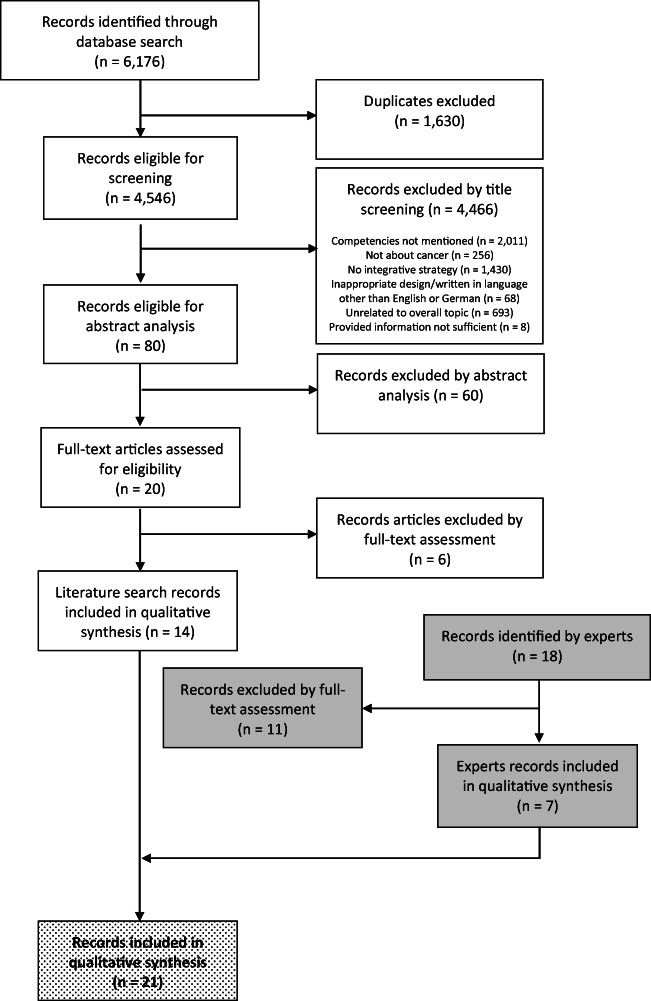
Integrative oncology is a burgeoning field and typically provided by a multiprofessional team. To ensure cancer patients receive effective, appropriate, and safe care, health professionals providing integrative cancer care should have a certain set of competencies. The aim of this project was to define core competencies for different health professions involved in integrative oncology. The project consisted of two phases. A systematic literature review on published competencies was performed, and the results informed an international and interprofessional consensus procedure. The second phase consisted of three rounds of consensus procedure and included 28 experts representing 7 different professions (medical doctors, psychologists, nurses, naturopathic doctors, traditional Chinese medicine practitioners, yoga practitioners, patient navigators) as well as patient advocates, public health experts, and members of the Society for Integrative Oncology. A total of 40 integrative medicine competencies were identified in the literature review. These were further complemented by 18 core oncology competencies. The final round of the consensus procedure yielded 37 core competencies in the following categories: knowledge (n = 11), skills (n = 17), and abilities (n = 9). There was an agreement that these competencies are relevant for all participating professions. The integrative oncology core competencies combine both fundamental oncology knowledge and integrative medicine competencies that are necessary to provide effective and safe integrative oncology care for cancer patients. They can be used as a starting point for developing profession-specific learning objectives and to establish integrative oncology education and training programs to meet the needs of cancer patients and health professionals.
整合肿瘤学是一个新兴的领域,通常由多专业团队提供服务。为确保癌症患者得到有效、适当和安全的护理,提供整合肿瘤学护理的卫生专业人员应具备一定的能力。本项目旨在为参与整合肿瘤学的不同卫生专业人员定义核心能力。该项目分为两个阶段。对已发表的能力进行了系统的文献回顾,结果为国际和跨专业共识程序提供了信息。第二阶段包括三轮共识程序,共有 28 名专家参与,代表 7 种不同的专业(医生、心理学家、护士、自然疗法医生、中医从业者、瑜伽从业者、患者导航员)以及患者权益倡导者、公共卫生专家和整合肿瘤学会成员。文献回顾中确定了 40 项整合医学能力。这些能力还进一步补充了 18 项核心肿瘤学能力。共识程序的最后一轮产生了以下类别的 37 项核心能力:知识(n=11)、技能(n=17)和能力(n=9)。专家们一致认为这些能力与所有参与的专业都相关。整合肿瘤学核心能力结合了基本肿瘤学知识和整合医学能力,这些都是为癌症患者提供有效和安全的整合肿瘤学护理所必需的。它们可以用作制定特定专业学习目标的起点,并建立整合肿瘤学教育和培训计划,以满足癌症患者和卫生专业人员的需求。