Internal Medicine Department, Sector Nephrology & Transplantation, University Medical Center Rotterdam, Erasmus MC, Postbus 2040, 3000 CA, Rotterdam, the Netherlands.
Department of Renal Medicine, Aarhus University Hospital, Aarhus, Denmark.
Stem Cell Res Ther. 2020 Aug 12;11(1):352. doi: 10.1186/s13287-020-01869-3.
The renal endothelium is a prime target for ischemia-reperfusion injury (IRI) during donation and transplantation procedures. Mesenchymal stromal cells (MSC) have been shown to ameliorate kidney function after IRI. However, whether this involves repair of the endothelium is not clear. Therefore, our objective is to study potential regenerative effects of MSC on injured endothelial cells and to identify the molecular mechanisms involved.
Human umbilical vein endothelial cells (HUVEC) were submitted to hypoxia and reoxygenation and TNF-α treatment. To determine whether physical interaction or soluble factors released by MSC were responsible for the potential regenerative effects of MSC on endothelial cells, dose-response experiments were performed in co-culture and transwell conditions and with secretome-deficient MSC.
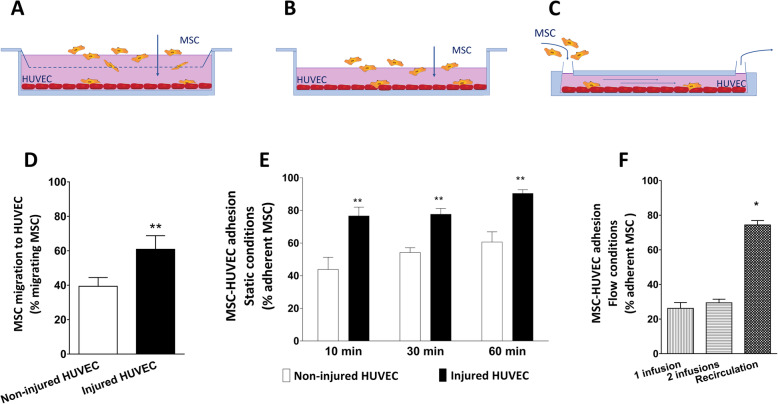
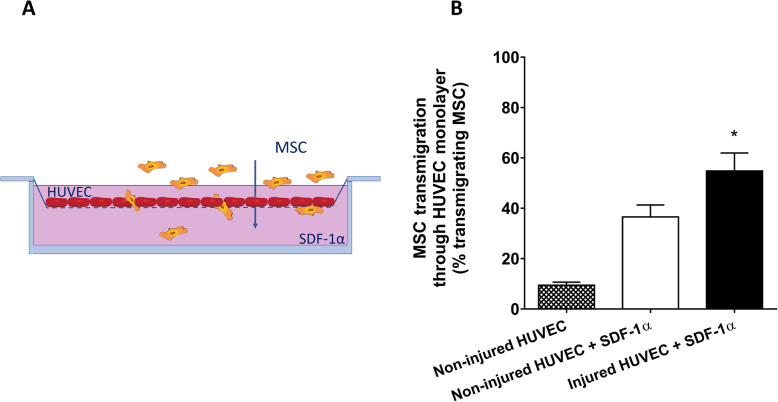
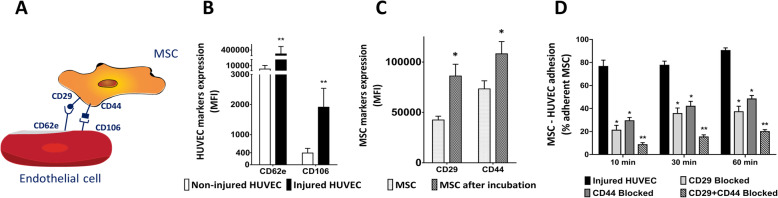
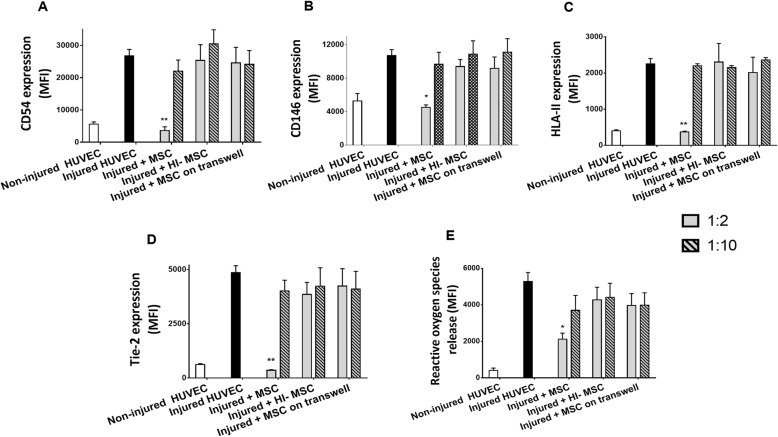
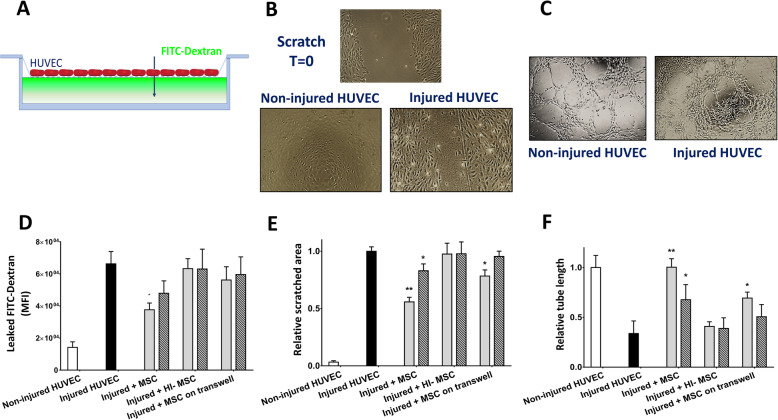
MSC showed increased migration and adhesion to injured HUVEC, mediated by CD29 and CD44 on the MSC membrane. MSC decreased membrane injury marker expression, oxidative stress levels, and monolayer permeability of injured HUVEC, which was observed only when allowing both physical and paracrine interaction between MSC and HUVEC. Furthermore, viable MSC in direct contact with injured HUVEC improved wound healing capacity by 45% and completely restored their angiogenic capacity. In addition, MSC exhibited an increased ability to migrate through an injured HUVEC monolayer compared to non-injured HUVEC in vitro.
These results show that MSC have regenerative effects on injured HUVEC via a mechanism which requires both physical and paracrine interaction. The identification of specific effector molecules involved in MSC-HUVEC interaction will allow targeted modification of MSC to apply and enhance the therapeutic effects of MSC in IRI.
肾脏内皮细胞是捐赠和移植过程中缺血再灌注损伤(IRI)的主要靶点。间充质基质细胞(MSC)已被证明可以改善 IRI 后的肾功能。然而,这是否涉及内皮细胞的修复尚不清楚。因此,我们的目标是研究 MSC 对受损内皮细胞的潜在再生作用,并确定涉及的分子机制。
将人脐静脉内皮细胞(HUVEC)进行缺氧再复氧和 TNF-α处理。为了确定 MSC 对内皮细胞的潜在再生作用是通过 MSC 与内皮细胞的物理相互作用还是通过 MSC 释放的可溶性因子介导的,我们在共培养和 Transwell 条件下以及在缺乏 MSC 分泌因子的条件下进行了剂量反应实验。
MSC 显示出增加的迁移和粘附到受损的 HUVEC,这是由 MSC 膜上的 CD29 和 CD44 介导的。MSC 降低了受损 HUVEC 的膜损伤标志物表达、氧化应激水平和单层通透性,只有当允许 MSC 和 HUVEC 之间进行物理和旁分泌相互作用时,才会观察到这种情况。此外,与受损的 HUVEC 直接接触的活 MSC 可将伤口愈合能力提高 45%,并完全恢复其血管生成能力。此外,MSC 在体外穿过受损的 HUVEC 单层的迁移能力比未受损的 HUVEC 更强。
这些结果表明,MSC 通过一种需要物理和旁分泌相互作用的机制对受损的 HUVEC 具有再生作用。鉴定参与 MSC-HUVEC 相互作用的特定效应分子将允许对 MSC 进行靶向修饰,以应用和增强 MSC 在 IRI 中的治疗效果。