Department of Medicine, University of Zurich, Zurich, Switzerland.
University of Zurich and Department of Consultation-Liaison Psychiatry and Psychosomatic Medicine, University Hospital Zurich, Zurich, Switzerland.
Psychol Med. 2022 May;52(7):1395-1398. doi: 10.1017/S0033291720003128. Epub 2020 Aug 13.
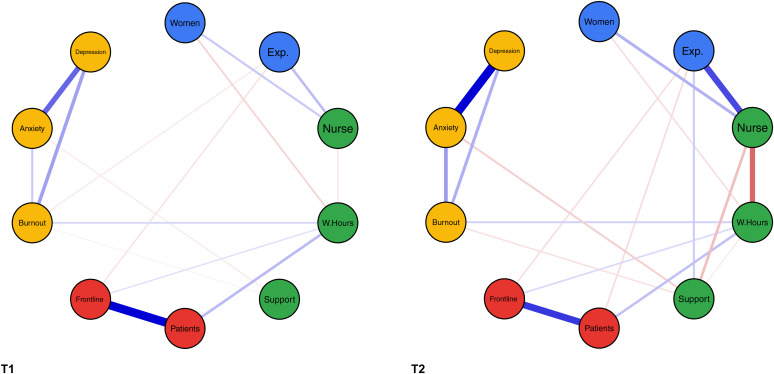
Virus outbreaks such as the current SARS-CoV-2 pandemic are challenging for health care workers (HCWs), affecting their workload and their mental health. Since both, workload and HCW's well-being are related to the quality of care, continuous monitoring of working hours and indicators of mental health in HCWs is of relevance during the current pandemic. The existing investigations, however, have been limited to a single study period. We examined changes in working hours and mental health in Swiss HCWs at the height of the pandemic (T1) and again after its flattening (T2).
We conducted two cross-sectional online studies among Swiss HCWs assessing working hours, depression, anxiety, and burnout. From each study, 812 demographics-matched participants were included into the analysis. Working hours and mental health were compared between the two samples.
Compared to prior to the pandemic, the share of participants working less hours was the same in both samples, whereas the share of those working more hours was lower in the T2 sample. The level of depression did not differ between the samples. In the T2 sample, participants reported more anxiety, however, this difference was below the minimal clinically important difference. Levels of burnout were slightly higher in the T2 sample.
Two weeks after the health care system started to transition back to normal operations, HCWs' working hours still differed from their regular hours in non-pandemic times. Overall anxiety and depression among HCWs did not change substantially over the course of the current SARS-CoV-2 pandemic.
当前的 SARS-CoV-2 大流行等病毒爆发对医护人员(HCWs)构成了挑战,影响了他们的工作量和心理健康。由于工作量和 HCW 的健康状况都与护理质量有关,因此在当前大流行期间,连续监测 HCW 的工作时间和心理健康指标非常重要。然而,现有的调查研究仅限于单个研究期间。我们在大流行高峰期(T1)和大流行缓解后(T2)检查了瑞士 HCW 的工作时间和心理健康变化。
我们在瑞士 HCW 中进行了两项横断面在线研究,评估工作时间、抑郁、焦虑和倦怠。每项研究均纳入了 812 名年龄、性别匹配的参与者进行分析。比较了两个样本之间的工作时间和心理健康状况。
与大流行前相比,两个样本中工作时间较少的参与者比例相同,而 T2 样本中工作时间较多的参与者比例较低。两个样本的抑郁水平没有差异。在 T2 样本中,参与者报告的焦虑程度更高,但这一差异低于最小临床重要差异。T2 样本的倦怠程度略高。
在医疗保健系统开始恢复正常运作两周后,HCW 的工作时间仍与非大流行时期的正常工作时间不同。在当前的 SARS-CoV-2 大流行期间,HCW 的总体焦虑和抑郁并未发生实质性变化。