Richter Romy, Giroldi Esther, Jansen Jesse, van der Weijden Trudy
Department of Family Medicine, School Care and Public Health Research Institute (CAPHRI), Faculty of Health Medicine and Life Sciences (FHML), Maastricht University, Maastricht, Limburg, Netherlands.
Department of Educational Development and Research, School of Health Professions Education (SHE), Faculty of Health Medicine and Life Sciences (FHML), Maastricht University, Maastricht, Limburg, Netherlands.
PLoS One. 2020 Aug 13;15(8):e0236751. doi: 10.1371/journal.pone.0236751. eCollection 2020.
Risk communication, situated in the model of shared decision making (SDM), is an essential element in daily clinical practice. The scientific literature makes a number of generic recommendations. Yet the application of risk communication remains a challenge in patient-clinician encounters. How clinicians actually communicate risk during consultations is not well understood. We aimed to explore the risk communication strategies used by clinicians and extract narratives and visualizations of those strategies to help inform medical education.
In this qualitative descriptive study, we interviewed fifteen purposely sampled clinicians from several medical disciplines, who were familiar with the concept of SDM. Deductive and inductive content analysis was used during an iterative data collection and analyses process.
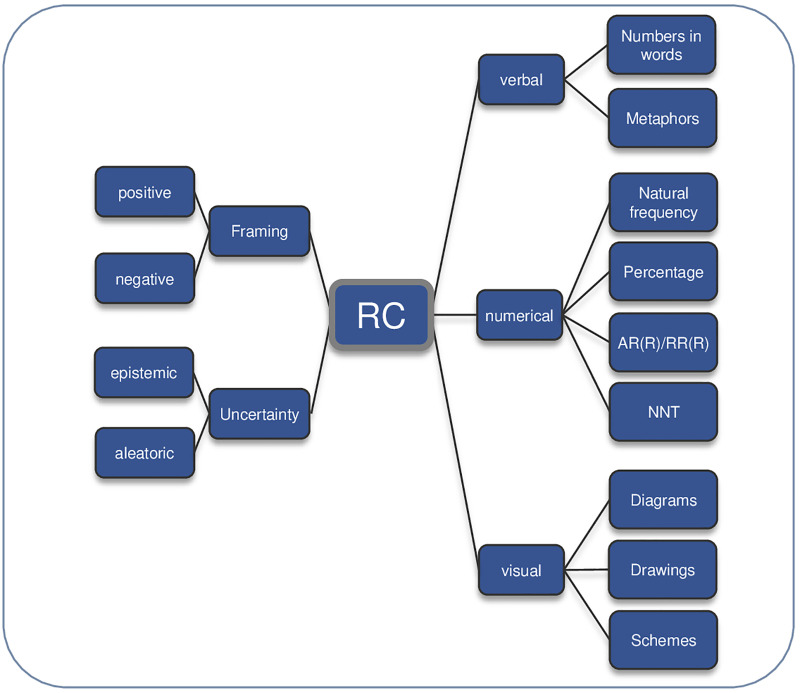
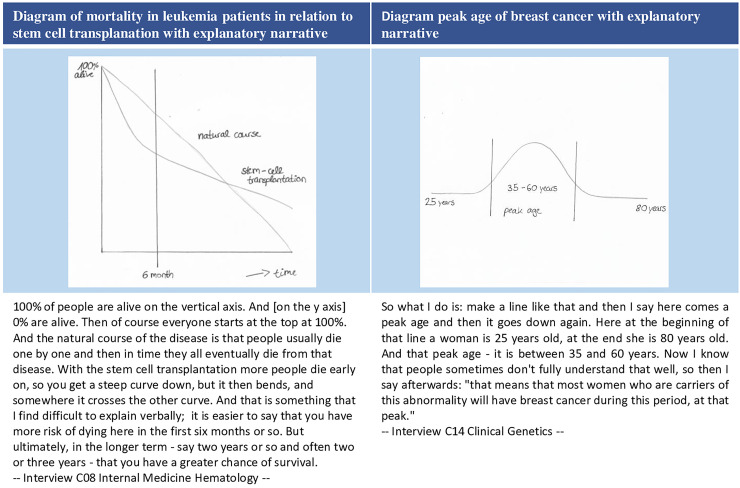
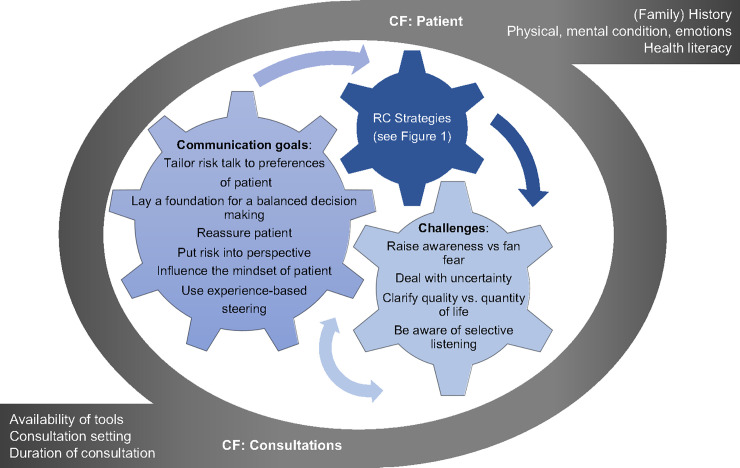
Our study identified various strategies reported to be used by clinicians to address the complexities of risk communication such as dealing with uncertainty. These included verbal, numerical and visual risk communication and framing. Clinicians were familiar with recommended risk formats such as natural frequencies and population pictograms. However, it became clear that clinicians' expertise and communication goals also play an important role in the risk talk. Clinicians try to lay a foundation for balanced decision-making and to incorporate patient preferences while faced with several challenges such as the dilemma of raising awareness but triggering anxiety or fan fear in patients. Consequently, they also use communication goals such as influencing mindset and reassuring patients. Additionally, clinicians frequently have to account for the illusion of certainty in the risk talk.
Risk communication is a multi-faceted construct that cannot be dealt with in isolation from the clinical context. For future research we recommend considering a more practical framework within the clinical setting and to take a goal-directed approach into account when investigating and teaching the topic. The patient perspective should also be addressed in further research.
风险沟通是共享决策模式(SDM)的一部分,是日常临床实践中的一个重要元素。科学文献提出了一些一般性建议。然而,风险沟通在医患交流中的应用仍然是一个挑战。临床医生在会诊期间实际如何沟通风险尚不清楚。我们旨在探索临床医生使用的风险沟通策略,并提取这些策略的叙述和可视化内容,以帮助医学教育。
在这项定性描述性研究中,我们采访了15名从几个医学学科中特意挑选出来的临床医生,他们熟悉共享决策的概念。在迭代的数据收集和分析过程中使用了演绎和归纳内容分析。
我们的研究确定了临床医生报告使用的各种策略,以应对风险沟通的复杂性,如处理不确定性。这些策略包括口头、数字和视觉风险沟通以及框架构建。临床医生熟悉推荐的风险形式,如自然频率和群体象形图。然而,很明显,临床医生的专业知识和沟通目标在风险谈话中也起着重要作用。临床医生试图为平衡决策奠定基础,并在面对提高患者意识但引发焦虑或恐惧等挑战时纳入患者偏好。因此,他们还使用影响思维方式和安抚患者等沟通目标。此外,临床医生在风险谈话中经常不得不考虑确定性的错觉。
风险沟通是一个多方面的概念,不能脱离临床背景单独处理。对于未来的研究,我们建议在临床环境中考虑一个更实用的框架,并在研究和教授该主题时考虑采用目标导向的方法。患者的观点也应在进一步的研究中得到探讨。