Department of ELIZA (Primary and Interdisciplinary Care), University of Antwerp, Antwerpen, Belgium.
PLoS One. 2020 Aug 13;15(8):e0237629. doi: 10.1371/journal.pone.0237629. eCollection 2020.
During the COVID-19 pandemic, general practitioners worldwide re-organise care in very different ways because of the lack of evidence-based protocols.
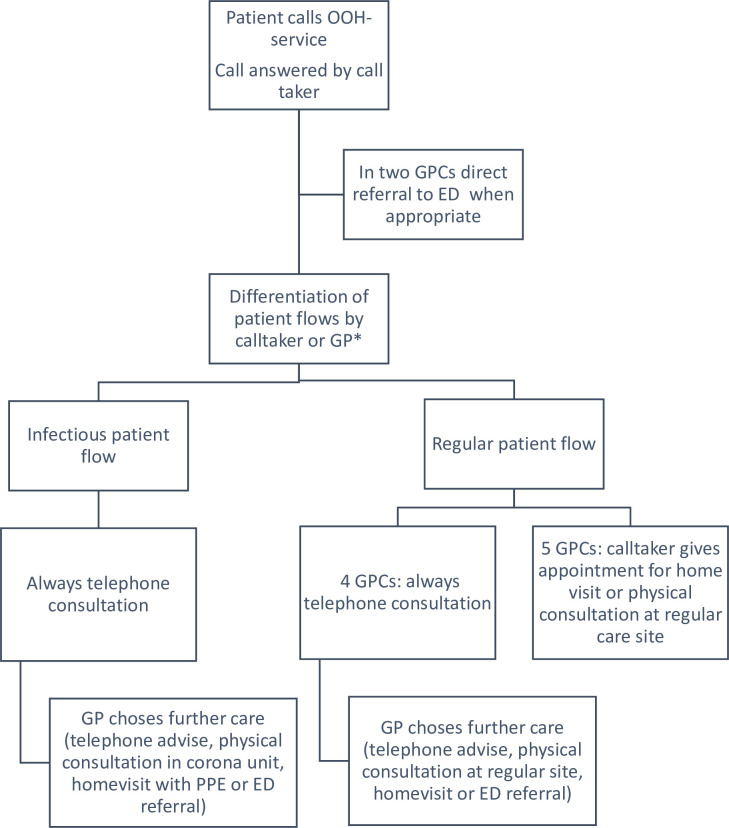
This paper describes the organisation and the characteristics of consultations in Belgian out-of-hours primary care during five weekends at the peak of a COVID-19 outbreak and compares it to a similar period in 2019.
Real-time observational study using pseudonymised routine clinical data extracted out of reports from home visits, telephone- and physical consultations (iCAREdata). Nine general practice cooperatives (GPCs) participated covering a population of 1 513 523.
All GPCs rapidly re-organised care in order to handle the outbreak and provide a safe working environment. The average consultation rate was 222 per 100 000 citizens per weekend. These consultations were handled by telephone alone in 40% (N = 6293). A diagnosis at risk of COVID-19 was registered in 6692 (43%) consultations,. Out of 5311 physical consultations, 1460 were at risk of COVID-19 of which 443 (30%) did not receive prior telephone consultation to estimate this risk. Compared to 2019, the workload initially increased due to telephone consultations but afterwards declined drastically. The physical consultation rate declined by 45% with a marked decline in diagnoses unrelated to COVID-19.
General practitioners can rapidly re-organise out-of-hours care to handle patient flows during a COVID-19 outbreak. Forty percent of the out-of-hours primary care contacts are handled by telephone consultations alone. We recommend to give a telephone consultation to all patients and not to rely on call takers to differentiate between infectious and regular care. The demand for physical consultations declined drastically provoking questions about patient's safety for care unrelated to COVID-19.
在 COVID-19 大流行期间,由于缺乏基于证据的方案,全球的全科医生以非常不同的方式重新组织医疗服务。
本文描述了在 COVID-19 疫情高峰期的五个周末期间,比利时非工作时间初级保健中咨询的组织和特点,并将其与 2019 年的类似时期进行了比较。
使用从家庭访问、电话和身体咨询报告中提取的假名化常规临床数据实时观察性研究(iCAREdata)。9 个全科医生合作组织(GPC)参与了研究,覆盖了 1 513 523 名居民。
所有 GPC 都迅速重新组织了医疗服务,以应对疫情并提供安全的工作环境。平均每个周末的咨询率为每 10 万居民 222 次。这些咨询中有 40%(N = 6293)仅通过电话处理。在 6692 次咨询中记录了有 COVID-19 风险的诊断,在 5311 次身体咨询中,有 1460 次有 COVID-19 风险,其中 443 次(30%)没有进行事先的电话咨询来评估这种风险。与 2019 年相比,由于电话咨询,工作量最初有所增加,但后来急剧下降。身体咨询率下降了 45%,与 COVID-19 无关的诊断明显减少。
全科医生可以迅速重新组织非工作时间的医疗服务,以应对 COVID-19 疫情期间的患者流量。40%的非工作时间初级保健接触通过电话咨询单独处理。我们建议给所有患者打电话咨询,而不是依赖接线员来区分传染病和常规护理。对身体咨询的需求急剧下降,引发了关于与 COVID-19 无关的护理的患者安全问题。