Department of Epidemiology, Emory University School of Public Health, Atlanta, GA.
Department of Epidemiology, Emory University School of Public Health, Atlanta, GA.
Ann Epidemiol. 2020 Sep;49:50-60. doi: 10.1016/j.annepidem.2020.07.015. Epub 2020 Aug 11.
The U.S. response to the SARS-CoV-2 epidemic has been hampered by early and ongoing delays in testing for infection; without data on where infections were occurring and the magnitude of the epidemic, early public health responses were not data-driven. Understanding the prevalence of SARS-CoV-2 infections and immune response is critical to developing and implementing effective public health responses. Most serological surveys have been limited to localities that opted to conduct them and/or were based on convenience samples. Moreover, results of antibody testing might be subject to high false positive rates in the setting of low prevalence of immune response and imperfect test specificity.
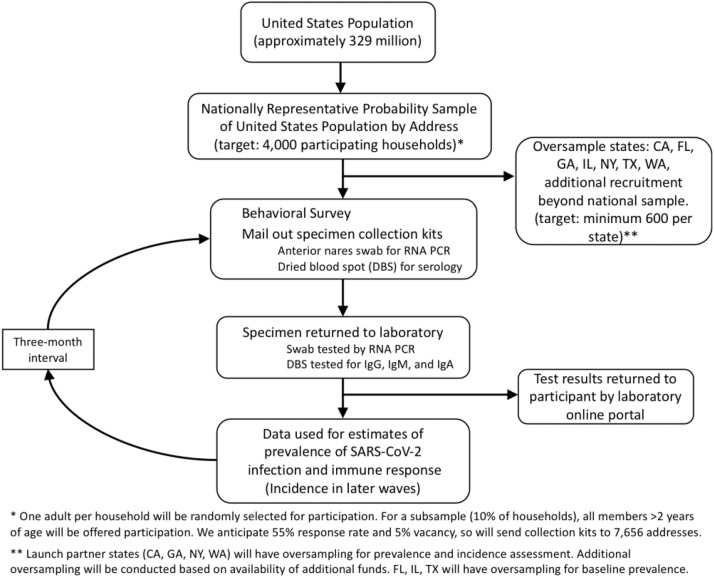
We will conduct a national serosurvey for SARS-CoV-2 PCR positivity and immune experience. A probability sample of U.S. addresses will be mailed invitations and kits for the self-collection of anterior nares swab and finger prick dried blood spot specimens. Within each sampled household, one adult 18 years or older will be randomly selected and asked to complete a questionnaire and to collect and return biological specimens to a central laboratory. Nasal swab specimens will be tested for SARS-CoV-2 RNA by RNA PCR; dried blood spot specimens will be tested for antibodies to SARS-CoV-2 (i.e., immune experience) by enzyme-linked immunoassays. Positive screening tests for antibodies will be confirmed by a second antibody test with different antigenic basis to improve predictive value of positive (PPV) antibody test results. All persons returning specimens in the baseline phase will be enrolled into a follow-up cohort and mailed additional specimen collection kits 3 months after baseline. A subset of 10% of selected households will be invited to participate in full household testing, with tests offered for all household members aged ≥3 years. The main study outcomes will be period prevalence of infection with SARS-CoV-2 and immune experience, and incidence of SARS-CoV-2 infection and antibody responses.
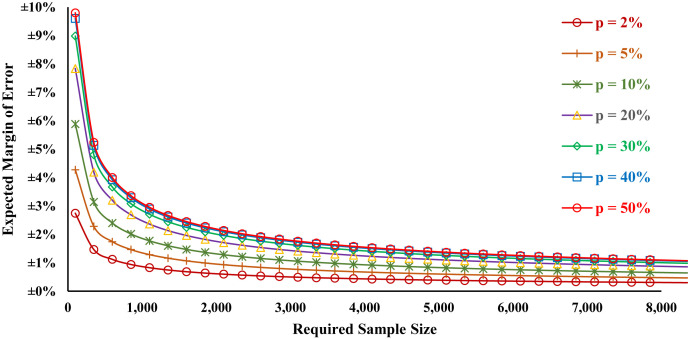
Power calculations indicate that a national sample of 4000 households will facilitate estimation of national SARS-CoV-2 infection and antibody prevalence with acceptably narrow 95% confidence intervals across several possible scenarios of prevalence levels. Oversampling in up to seven populous states will allow for prevalence estimation among subpopulations. Our 2-stage algorithm for antibody testing produces acceptable PPV at prevalence levels ≥1.0%. Including oversamples in states, we expect to receive data from as many as 9156 participants in 7495 U.S. households.
In addition to providing robust estimates of prevalence of SARS-CoV-2 infection and immune experience, we anticipate this study will establish a replicable methodology for home-based SARS-CoV-2 testing surveys, address concerns about selection bias, and improve positive predictive value of serology results. Prevalence estimates of SARS-CoV-2 infection and immune experience produced by this study will greatly improve our understanding of the spectrum of COVID-19 disease, its current penetration in various demographic, geographic, and occupational groups, and inform the range of symptoms associated with infection. These data will inform resource needs for control of the ongoing epidemic and facilitate data-driven decisions for epidemic mitigation strategies.
美国对 SARS-CoV-2 疫情的反应受到早期和持续的感染检测延迟的阻碍;由于缺乏感染发生地点和疫情严重程度的数据,早期的公共卫生应对措施并非基于数据。了解 SARS-CoV-2 感染和免疫反应的流行情况对于制定和实施有效的公共卫生应对措施至关重要。大多数血清学调查仅限于选择进行调查的地点和/或基于方便样本。此外,抗体检测的结果可能受到低免疫反应流行率和不完善的测试特异性的高假阳性率的影响。
我们将对 SARS-CoV-2 的 PCR 阳性率和免疫经验进行全国性血清学调查。将通过邮件向美国地址的概率样本发送邀请和套件,以自行采集前鼻腔拭子和指尖干血斑样本。在每个抽样家庭中,将随机选择一名 18 岁或以上的成年人,并要求其完成问卷调查,并将生物样本收集并送回中央实验室。通过 RNA PCR 检测鼻腔拭子样本中的 SARS-CoV-2 RNA;通过酶联免疫吸附试验检测干血斑样本中针对 SARS-CoV-2 的抗体(即免疫经验)。通过具有不同抗原基础的第二种抗体测试来确认对抗体的阳性筛选测试,以提高阳性(PPV)抗体测试结果的预测值。在基线阶段返回标本的所有人将被纳入随访队列,并在基线后 3 个月再次邮寄额外的标本采集套件。将邀请所选家庭的 10%作为一个亚组,为所有 3 岁及以上的家庭成员提供检测。主要研究结果将是 SARS-CoV-2 感染和免疫经验的时期流行率,以及 SARS-CoV-2 感染和抗体反应的发病率。
计算能力表明,全国 4000 户家庭的抽样将有助于在几种可能的流行率水平下,以可接受的窄 95%置信区间估计全国 SARS-CoV-2 感染和抗体流行率。在人口最多的七个州进行超额抽样将允许在亚人群中进行流行率估计。我们的抗体检测两阶段算法在流行率水平≥1.0%时产生可接受的 PPV。包括在各州的抽样,我们预计将从 7495 个美国家庭的 9156 名参与者那里获得数据。
除了提供 SARS-CoV-2 感染和免疫经验流行率的可靠估计外,我们预计这项研究还将建立一种基于家庭的 SARS-CoV-2 检测调查的可复制方法,解决对选择偏差的担忧,并提高血清学结果的阳性预测值。这项研究产生的 SARS-CoV-2 感染和免疫经验的流行率估计将极大地提高我们对 COVID-19 疾病谱的理解,以及它在各种人口统计学、地理和职业群体中的当前渗透程度,并为感染相关症状提供信息。这些数据将为控制正在进行的疫情提供资源需求,并为缓解疫情策略的数据驱动决策提供信息。