Department of Urology, Tianjin Institute of Urology, The Second Hospital of Tianjin Medical University, Tianjin, 300211, China.
World J Surg Oncol. 2020 Aug 13;18(1):201. doi: 10.1186/s12957-020-01977-7.
To estimate the prognostic value of positive surgical margins (PSM) location and perineural invasion (PNI) for biochemical recurrence (BCR) in patients undergoing radical prostatectomy (RP).
All men with prostate cancer (PCa) who received RP in the second hospital of Tianjin Medical University from 2014 to 2018 were retrospectively identified. All patients met the following criteria: no neoadjuvant or adjuvant treatment, absence of lymph node invasion, or distant metastasis confirmed by surgery or imaging. Comparisons were made between cases with only apex positive (AM), isolated nonapical positive (OM), multiple positive (MM), and negative surgical margins (NSM). Patients were also subdivided according to the Gleason score and pathological tumor stage for analysis.
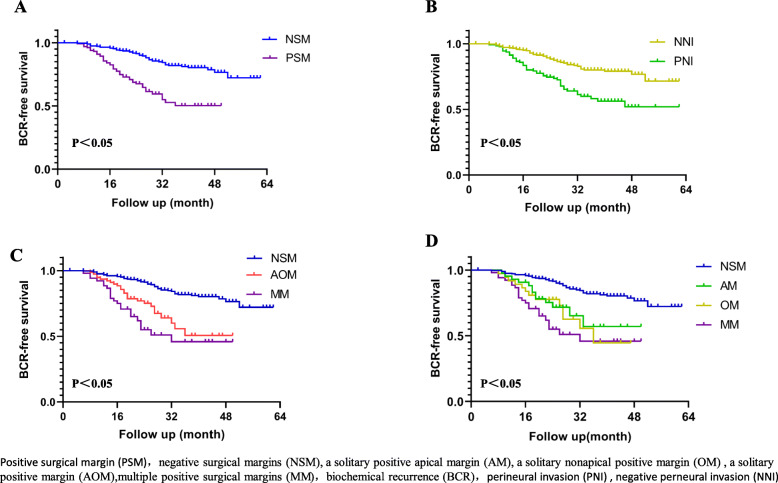
A total of 416 patients available for analysis, of which 132 (31.7%) were PSM, 43 were AM, 37 were OM, and 52 were MM at a median follow-up of 27 months. The PNI was in 30.5% of patients. BCR occurred in 22.6% of patients during follow-up. Both AM and MM were noticed to be independent predictors of BCR with a hazard ratio of 4.192 (95% CI 2.185-8.042; p < 0.001) and 2.758 (95% CI 1.559-4.880; p < 0.001), respectively, when compared to NSM. Though the correlation was significant in univariate analysis, PNI was not an independent risk factor for BCR (p = 0.369). Subgroup analyses suggested that MM was not particularly predictive for BCR in the Gleason score < 8. The hole Cox regression model for the C-index was 0.843 CONCLUSIONS: PSM location was a significant independent predictor of BCR in PCa, especially in patients with AM or MM, while PNI is a non-independent risk factor. Compared with other locations, AM has a higher BCR risk.
评估前列腺癌根治术后(RP)切缘阳性(PSM)位置和神经周围侵犯(PNI)对生化复发(BCR)的预后价值。
回顾性分析 2014 年至 2018 年在天津医科大学第二医院接受 RP 的所有前列腺癌(PCa)患者。所有患者均符合以下标准:无新辅助或辅助治疗、手术或影像学证实无淋巴结侵犯或远处转移。对仅尖端阳性(AM)、孤立非尖端阳性(OM)、多处阳性(MM)和阴性切缘(NSM)的病例进行比较。根据 Gleason 评分和病理肿瘤分期对患者进行亚组分析。
共纳入 416 例可分析患者,其中 132 例(31.7%)为 PSM,43 例为 AM,37 例为 OM,52 例为 MM,中位随访时间为 27 个月。30.5%的患者存在 PNI。随访期间 22.6%的患者发生 BCR。AM 和 MM 均被认为是 BCR 的独立预测因素,风险比分别为 4.192(95%CI 2.185-8.042;p<0.001)和 2.758(95%CI 1.559-4.880;p<0.001),与 NSM 相比。虽然单因素分析相关性显著,但 PNI 不是 BCR 的独立危险因素(p=0.369)。亚组分析表明,在 Gleason 评分<8 时,MM 对 BCR 无特别预测作用。C 指数的全 Cox 回归模型为 0.843。
PSM 位置是 PCa 患者 BCR 的重要独立预测因素,尤其是 AM 或 MM 患者,而 PNI 是非独立危险因素。与其他部位相比,AM 有更高的 BCR 风险。