Tatschl Josef M, Hochfellner Sigurd M, Schwerdtfeger Andreas R
Health Psychology Unit, Institute of Psychology, University of Graz, Graz, Austria.
Privatklinik St. Radegund Betriebs GmbH, St. Radegund, Austria.
Front Neurosci. 2020 Jul 21;14:738. doi: 10.3389/fnins.2020.00738. eCollection 2020.
New treatment options for depression are warranted, due to high recurrence rates. Recent research indicates benefits of heart rate variability biofeedback (HRVBF) on symptom recovery and autonomic functioning in depressed individuals. Slow-paced breathing-induced amplification of vagus nerve activity is the main element of HRVBF. Thus, the latter represents a safe and non-invasive complementary depression treatment. However, its efficacy in patients undergoing inpatient psychiatric rehabilitation receiving highly comprehensive treatments has not been evaluated.
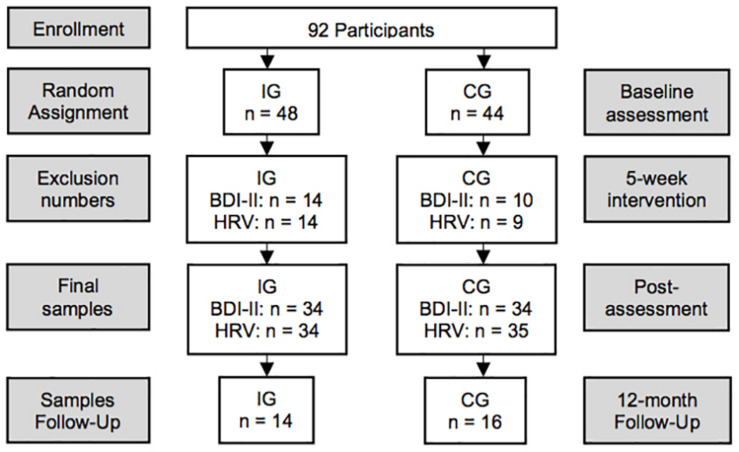
Ninety-two inpatients were randomly assigned to an intervention group (IG) or control group (CG). While the latter received the standard treatment only, adjunctive HRVBF was provided to the IG over 5 weeks. Depression severity and heart rate variability (HRV) were assessed before (pre) and after 5 weeks (post). Moreover, 1-year follow-up depression scores were available for 30 participants.
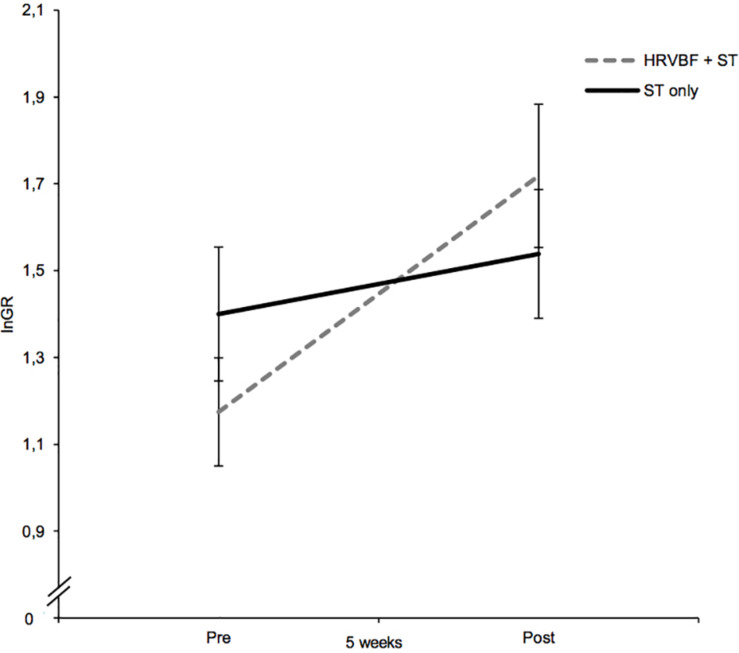
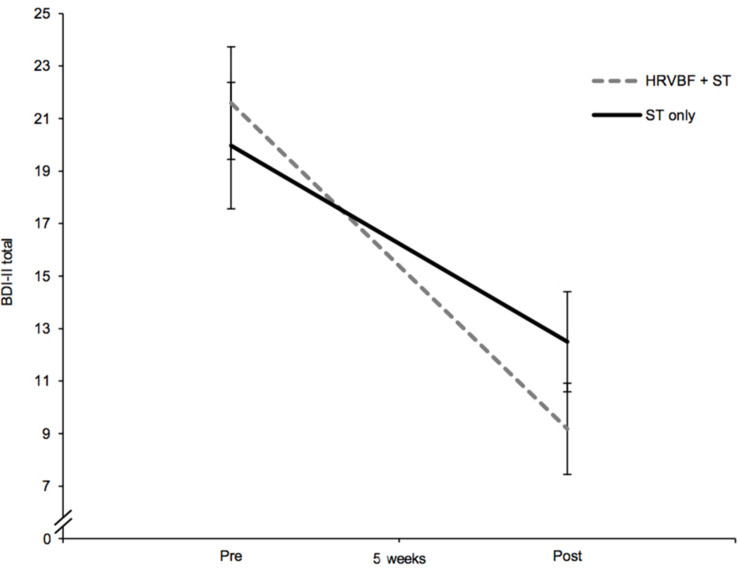
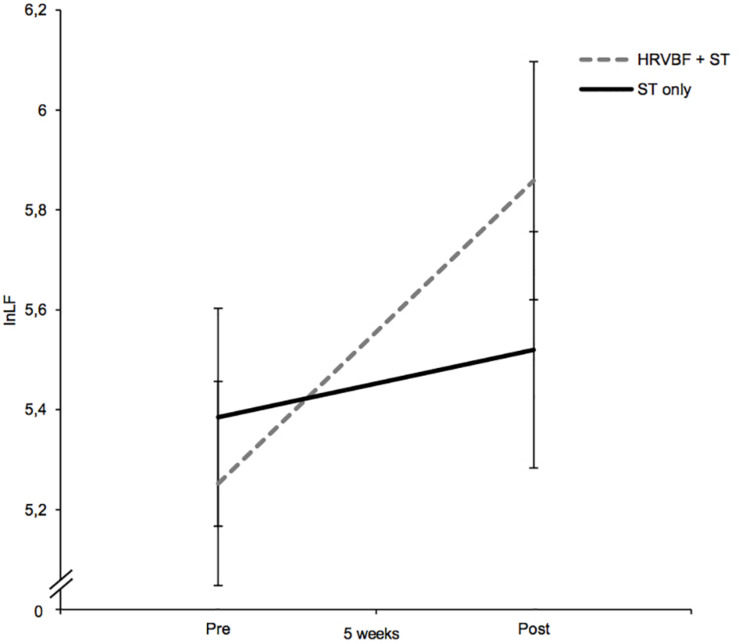
Although depression improved in both groups, the IG exhibited significantly larger improvements at post-assessment ( = 0.065) and significant increases in resting LF-HRV ( = 0.45) and cardiorespiratory coherence ( = 0.61). No significant effects for RMSSD, SDNN, HF-HRV, or HR were found (s > 0.05). Additionally, the IG showed a medium- to large-sized reduction in resting respiratory rate from 13.2 to 9.8 breaths per minute ( < 0.001, = 0.86), with the CG exhibiting only a small decrease from 13.5 to 12.4 ( = 0.49; = 0.35). While the IG exhibited significantly lower depression scores at post-assessment ( = 0.042, = 0.79), this effect decreased during follow-up ( = 0.195, = 0.48).
HRVBF as adjuvant therapy during inpatient psychiatric rehabilitation facilitated depression recovery. Additionally, amplified LF-HRV as well as cardiorespiratory coherence at rest and a decrease in resting breathing frequency was observed in the HRVBF group. These findings emphasize HRVBF's value as complementary therapy regardless of concurrent treatments. Moreover, these incremental benefits could serve as resource even after the actual training period. However, the additional antidepressant gains vanish during the long-term follow-up, indicating the need for more intense training or regular practice afterward, respectively. Thus, future studies are warranted to examine how the initial benefits of HRVBF during inpatient psychiatric rehabilitation can be preserved post discharge.
由于抑郁症复发率高,因此需要新的治疗方案。最近的研究表明,心率变异性生物反馈(HRVBF)对抑郁症患者的症状恢复和自主神经功能有益。慢节奏呼吸引起的迷走神经活动增强是HRVBF的主要要素。因此,HRVBF是一种安全、无创的辅助抑郁症治疗方法。然而,其在接受高度综合治疗的住院精神科康复患者中的疗效尚未得到评估。
92名住院患者被随机分配到干预组(IG)或对照组(CG)。对照组仅接受标准治疗,干预组在5周内接受辅助HRVBF治疗。在治疗前(pre)和5周后(post)评估抑郁严重程度和心率变异性(HRV)。此外,30名参与者有1年的随访抑郁评分。
虽然两组的抑郁症状均有所改善,但干预组在评估后表现出显著更大的改善(P = 0.065),静息低频HRV(P = 0.45)和心肺协调性显著增加(P = 0.61)。未发现RMSSD、SDNN、高频HRV或心率有显著影响(P>0.05)。此外,干预组静息呼吸频率从每分钟13.2次大幅降至9.8次(P<0.001,Cohen's d = 0.86),而对照组仅从13.5次小幅降至12.4次(P = 0.49;Cohen's d = 0.35)。虽然干预组在评估后抑郁评分显著较低(P = 0.042,Cohen's d = 0.79),但这种效果在随访期间有所下降(P = 0.195,Cohen's d = 0.48)。
HRVBF作为住院精神科康复期间的辅助治疗有助于抑郁症的恢复。此外,在HRVBF组中观察到静息低频HRV以及心肺协调性增强,静息呼吸频率降低。这些发现强调了HRVBF作为辅助治疗的价值,无论同时进行何种治疗。此外,即使在实际训练期之后,这些额外的益处也可作为一种资源。然而,在长期随访中,额外的抗抑郁效果消失,这表明分别需要更强化的训练或后续的定期练习。因此,有必要进行未来的研究,以探讨如何在出院后保留HRVBF在住院精神科康复期间的初始益处。