Köhler-Forsberg Kristin, Jorgensen Anders, Dam Vibeke H, Stenbæk Dea Siggaard, Fisher Patrick M, Ip Cheng-Teng, Ganz Melanie, Poulsen Henrik Enghusen, Giraldi Annamaria, Ozenne Brice, Jørgensen Martin Balslev, Knudsen Gitte Moos, Frokjaer Vibe Gedsoe
Neurobiology Research Unit, Copenhagen University Hospital, Rigshospitalet, Copenhagen, Denmark.
Department of Clinical Medicine, Faculty of Health and Medical Sciences, University of Copenhagen, Copenhagen, Denmark.
Front Psychiatry. 2020 Jul 23;11:641. doi: 10.3389/fpsyt.2020.00641. eCollection 2020.
Between 30 and 50% of patients with major depressive disorder (MDD) do not respond sufficiently to antidepressant regimens. The conventional pharmacological treatments predominantly target serotonergic brain signaling but better tools to predict treatment response and identify relevant subgroups of MDD are needed to support individualized and mechanistically targeted treatment strategies. The aim of this study is to investigate antidepressant-free patients with MDD using neuroimaging, electrophysiological, molecular, cognitive, and clinical examinations and evaluate their ability to predict clinical response to SSRI treatment as individual or combined predictors.
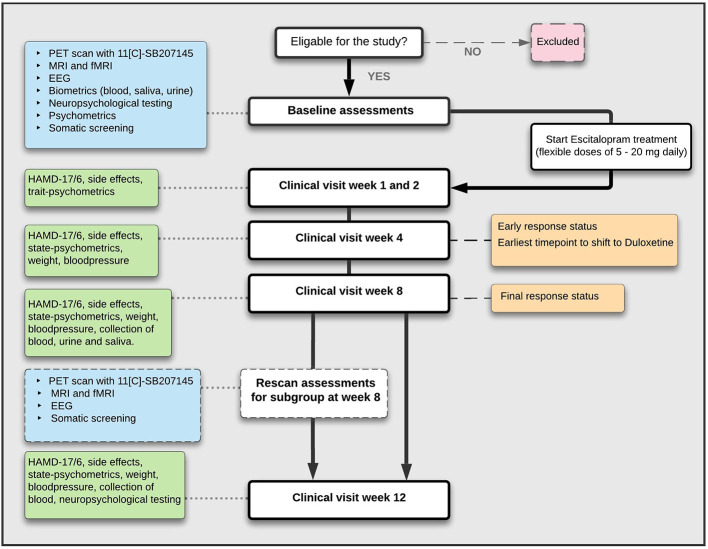
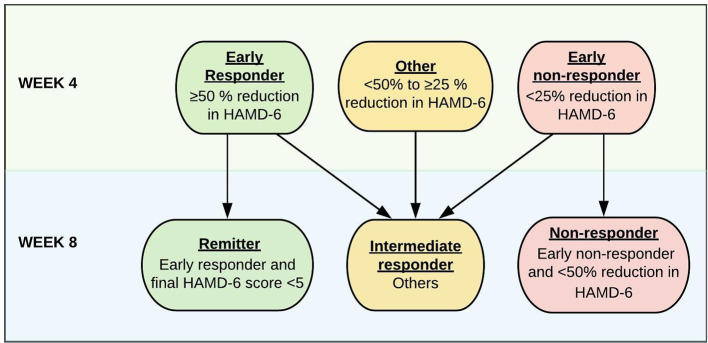
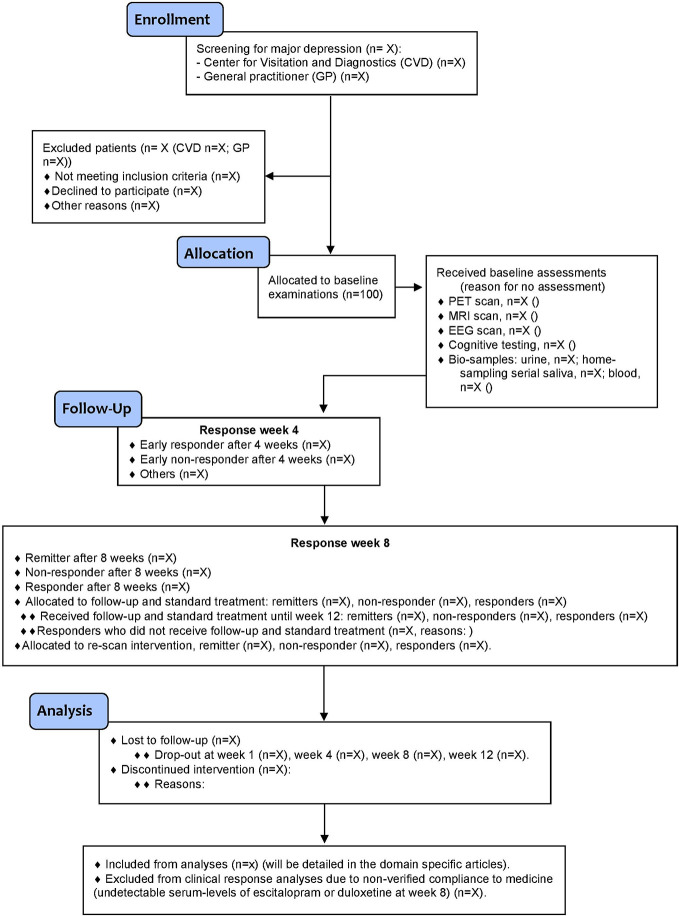
We will include 100 untreated patients with moderate to severe depression (>17 on the Hamilton Depression Rating Scale 17) in a non-randomized open clinical trial. We will collect data from serotonin 4 receptor positron emission tomography (PET) brain scans, functional magnetic resonance imaging (fMRI), electroencephalogram (EEG), cognitive tests, psychometry, and peripheral biomarkers, before (at baseline), during, and after 12 weeks of standard antidepressant treatment. Patients will be treated with escitalopram, and in case of non-response at week 4 or intolerable side effects, offered to switch to a second line treatment with duloxetine. Our primary outcome (treatment response) is assessed using the Hamilton depression rating subscale 6-item scores at week 8, compared to baseline. In a subset of the patients (n = ~40), we will re-assess the neurobiological response (using PET, fMRI, and EEG) 8 weeks after initiated pharmacological antidepressant treatment, to map neurobiological signatures of treatment responses. Data from matched controls will either be collected or is already available from other cohorts.
The extensive investigational program with follow-up in this large cohort of participants provides a unique possibility to (a) uncover potential biomarkers for antidepressant treatment response, (b) apply the findings for future stratification of MDD, (c) advance the understanding of pathophysiological underpinnings of MDD, and (d) uncover how putative biomarkers change in response to 8 weeks of pharmacological antidepressant treatment. Our data can pave the way for a precision medicine approach for optimized treatment of MDD and also provides a resource for future research and data sharing.
The study was registered at clinicaltrials.gov prior to initiation (NCT02869035; 08.16.2016, URL: https://clinicaltrials.gov/ct2/results?cond=&term=NCT02869035&cntry=&state=&city=&dist=).
30%至50%的重度抑郁症(MDD)患者对抗抑郁治疗方案反应欠佳。传统的药物治疗主要针对血清素能脑信号传导,但需要更好的工具来预测治疗反应并识别MDD的相关亚组,以支持个体化和基于机制的靶向治疗策略。本研究的目的是对未服用抗抑郁药的MDD患者进行神经影像学、电生理学、分子、认知和临床检查,并评估其作为个体或联合预测指标预测对SSRI治疗临床反应的能力。
我们将在一项非随机开放临床试验中纳入100名未接受治疗的中度至重度抑郁症患者(汉密尔顿抑郁量表评分>17)。我们将在标准抗抑郁治疗的12周前(基线时)、治疗期间和治疗后,收集来自血清素4受体正电子发射断层扫描(PET)脑扫描、功能磁共振成像(fMRI)、脑电图(EEG)、认知测试、心理测量和外周生物标志物的数据。患者将接受艾司西酞普兰治疗,若在第4周无反应或出现无法耐受的副作用,则改用度洛西汀进行二线治疗。我们的主要结局(治疗反应)在第8周时使用汉密尔顿抑郁量表6项评分子量表进行评估,并与基线进行比较。在一部分患者(n = ~40)中,我们将在开始药物抗抑郁治疗8周后重新评估神经生物学反应(使用PET、fMRI和EEG),以描绘治疗反应的神经生物学特征。匹配对照的数据将从其他队列中收集或已经可用。
在这一大型参与者队列中进行的广泛研究计划及随访提供了独特的可能性,即(a)发现抗抑郁治疗反应的潜在生物标志物,(b)将研究结果应用于未来MDD的分层,(c)加深对MDD病理生理基础的理解,以及(d)揭示假定的生物标志物如何因8周的药物抗抑郁治疗而发生变化。我们的数据可为优化MDD治疗的精准医学方法铺平道路,也为未来的研究和数据共享提供资源。
该研究在启动前已在clinicaltrials.gov注册(NCT02869035;2016年8月16日,网址:https://clinicaltrials.gov/ct2/results?cond=&term=NCT02869035&cntry=&state=&city=&dist=)。