Center for Vaccine Development and Global Health, University of Maryland School of Medicine , Baltimore, MD, USA.
Department of Medicine, Division of Gastroenterology and Hepatology, Johns Hopkins University School of Medicine , Baltimore, MD, USA.
Gut Microbes. 2020 Nov 9;12(1):1795492. doi: 10.1080/19490976.2020.1795389.
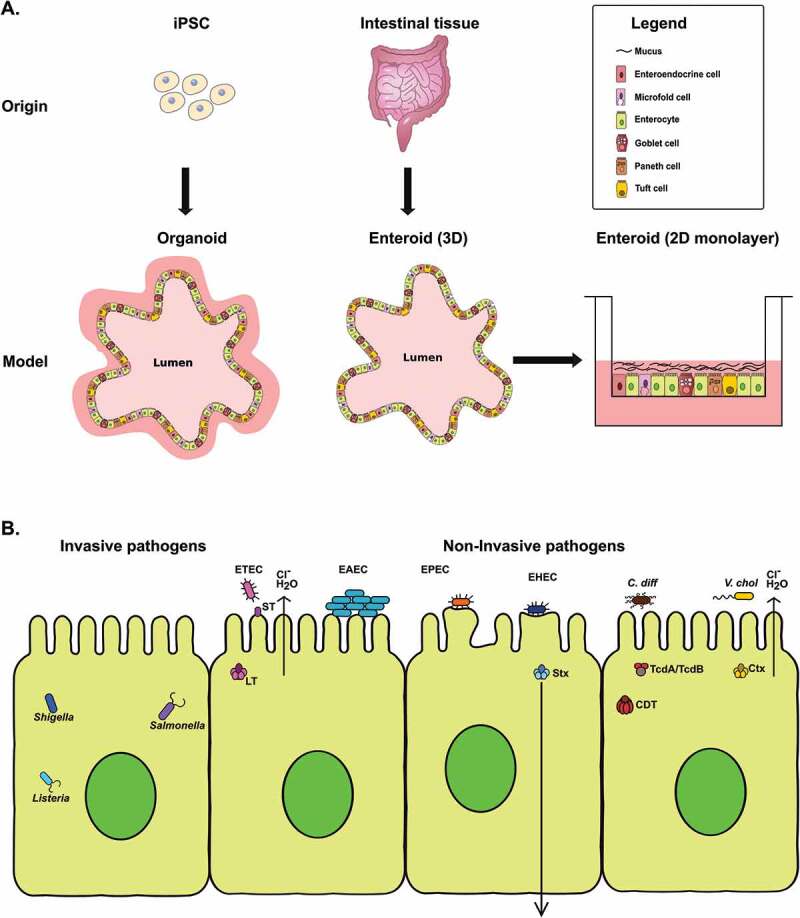
Enteric bacterial pathogens cause significant morbidity and mortality globally. Studies in tissue culture and animal models shaped our initial understanding of these host-pathogen interactions. However, intrinsic shortcomings in these models limit their application, especially in translational applications like drug screening and vaccine development. Human intestinal enteroid and organoid models overcome some limitations of existing models and advance the study of enteric pathogens. In this review, we detail the use of human enteroids and organoids to investigate the pathogenesis of invasive bacteria , and , and noninvasive bacteria pathogenic , and . We highlight how these studies confirm previously identified mechanisms and, importantly, reveal novel ones. We also discuss the challenges for model advancement, including platform engineering to integrate environmental conditions, innate immune cells and the resident microbiome, and the potential for pre-clinical testing of recently developed antimicrobial drugs and vaccines.
肠细菌病原体在全球范围内造成了很大的发病率和死亡率。在组织培养和动物模型中的研究塑造了我们对这些宿主-病原体相互作用的初步理解。然而,这些模型固有的缺陷限制了它们的应用,特别是在药物筛选和疫苗开发等转化应用中。人类肠道类器官和类器官模型克服了现有模型的一些局限性,并推进了对肠病原体的研究。在这篇综述中,我们详细介绍了人类类肠和类器官在研究侵袭性细菌和非侵袭性细菌的发病机制中的应用。我们强调了这些研究如何证实先前确定的机制,以及重要的是,揭示新的机制。我们还讨论了模型发展的挑战,包括整合环境条件、先天免疫细胞和常驻微生物组的平台工程,以及最近开发的抗菌药物和疫苗的临床前测试的潜力。