Department of Paediatrics, Medisch Spectrum Twente, Enschede, Netherlands.
Department of Biomedical Signals and Systems, University of Twente, Enschede, Netherlands.
BMC Med Inform Decis Mak. 2020 Aug 14;20(1):192. doi: 10.1186/s12911-020-01210-1.
Asthma is one of the most common chronic diseases in childhood. Regular follow-up of physiological parameters in the home setting, in relation to asthma symptoms, can provide complementary quantitative insights into the dynamics of the asthma status. Despite considerable interest in asthma home-monitoring in children, there is a paucity of scientific evidence, especially on multi-parameter monitoring approaches. Therefore, the aim of this study is to investigate whether asthma control can be accurately assessed in the home situation by combining parameters from respiratory physiology sensors.
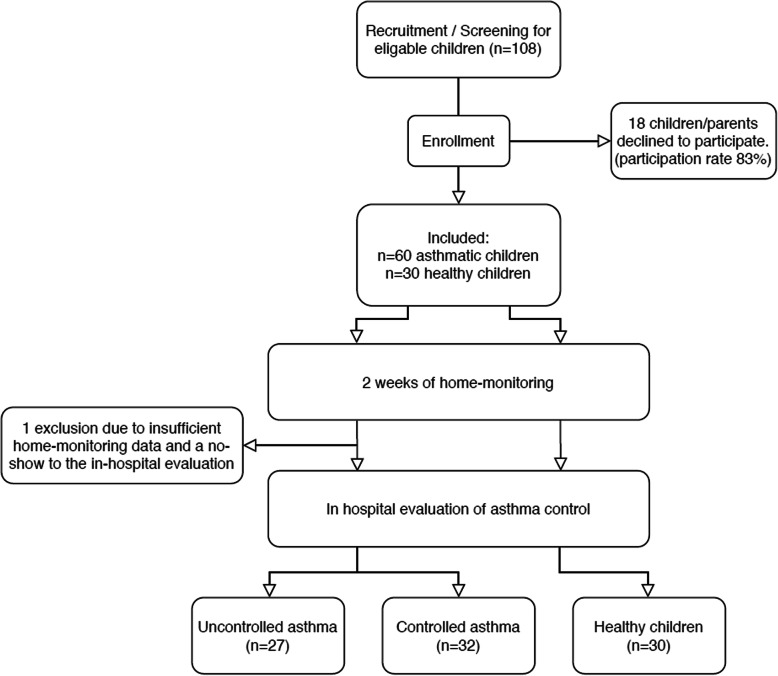
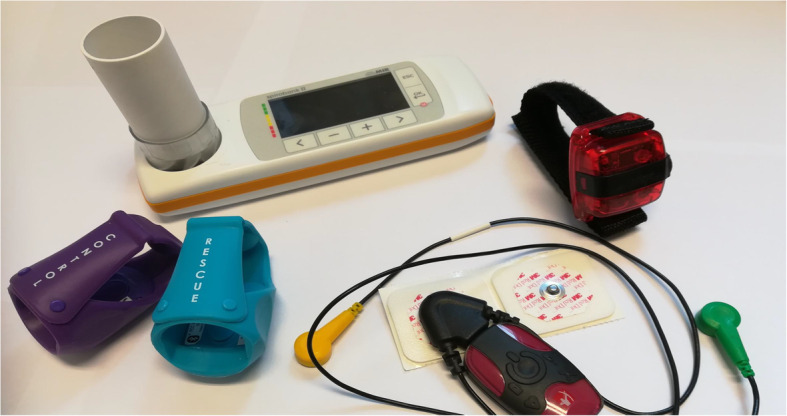
Sixty asthmatic and thirty non-asthmatic children were enrolled in the observational WEARCON-study. Asthma control was assessed according to GINA guidelines by the paediatrician. All children were also evaluated during a 2-week home-monitoring period with wearable devices; a physical activity tracker, a handheld spirometer, smart inhalers, and an ambulatory electrocardiography device to monitor heart and respiratory rate. Multiple logistic regression analysis was used to determine which diagnostic measures were associated with asthma control.
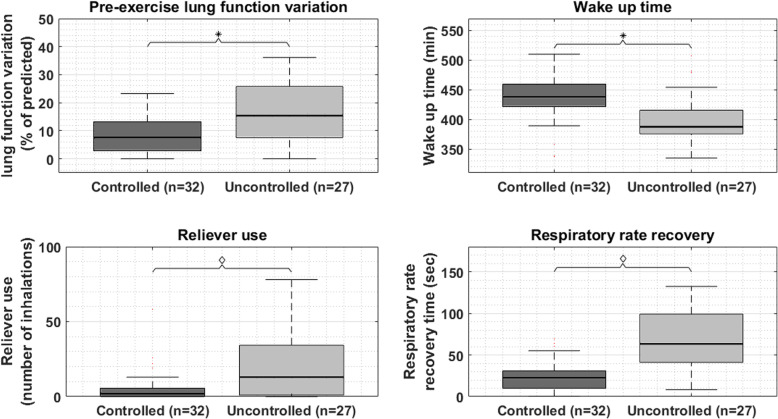
24 of the 27 uncontrolled asthmatic children and 29 of the 32 controlled asthmatic children could be accurately identified with this model. The final model showed that a larger variation in pre-exercise lung function (OR = 1.34 95%-CI 1.07-1.68), an earlier wake-up-time (OR = 1.05 95%-CI 1.01-1.10), more reliever use (OR = 1.11 95%-CI 1.03-1.19) and a longer respiratory rate recovery time (OR = 1.12 95%-CI 1.05-1.20) were significant contributors to the probability of having uncontrolled asthma.
Home-monitoring of physiological parameters correlates with paediatrician assessed asthma control. The constructed multivariate model identifies 88.9% of all uncontrolled asthmatic children, indicating a high potential for monitoring of asthma control. This may allow healthcare professionals to assess asthma control at home.
Netherlands Trail Register, NL6087 . Registered 14 February 2017.
哮喘是儿童最常见的慢性疾病之一。在家中针对哮喘症状定期监测生理参数,可以提供有关哮喘状态动态的补充定量见解。尽管人们对儿童哮喘家庭监测非常感兴趣,但科学证据很少,尤其是关于多参数监测方法的证据。因此,本研究旨在通过组合呼吸生理传感器的参数来研究是否可以在家中准确评估哮喘控制情况。
在观察性 WEARCON 研究中,共纳入 60 名哮喘患儿和 30 名非哮喘患儿。哮喘控制情况根据 GINA 指南由儿科医生评估。所有儿童在为期 2 周的家庭监测期间还使用可穿戴设备进行评估;可穿戴设备包括活动追踪器、手持式肺活量计、智能吸入器和动态心电图仪,以监测心率和呼吸频率。采用多变量逻辑回归分析确定与哮喘控制相关的诊断措施。
该模型可以准确识别 27 名未控制哮喘儿童中的 24 名和 32 名控制哮喘儿童中的 29 名。最终模型表明,运动前肺功能变化较大(OR=1.34,95%CI 1.07-1.68)、早起时间较早(OR=1.05,95%CI 1.01-1.10)、更多使用缓解药物(OR=1.11,95%CI 1.03-1.19)和呼吸频率恢复时间较长(OR=1.12,95%CI 1.05-1.20)与未控制哮喘的概率有显著相关性。
生理参数的家庭监测与儿科医生评估的哮喘控制相关。构建的多变量模型可以识别出 88.9%的所有未控制哮喘儿童,表明对哮喘控制的监测具有很高的潜力。这可能使医疗保健专业人员能够在家中评估哮喘控制情况。
荷兰试验注册处,NL6087。注册于 2017 年 2 月 14 日。