Kurchaba Nicholas, Cassone Bryan J, Northam Caleb, Ardelli Bernadette F, LeMoine Christophe M R
Department of Biology, Brandon University, Brandon, MB R7A 6A9, Canada.
Toxics. 2020 Aug 11;8(3):55. doi: 10.3390/toxics8030055.
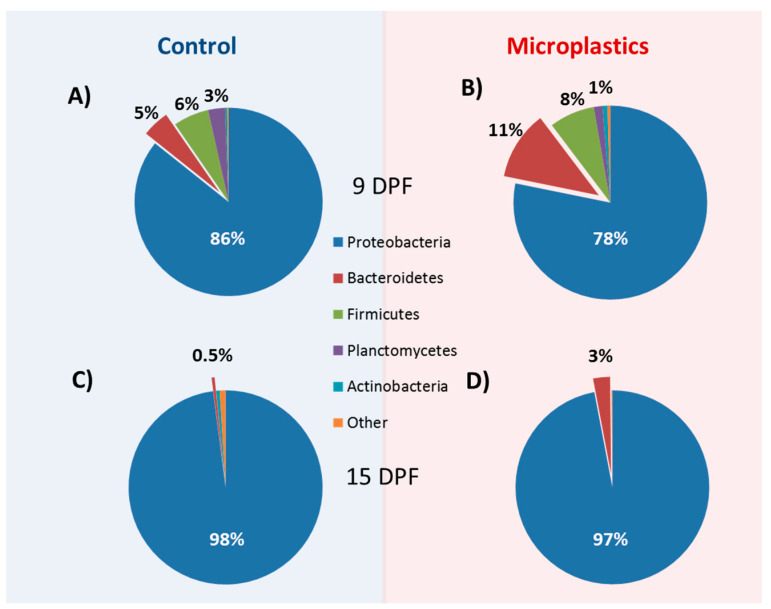
Plastic polymers have quickly become one of the most abundant materials on Earth due to their low production cost and high versatility. Unfortunately, some of the discarded plastic can make its way into the environment and become fragmented into smaller microscopic particles, termed secondary microplastics (MP). In addition, primary MP, purposely manufactured microscopic plastic particles, can also make their way into our environment via various routes. Owing to their size and resilience, these MP can then be easily ingested by living organisms. The effect of MP particles on living organisms is suspected to have negative implications, especially during early development. In this study, we examined the effects of polyethylene MP ingestion for four and ten days of exposure starting at 5 days post-fertilization (dpf). In particular, we examined the effects of polyethylene MP exposure on resting metabolic rate, on gene expression of several inflammatory and oxidative stress linked genes, and on microbiome composition between treatments. Overall, we found no evidence of broad metabolic disturbances or inflammatory markers in MP-exposed fish for either period of time. However, there was a significant increase in the oxidative stress mediator L-FABP that occurred at 15 dpf. Furthermore, the microbiome was disrupted by MP exposure, with evidence of an increased abundance of in MP fish, a combination frequently found in intestinal pathologies. Thus, it appears that acute polyethylene MP exposure can increase oxidative stress and dysbiosis, which may render the animal more susceptible to diseases.
由于生产成本低且通用性强,塑料聚合物迅速成为地球上最丰富的材料之一。不幸的是,一些废弃塑料会进入环境并破碎成更小的微观颗粒,即所谓的次生微塑料(MP)。此外,原生微塑料,即专门制造的微观塑料颗粒,也可以通过各种途径进入我们的环境。由于其尺寸和韧性,这些微塑料很容易被生物摄取。微塑料颗粒对生物的影响被怀疑具有负面影响,尤其是在早期发育阶段。在这项研究中,我们研究了从受精后5天(dpf)开始摄入聚乙烯微塑料4天和10天的影响。特别是,我们研究了聚乙烯微塑料暴露对静息代谢率、几种炎症和氧化应激相关基因的基因表达以及不同处理之间微生物群组成的影响。总体而言,我们没有发现暴露于微塑料的鱼类在这两个时间段内存在广泛代谢紊乱或炎症标志物的证据。然而,在15 dpf时氧化应激介质L-FABP显著增加。此外,微生物群因微塑料暴露而受到干扰,有证据表明微塑料处理组中[此处原文缺失具体微生物名称]的丰度增加,这种组合在肠道疾病中经常出现。因此,急性聚乙烯微塑料暴露似乎会增加氧化应激和生态失调,这可能使动物更容易患病。