Department of Immunology, University of Toronto, Toronto, Ontario, Canada.
School of Kinesiology and Health Science, Muscle Health Research Centre, York University, Toronto, Ontario Canada; The University Health Network, Toronto Western Hospital, University of Toronto, Toronto, Ontario, Canada.
Biomed J. 2021 Apr;44(2):172-182. doi: 10.1016/j.bj.2020.06.010. Epub 2020 Jul 8.
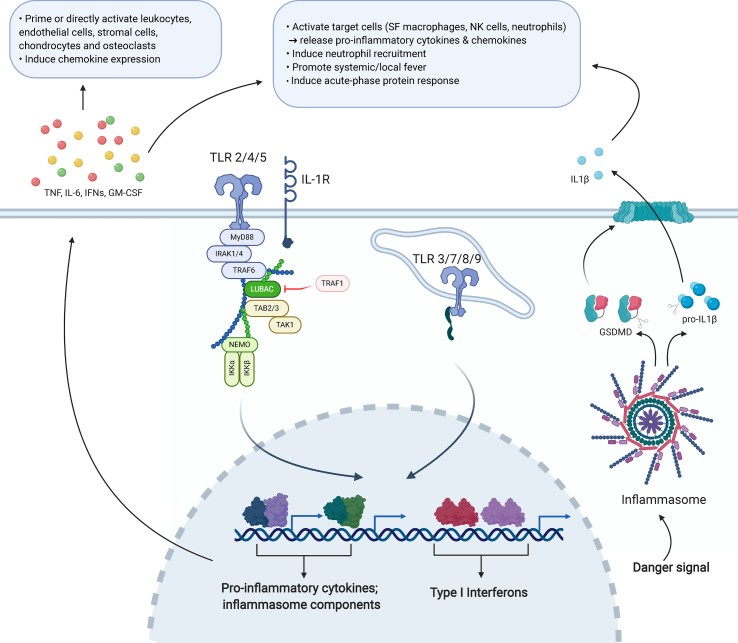
Rheumatoid arthritis (RA) is an autoimmune disease affecting ∼1% of the general population. This disease is characterized by persistent articular inflammation and joint damage driven by the proliferating synovial tissue fibroblasts as well as neutrophil, monocyte and lymphocyte trafficking into the synovium. The factors leading to RA pathogenesis remain poorly elucidated although genetic and environmental factors have been proposed to be the main contributors to RA. The majority of the early studies focused on the role of lymphocytes and adaptive immune responses in RA. However, in the past two decades, emerging studies showed that the innate immune system plays a critical role in the onset and progression of RA pathogenesis. Various innate immune cells including monocytes, macrophages and dendritic cells are involved in inflammatory responses seen in RA patients as well as in driving the activation of the adaptive immune system, which plays a major role in the later stages of the disease. Here we focus the discussion on the role of different innate immune cells and components in initiation and progression of RA. New therapeutic approaches targeting different inflammatory pathways and innate immune cells will be highlighted here. Recent emergence and the significant roles of innate lymphoid cells and inflammasomes will be also discussed.
类风湿关节炎(RA)是一种影响约 1%普通人群的自身免疫性疾病。这种疾病的特征是持续的关节炎症和关节损伤,由增生的滑膜组织成纤维细胞以及中性粒细胞、单核细胞和淋巴细胞向滑膜的迁移所驱动。尽管遗传和环境因素被认为是 RA 的主要诱因,但导致 RA 发病机制的因素仍未得到充分阐明。大多数早期研究集中在淋巴细胞和适应性免疫反应在 RA 中的作用。然而,在过去的二十年中,新出现的研究表明,固有免疫系统在 RA 发病机制的发生和进展中起着关键作用。各种固有免疫细胞,包括单核细胞、巨噬细胞和树突状细胞,参与了 RA 患者的炎症反应,并驱动适应性免疫系统的激活,这在疾病的后期阶段起着主要作用。在这里,我们重点讨论不同固有免疫细胞和成分在 RA 发病和进展中的作用。这里将强调针对不同炎症途径和固有免疫细胞的新治疗方法。最近出现的固有淋巴细胞和炎性体的重要作用也将进行讨论。