Department of clinical laboratory, Guangdong Province Hospital for Occupational Disease Prevention and Treatment, Guangzhou, China.
Guangdong Provincial Key Laboratory of Occupational Disease Prevention and Treatment, Guangdong Province Hospital for Occupational Disease Prevention and Treatment, Guangzhou, China.
J Occup Health. 2020 Jan;62(1):e12142. doi: 10.1002/1348-9585.12142.
Occupational exposure to trichloroethylene (TCE) induces trichloroethylene hypersensitivity syndrome (TCEHS), which causes hypersensitivity dermatitis and hepatitis. However, whether TCE itself or its two metabolites, trichloroethanol (TCEOH) and trichloroacetic acid (TCA), are involved in TCEHS remains unclear. Therefore, in this study we explored the allergens causing TCEHS and characterized TCEHS-related liver injury in guinea pigs.
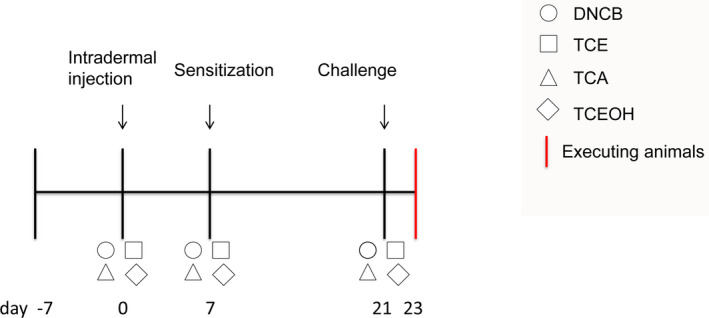
The guinea pig maximization test was performed using TCE, TCEOH, and TCA as candidate allergens. Skin inflammation was scored, and liver function and histopathological changes were evaluated by biochemical tests and hematoxylin and eosin staining, respectively.
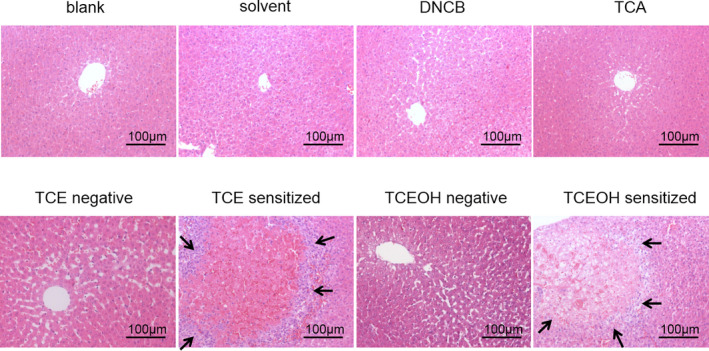
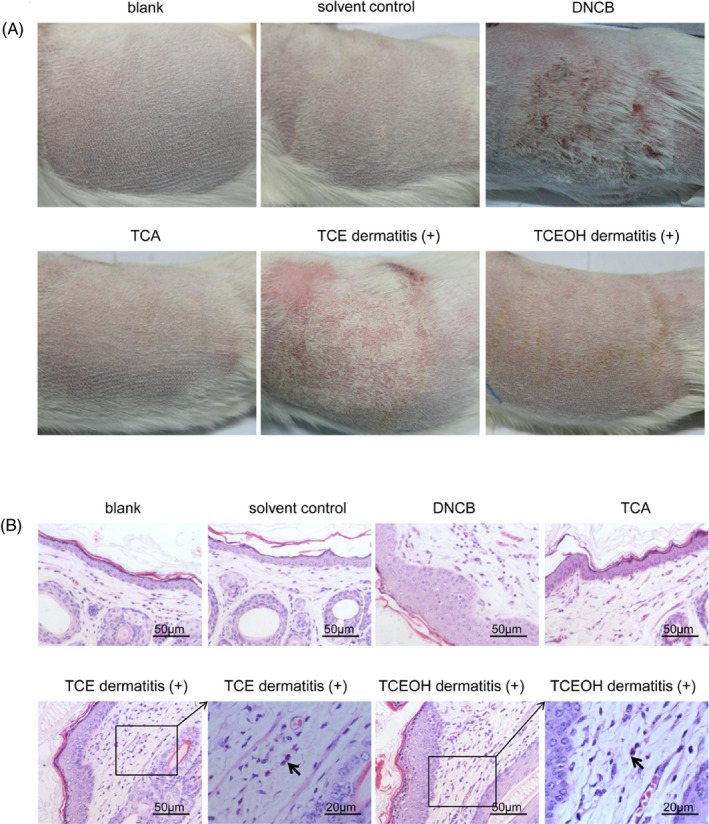
The sensitization rates for TCE, TCEOH, and TCA were 90.0%, 50.0%, and 0.0%, respectively. In the TCE and TCEOH experimental groups, the skin showed varying degrees of erythema with eosinophil granulocyte infiltration in the dermis. Additionally, serum alanine aminotransferase and γ-glutamyl transpeptidase levels increased significantly, and histological analysis revealed focal hepatocellular necrosis with inflammatory cell infiltration in the liver.
TCE is the main cause of allergy and TCEOH is a secondary factor for allergy in guinea pigs. TCE and TCEOH can cause immune-mediated skin sensitization complicated by focal hepatic necrosis.
职业性接触三氯乙烯(TCE)可诱发三氯乙烯过敏综合征(TCEHS),导致过敏性皮炎和肝炎。然而,引起 TCEHS 的是 TCE 本身还是其两种代谢产物,三氯乙醇(TCEOH)和三氯乙酸(TCA)尚不清楚。因此,本研究旨在探索引起 TCEHS 的过敏原,并对豚鼠 TCEHS 相关肝损伤进行特征描述。
使用 TCE、TCEOH 和 TCA 作为候选变应原进行豚鼠最大剂量试验。通过皮肤炎症评分,以及生化检测评估肝功能和苏木精-伊红染色评估组织病理学变化,分别评估皮肤炎症和肝损伤情况。
TCE、TCEOH 和 TCA 的致敏率分别为 90.0%、50.0%和 0.0%。在 TCE 和 TCEOH 实验组中,皮肤出现不同程度的红斑,真皮层有嗜酸性粒细胞浸润。此外,血清丙氨酸氨基转移酶和γ-谷氨酰转肽酶水平显著升高,肝脏组织学分析显示局灶性肝细胞坏死伴炎症细胞浸润。
TCE 是引起过敏的主要原因,TCEOH 是豚鼠过敏的次要因素。TCE 和 TCEOH 可引起免疫介导的皮肤致敏,伴有局灶性肝坏死。