Smith Christopher David, Morgan Eric René, Jones Rhys Aled
Department of Life Sciences, Aberystwyth University, Penglais, Aberystwyth, UK.
School of Biological Sciences, Queen's University Belfast, Belfast, UK.
Parasitology. 2024 Sep;151(11):1201-1224. doi: 10.1017/S0031182024000957. Epub 2024 Dec 3.
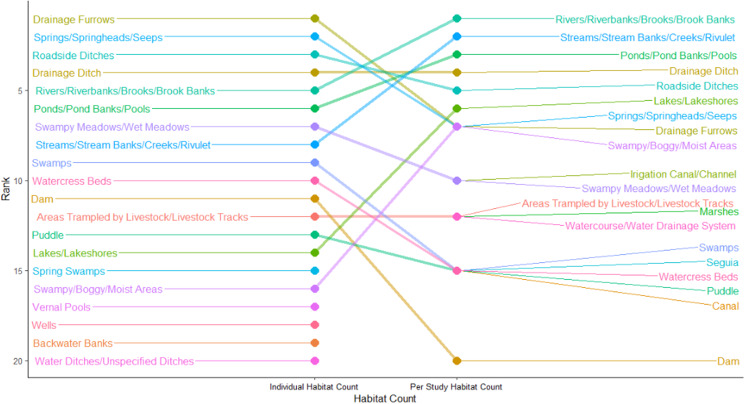
is one of the most distributed intermediate hosts of across Europe, North Africa and South America. Therefore, understanding the environmental preferences of this species is vital for developing control strategies for fascioliasis and other trematodes such as . This systematic literature review evaluates the current understanding of the snail's environmental preferences to identify factors which might aid control and areas where further research is needed. Searches were conducted using Google Scholar and PubMed and included papers published up to August 2023. After filtration, 198 papers with data from 64 countries were evaluated, and data regarding habitat type and habitat pH were noted, along with any other information pertaining to the snail's environmental preferences. The results show that can survive in a diverse range of climates and habitats, generally favours shallow slow-moving water or moist bare mud surfaces, temperatures between 10 and 25°C and was found in habitats with a water pH ranging from 5.0 to 9.4. However, there is limited understanding of the impact of several factors, such as the true optimum pH and temperature preferences within the respective tolerance limits or the reason for the snail's apparent aversion to peatland. Further research is needed to clarify the impact of biotic and abiotic factors on the snail to create robust risk assessments of fluke infection and assess opportunities for environmental control strategies, and for predicting how the snail and fluke transmission may be impacted by climate change.
是欧洲、北非和南美洲分布最广的中间宿主之一。因此,了解该物种的环境偏好对于制定肝片吸虫病和其他吸虫(如 )的控制策略至关重要。本系统文献综述评估了目前对蜗牛环境偏好的理解,以确定可能有助于控制的因素以及需要进一步研究的领域。使用谷歌学术和PubMed进行搜索,纳入截至2023年8月发表的论文。经过筛选,评估了来自64个国家的198篇有数据的论文,记录了有关栖息地类型和栖息地pH值的数据,以及与蜗牛环境偏好有关的任何其他信息。结果表明, 可以在多种气候和栖息地中生存,通常喜欢浅缓流水或潮湿的裸露泥面,温度在10至25°C之间,并且在水pH值为5.0至9.4的栖息地中被发现。然而,对于几个因素的影响了解有限,例如在各自耐受限度内的真正最佳pH值和温度偏好,或者蜗牛明显厌恶泥炭地的原因。需要进一步研究以阐明生物和非生物因素对蜗牛的影响,从而建立对吸虫感染的可靠风险评估,评估环境控制策略的机会,并预测蜗牛和吸虫传播可能如何受到气候变化的影响。