Akya Alisha, Chegenelorestani Roya, Shahvaisi-Zadeh Jila, Bozorgomid Arezoo
Infectious Diseases Research Center, Health Institute, Kermanshah University of Medical Sciences, Kermanshah, Iran.
Department of Microbiology, Kermanshah University of Medical Sciences, Kermanshah, Iran.
Risk Manag Healthc Policy. 2020 Aug 5;13:1035-1042. doi: 10.2147/RMHP.S261311. eCollection 2020.
Hospital wastewater contains highly resistant and virulent bacteria that can spread into the environment. This study was conducted to investigate the antimicrobial resistance of methicillin-resistant (MRSA) and methicillin-sensitive (MSSA) in raw and treated hospital wastewater.
During a three-month period, 40 sewage samples were collected from the hospital sewage (Kermanshah, Iran), and were identified using culture and biochemical tests. MRSA was detected by resistance to cefoxitin. Antibiotic resistance (AR) was determined using disk diffusion according to the Clinical and Laboratory Standards Institute (CLSI) in 20 MSSA (10 raw and 10 treated sewage) and 40 MRSA isolates (20 raw and 20 treated sewage). The antimicrobial resistance genes (ARGs) were determined by PCR.
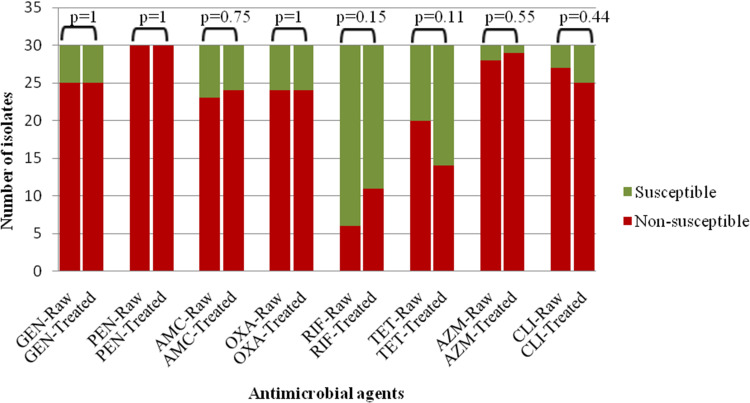
Eleven and eight percent of the isolates were MRSA in raw and treated sewage samples, respectively. Out of 60 isolates, 59 (98%) were multidrug resistant (MDR). The most common ARGs were mecA (raw=100%, treated=100%), aacA-D (raw=100%, treated=85%) and tetK (raw =95%, treated =45%) in MRSA, while the tetM gene was the most abundant gene (raw=50%, treated=80%) in MSSA. None of isolates (n=60) was positive for the vanB gene. MSSR (n=20) had the highest level of resistance against penicillin (100%), clindamycin (raw=90%, treated=90%), azithromycin (raw=80%, treated=90%). All MRSA isolates (n=40,100%) in both raw and treated sewage samples were non-susceptible to penicillin, oxacillin and azithromycin. There was no significant difference in the frequency AR and ARGs between raw and treated sewage samples (p>0.05).
The results indicated a high frequency of MDR and ARGs in both raw and treated sewage isolates which could be released into the environment through sewage system and pose a serious threat to public health. Hospital wastewater treatment processes should be improved in order to prevent the dissemination of the most resistant strains of .
医院废水含有高抗性和高致病性细菌,可传播至环境中。本研究旨在调查医院原废水和处理后废水中耐甲氧西林金黄色葡萄球菌(MRSA)和甲氧西林敏感金黄色葡萄球菌(MSSA)的抗菌耐药性。
在三个月的时间里,从伊朗克尔曼沙阿的医院污水中采集了40份污水样本,并通过培养和生化试验进行鉴定。通过对头孢西丁的耐药性检测MRSA。根据临床和实验室标准协会(CLSI)的方法,采用纸片扩散法测定20株MSSA(10份原污水和10份处理后污水)和40株MRSA分离株(20份原污水和20份处理后污水)的抗生素耐药性(AR)。通过PCR测定抗菌耐药基因(ARGs)。
原污水和处理后污水样本中分离株的MRSA分别占11%和8%。在60株分离株中,59株(98%)为多重耐药(MDR)。MRSA中最常见的ARGs是mecA(原污水=100%,处理后污水=100%)、aacA-D(原污水=100%,处理后污水=85%)和tetK(原污水=95%,处理后污水=45%),而tetM基因是MSSA中最丰富的基因(原污水=50%,处理后污水=80%)。所有分离株(n = 60)的vanB基因均为阴性。MSSR(n = 20)对青霉素(100%)、克林霉素(原污水=90%,处理后污水=90%)、阿奇霉素(原污水=80%,处理后污水=90%)的耐药水平最高。原污水和处理后污水样本中的所有MRSA分离株(n = 40,100%)对青霉素、苯唑西林和阿奇霉素均不敏感。原污水和处理后污水样本之间的AR和ARGs频率无显著差异(p>0.05)。
结果表明,原污水和处理后污水分离株中MDR和ARGs的频率较高,这些分离株可能通过污水系统释放到环境中,对公众健康构成严重威胁。应改进医院废水处理工艺,以防止最耐药菌株的传播。