Zhao Yan, Ren Mudan, Wang Xin, Lu Guifang, Lu Xinlan, Zhang Dan, He Shuixiang
Department of Gastroenterology, First Affiliated Hospital of Xi'an Jiaotong University, Xi'an 710061, China.
Gastroenterol Res Pract. 2020 Jul 31;2020:8972473. doi: 10.1155/2020/8972473. eCollection 2020.
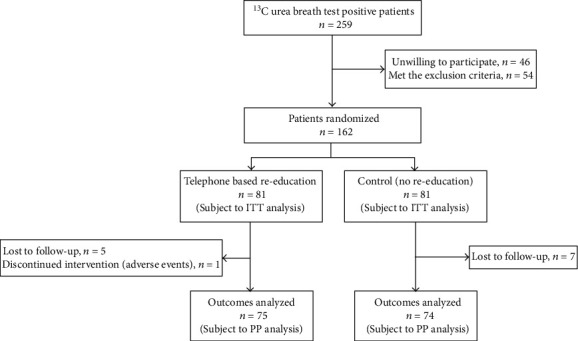
Poor adherence to treatment instructions may play an important role in the failure of eradication. The aim of this study was to evaluate the effects of telephone-based reeducation on 14-day quadruple . eradication therapy. In total, 162 patients were randomly assigned (1 : 1) to either the intervention group (patients received telephone-based reeducation on the 4, 7, and 10 days of the course) or the control group (patients received instructions only at the time of getting the prescriptions). All patients received a 14-day quadruple . eradication therapy. The primary outcome was the . eradication rate. The secondary outcomes included the symptom relief rates and the incidence rates of adverse events. Seventy-five patients in the reeducation group and 74 patients in the control group completed the follow-up. The . eradication rate in the reeducation group was statistically higher than that in the control group (intention-to-treat: 72.8% vs. 50.6%, = 0.006; per-protocol: 78.7% vs. 55.4%, = 0.003). However, the symptom relief rates and the adverse event rates in these two groups were not significantly different. Overall, the results from this study suggest that telephone-based reeducation can be potentially applied to improve the . eradication rate in clinical practice, without significantly increasing the adverse effects.
对治疗指示依从性差可能在根除失败中起重要作用。本研究的目的是评估基于电话的再教育对14天四联根除治疗的效果。总共162例患者被随机分配(1∶1)至干预组(患者在疗程的第4、7和10天接受基于电话的再教育)或对照组(患者仅在取药时接受指示)。所有患者均接受14天四联根除治疗。主要结局是根除率。次要结局包括症状缓解率和不良事件发生率。再教育组75例患者和对照组74例患者完成了随访。再教育组的根除率在统计学上高于对照组(意向性分析:72.8%对50.6%,P = 0.006;符合方案分析:78.7%对55.4%,P = 0.003)。然而,这两组的症状缓解率和不良事件率无显著差异。总体而言,本研究结果表明,基于电话的再教育在临床实践中可能有助于提高根除率,且不会显著增加不良反应。