Sun Lin, Xi Shugang, He Guangyu, Li Zhuo, Gang Xiaokun, Sun Chenglin, Guo Weiying, Wang Guixia
Department of Endocrinology and Metabolism, The First Hospital of Jilin University, Changchun, 130021 Jilin, China.
J Diabetes Res. 2020 Jul 30;2020:4106518. doi: 10.1155/2020/4106518. eCollection 2020.
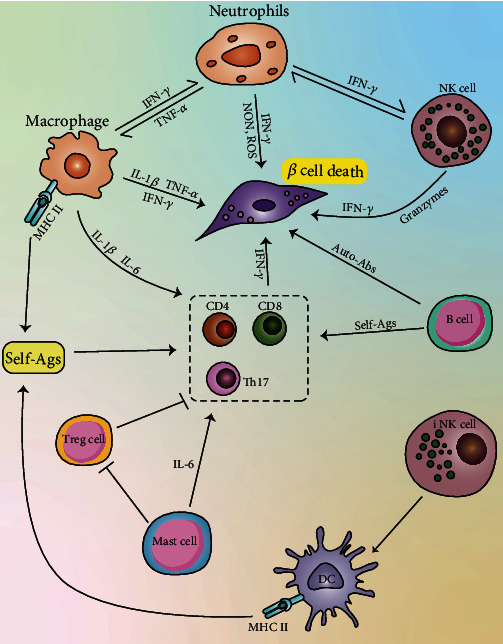
Type 1 diabetes mellitus (T1DM) is a long-term and chronic autoimmune disorder, in which the immune system attacks the pancreatic -cells. Both adaptive and innate immune systems are involved in T1DM development. Both B-cells and T-cells, including CD4 and CD8 T-cells, as well as other T-cell subsets, could affect onset of autoimmunity. Furthermore, cells involved in innate immunity, including the macrophages, dendritic cells, and natural killer (NK) cells, could also accelerate or decelerate T1DM development. In this review, the crosstalk and function of immune cells in the pathogenesis of T1DM, as well as the corresponding therapeutic interventions, are discussed.
1型糖尿病(T1DM)是一种长期慢性自身免疫性疾病,免疫系统会攻击胰腺β细胞。适应性免疫系统和先天性免疫系统均参与T1DM的发病过程。B细胞和T细胞,包括CD4+和CD8+T细胞以及其他T细胞亚群,均可影响自身免疫的发生。此外,参与先天性免疫的细胞,包括巨噬细胞、树突状细胞和自然杀伤(NK)细胞,也可加速或延缓T1DM的发展。在本综述中,将讨论免疫细胞在T1DM发病机制中的相互作用和功能,以及相应的治疗干预措施。