Department of Neurology, Saarland University, Kirrberger Strasse, Homburg, Germany.
Department of Neuroradiology, Saarland University, Kirrberger Strasse, Homburg, Germany.
J Parkinsons Dis. 2020;10(4):1699-1707. doi: 10.3233/JPD-202144.
Altered gastric motility is a frequent non-motor symptom of Parkinson's disease (PD). It has been hypothesized that disturbed gastric motility contributes to motor fluctuations in PD due to an erratic gastro-duodenal transport and an unpredictable absorption of drugs.
We investigated whether patient-reported fluctuations are associated with parameters of gastric motility visualized by real-time magnetic resonance imaging (MRI) of the stomach.
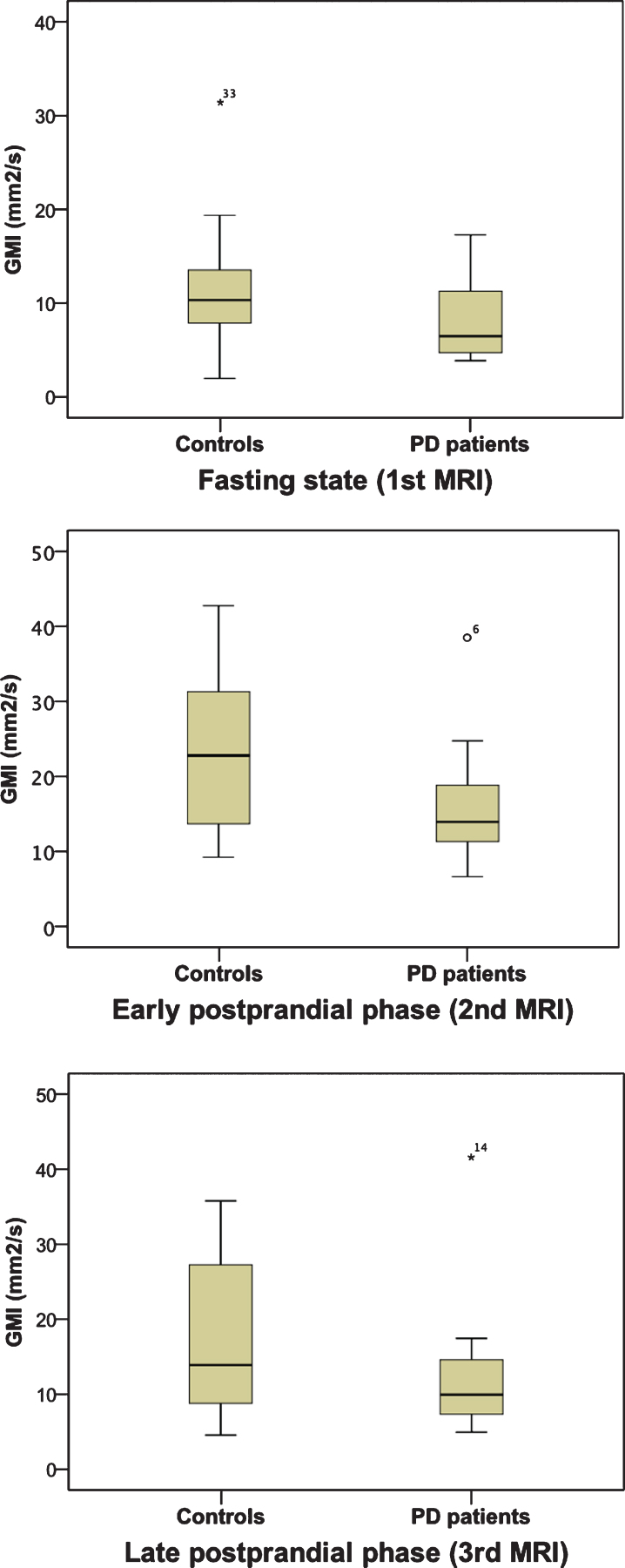
We analyzed real-time MRI-scans of the stomach after an overnight fasting period in 16 PD patients and 20 controls. MRI was performed 1) in the fasting state, 2) directly after a test meal, and 3) 4 hours postprandially. Gastric motility indices were calculated and compared between groups.
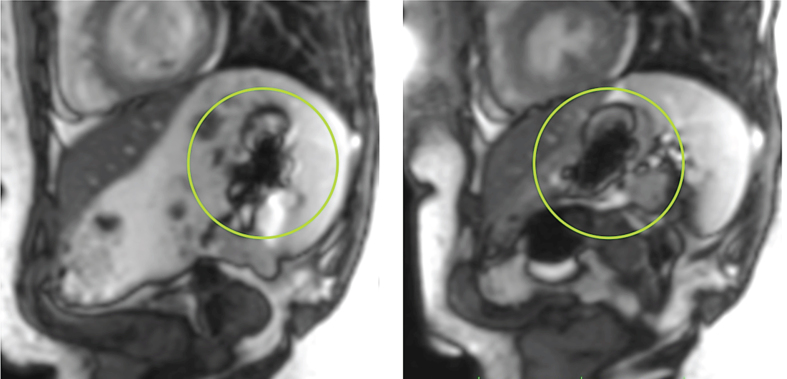
MRI showed an attenuated gastric motility in PD patients compared to controls. The difference was most obvious in the early postprandial phase. Gastric motility was not associated with patient-reported motor fluctuations. Using an iron-containing capsule we were able to retrace retention of drugs in the stomach.
The results of this study stress the importance of considering the phase of digestion when investigating gastric motility in PD. Despite theoretical considerations, we did not find robust evidence for an association between MRI parameters of gastric motility and patient-reported motor fluctuations. For future studies that aim to investigate gastric motility in PD by MRI, we suggest multiple short-time MRIs to better track the whole gastro-duodenal phase in PD. Such an approach would also allow to retrace the retention of drugs in the stomach as shown by our approach using an iron-containing capsule.
胃动力改变是帕金森病(PD)常见的非运动症状。有人假设,胃动力紊乱会导致 PD 的运动波动,这是由于胃-十二指肠输送不稳定和药物吸收不可预测。
我们研究了患者报告的波动是否与胃实时磁共振成像(MRI)显示的胃动力参数有关。
我们分析了 16 名 PD 患者和 20 名对照者在隔夜禁食后进行的胃实时 MRI 扫描。MRI 分别在 1)空腹状态下,2)餐后立即,3)餐后 4 小时进行。计算并比较了胃动力指数。
与对照组相比,PD 患者的胃动力明显减弱。这种差异在餐后早期最为明显。胃动力与患者报告的运动波动无关。使用含铁胶囊,我们能够追踪药物在胃中的滞留情况。
本研究结果强调了在研究 PD 中的胃动力时考虑消化阶段的重要性。尽管存在理论上的考虑,但我们没有发现胃动力 MRI 参数与患者报告的运动波动之间存在关联的有力证据。对于未来旨在通过 MRI 研究 PD 胃动力的研究,我们建议进行多次短时间 MRI,以更好地跟踪 PD 中的整个胃-十二指肠相。这种方法还可以像我们使用含铁胶囊的方法一样,追踪药物在胃中的滞留情况。