Department of Pharmacy and Medicine, Sinai Health System, Toronto, ON, Canada; Leslie Dan Faculty of Pharmacy, University of Toronto, Toronto, ON, Canada.
College of Pharmacy, Midwestern University, Glendale, AZ.
Chest. 2020 Dec;158(6):2414-2424. doi: 10.1016/j.chest.2020.08.015. Epub 2020 Aug 14.
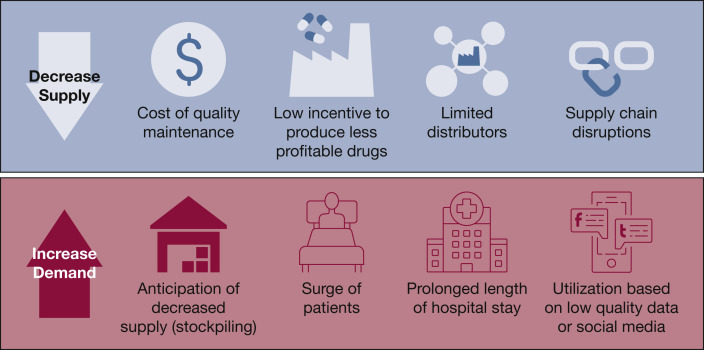
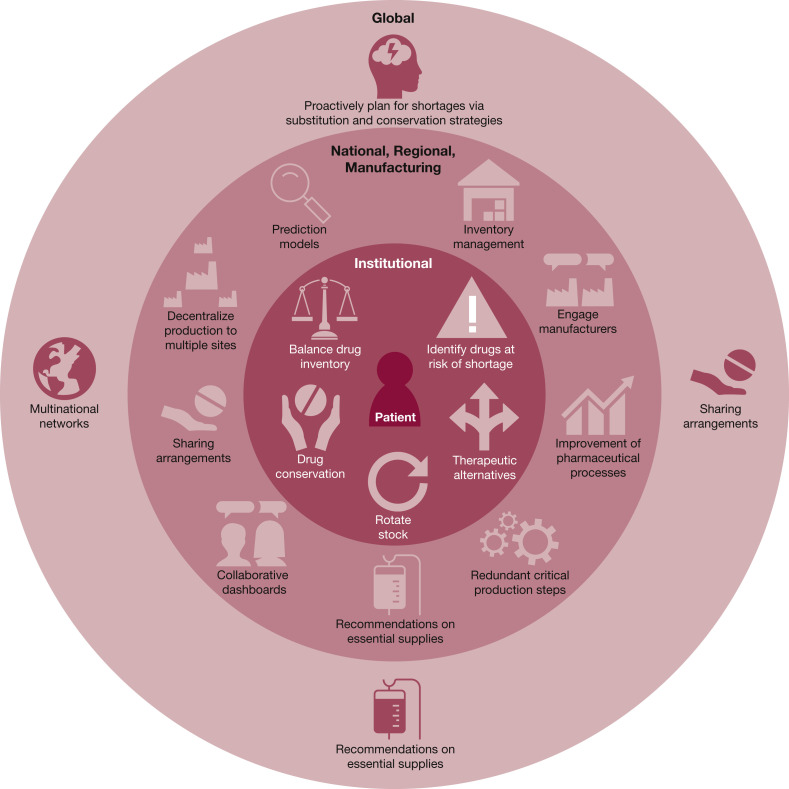
Critical drug shortages have been widely documented during the coronavirus disease 2019 (COVID-19) pandemic, particularly for IV sedatives used to facilitate mechanical ventilation. Surges in volume of patients requiring mechanical ventilation coupled with prolonged ventilator days and the high sedative dosing requirements observed quickly led to the depletion of "just-in-time" inventories typically maintained by institutions. This manuscript describes drug shortages in the context of global, manufacturing, regional and institutional perspectives in times of a worldwide crisis such as a pandemic. We describe etiologic factors that lead to drug shortages including issues related to supply (eg, manufacturing difficulties, supply chain breakdowns) and variables that influence demand (eg, volatile prescribing practices, anecdotal or low-level data, hoarding). In addition, we describe methods to mitigate drug shortages as well as conservation strategies for sedatives, analgesics and neuromuscular blockers that could readily be applied at the bedside. The COVID-19 pandemic has accentuated the need for a coordinated, multi-pronged approach to optimize medication availability as individual or unilateral efforts are unlikely to be successful.
在 2019 年冠状病毒病(COVID-19)大流行期间,已广泛记录到关键药物短缺,尤其是用于辅助机械通气的 IV 镇静剂。需要机械通气的患者数量激增,加上通气时间延长和观察到的高镇静剂剂量需求,这迅速导致机构通常维持的“即时”库存耗尽。本文档描述了在全球、制造、区域和机构层面,在全球危机(如大流行)时期药物短缺的情况。我们描述了导致药物短缺的病因因素,包括与供应相关的问题(例如,生产困难、供应链中断)和影响需求的变量(例如,波动的处方实践、传闻或低水平数据、囤积)。此外,我们还描述了缓解药物短缺的方法,以及镇静剂、镇痛药和神经肌肉阻滞剂的节约策略,这些策略可以在床边轻松应用。COVID-19 大流行凸显了需要采取协调的、多管齐下的方法来优化药物供应,因为个人或单方面的努力不太可能成功。