Department of Radiology, University Medical Center Utrecht and Utrecht University, Utrecht, the Netherlands.
Julius Center for Health Sciences and Primary Care, University Medical Center Utrecht and Utrecht University, Utrecht, the Netherlands.
J Cereb Blood Flow Metab. 2021 Jun;41(6):1229-1239. doi: 10.1177/0271678X20948614. Epub 2020 Aug 17.
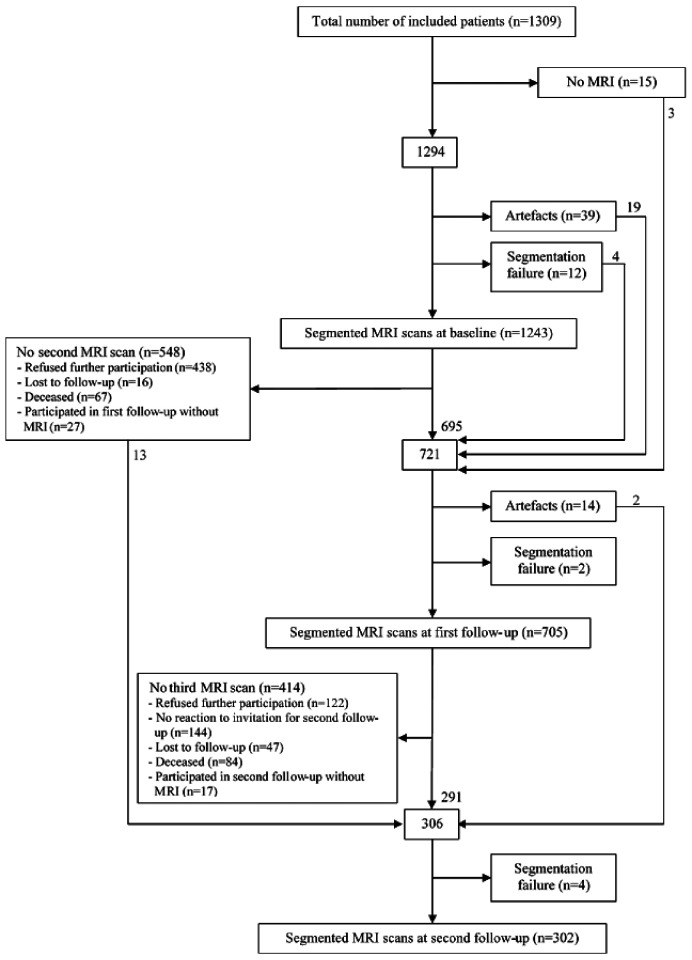
Global cerebral hypoperfusion may be involved in the aetiology of brain atrophy; however, long-term longitudinal studies on this relationship are lacking. We examined whether reduced cerebral blood flow was associated with greater progression of brain atrophy. Data of 1165 patients (61 ± 10 years) from the SMART-MR study, a prospective cohort study of patients with arterial disease, were used of whom 689 participated after 4 years and 297 again after 12 years. Attrition was substantial. Total brain volume and total cerebral blood flow were obtained from magnetic resonance imaging scans and expressed as brain parenchymal fraction (BPF) and parenchymal cerebral blood flow (pCBF). Mean decrease in BPF per year was 0.22% total intracranial volume (95% CI: -0.23 to -0.21). Mean decrease in pCBF per year was 0.24 ml/min per 100 ml brain volume (95% CI: -0.29 to -0.20). Using linear mixed models, lower pCBF at baseline was associated with a greater decrease in BPF over time (=0.01). Lower baseline BPF, however, was not associated with a greater decrease in pCBF (=0.43). These findings indicate that reduced cerebral blood flow is associated with greater progression of brain atrophy and provide further support for a role of cerebral blood flow in the process of neurodegeneration.
全球脑灌注不足可能与脑萎缩的病因有关;然而,关于这种关系的长期纵向研究还很缺乏。我们研究了脑血流量减少是否与脑萎缩的进展程度更大有关。我们使用了 SMART-MR 研究的数据,这是一项对动脉疾病患者的前瞻性队列研究,共纳入了 1165 名患者(61±10 岁),其中 689 名患者在 4 年后和 297 名患者在 12 年后参与了研究。研究的脱落率相当高。脑血流量用磁共振成像扫描获得,并表示为脑实质分数(BPF)和实质脑血流量(pCBF)。每年总颅内容积的 BPF 平均下降 0.22%(95%可信区间:-0.23 至 -0.21)。每年 pCBF 的平均下降为 0.24ml/min/100ml 脑容积(95%可信区间:-0.29 至 -0.20)。使用线性混合模型,基线时的 pCBF 越低,BPF 随时间的下降幅度越大(=0.01)。然而,较低的基线 BPF 与 pCBF 的更大下降无关(=0.43)。这些发现表明,脑血流量减少与脑萎缩的进展程度更大有关,并进一步支持脑血流量在神经退行性过程中的作用。