• 文献检索
  • 文档翻译
  • 深度研究
  • 学术资讯
  • Suppr Zotero 插件Zotero 插件
  • 邀请有礼
  • 套餐&价格
  • 历史记录
应用&插件
Suppr Zotero 插件Zotero 插件浏览器插件Mac 客户端Windows 客户端微信小程序
定价
高级版会员购买积分包购买API积分包
服务
文献检索文档翻译深度研究API 文档MCP 服务
关于我们
关于 Suppr公司介绍联系我们用户协议隐私条款
关注我们

Suppr 超能文献

核心技术专利:CN118964589B侵权必究
粤ICP备2023148730 号-1Suppr @ 2026

文献检索

告别复杂PubMed语法,用中文像聊天一样搜索,搜遍4000万医学文献。AI智能推荐,让科研检索更轻松。

立即免费搜索

文件翻译

保留排版,准确专业,支持PDF/Word/PPT等文件格式,支持 12+语言互译。

免费翻译文档

深度研究

AI帮你快速写综述,25分钟生成高质量综述,智能提取关键信息,辅助科研写作。

立即免费体验

体外心肺复苏治疗院内心搏骤停患者的神经结局:系统评价和荟萃分析。

Neurological outcome after extracorporeal cardiopulmonary resuscitation for in-hospital cardiac arrest: a systematic review and meta-analysis.

机构信息

Department of Anaesthesiology, Erasmus University Medical Centre, Rotterdam, The Netherlands.

Department of Public Health, Erasmus University Medical Centre, Rotterdam, The Netherlands.

出版信息

Crit Care. 2020 Aug 17;24(1):505. doi: 10.1186/s13054-020-03201-0.

DOI:10.1186/s13054-020-03201-0
PMID:32807207
原文链接:https://pmc.ncbi.nlm.nih.gov/articles/PMC7430015/
Abstract

BACKGROUND

In-hospital cardiac arrest (IHCA) is a major adverse event with a high mortality rate if not treated appropriately. Extracorporeal cardiopulmonary resuscitation (ECPR), as adjunct to conventional cardiopulmonary resuscitation (CCPR), is a promising technique for IHCA treatment. Evidence pertaining to neurological outcomes after ECPR is still scarce.

METHODS

We performed a comprehensive systematic search of all studies up to December 20, 2019. Our primary outcome was neurological outcome after ECPR at any moment after hospital discharge, defined by the Cerebral Performance Category (CPC) score. A score of 1 or 2 was defined as favourable outcome. Our secondary outcome was post-discharge mortality. A fixed-effects meta-analysis was performed.

RESULTS

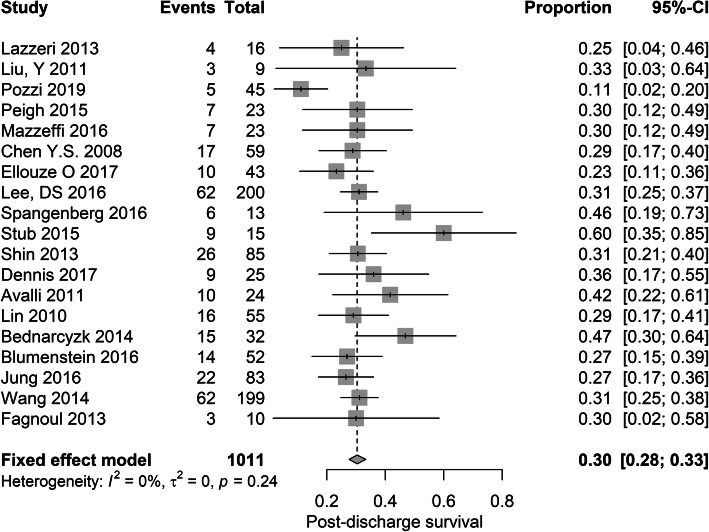
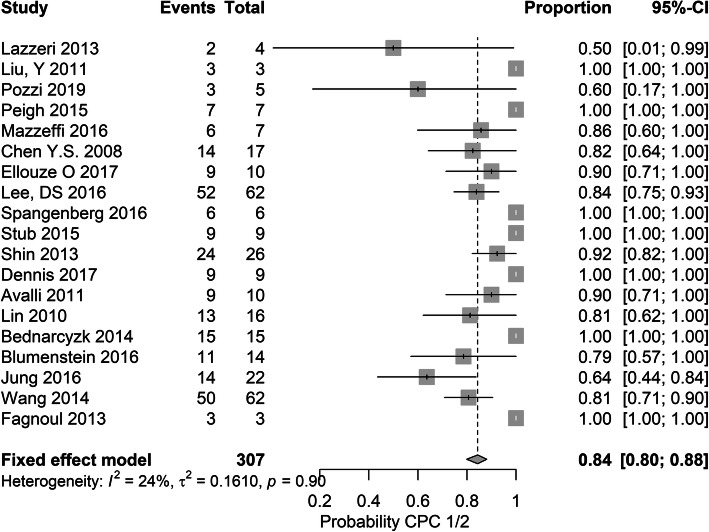
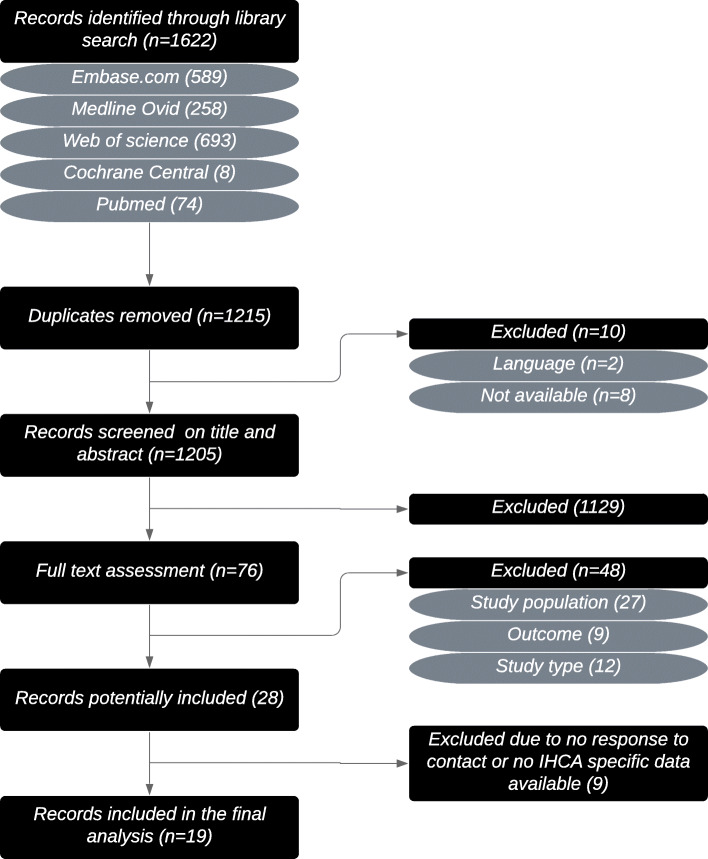
Our search yielded 1215 results, of which 19 studies were included in this systematic review. The average survival rate was 30% (95% CI 28-33%, I = 0%, p = 0.24). In the surviving patients, the pooled percentage of favourable neurological outcome was 84% (95% CI 80-88%, I = 24%, p = 0.90).

CONCLUSION

ECPR as treatment for in-hospital cardiac arrest is associated with a large proportion of patients with good neurological outcome. The large proportion of favourable outcome could potentially be explained by the selection of patients for treatment using ECPR. Moreover, survival is higher than described in the conventional CPR literature. As indications for ECPR might extend to older or more fragile patient populations in the future, research should focus on increasing survival, while maintaining optimal neurological outcome.

摘要

背景

院内心搏骤停(IHCA)是一种严重的不良事件,如果治疗不当,死亡率很高。体外心肺复苏(ECPR)作为常规心肺复苏(CCPR)的辅助手段,是治疗 IHCA 的一种有前途的技术。关于 ECPR 后神经功能结局的证据仍然很少。

方法

我们对截至 2019 年 12 月 20 日的所有研究进行了全面系统的检索。我们的主要结局是出院后任何时间 ECPR 的神经功能结局,用脑功能分类(CPC)评分来定义。评分 1 或 2 定义为良好结局。我们的次要结局是出院后的死亡率。采用固定效应荟萃分析。

结果

我们的搜索结果为 1215 项,其中 19 项研究被纳入本系统综述。平均存活率为 30%(95%CI 28-33%,I=0%,p=0.24)。在存活患者中,良好神经功能结局的汇总百分比为 84%(95%CI 80-88%,I=24%,p=0.90)。

结论

ECPR 作为治疗院内心搏骤停的方法,与大量神经功能良好的患者相关。良好结局的高比例可能是由于选择患者使用 ECPR 进行治疗。此外,存活率高于常规 CPR 文献中的描述。随着 ECPR 的适应证可能扩展到未来的老年或更脆弱的患者人群,研究应侧重于提高生存率,同时保持最佳的神经功能结局。
https://cdn.ncbi.nlm.nih.gov/pmc/blobs/3eb7/7430015/765a586f019c/13054_2020_3201_Fig3_HTML.jpg
https://cdn.ncbi.nlm.nih.gov/pmc/blobs/3eb7/7430015/7d837659e7c8/13054_2020_3201_Fig1_HTML.jpg
https://cdn.ncbi.nlm.nih.gov/pmc/blobs/3eb7/7430015/79b5b5dd0ce0/13054_2020_3201_Fig2_HTML.jpg
https://cdn.ncbi.nlm.nih.gov/pmc/blobs/3eb7/7430015/765a586f019c/13054_2020_3201_Fig3_HTML.jpg
https://cdn.ncbi.nlm.nih.gov/pmc/blobs/3eb7/7430015/7d837659e7c8/13054_2020_3201_Fig1_HTML.jpg
https://cdn.ncbi.nlm.nih.gov/pmc/blobs/3eb7/7430015/79b5b5dd0ce0/13054_2020_3201_Fig2_HTML.jpg
https://cdn.ncbi.nlm.nih.gov/pmc/blobs/3eb7/7430015/765a586f019c/13054_2020_3201_Fig3_HTML.jpg

相似文献

1
Neurological outcome after extracorporeal cardiopulmonary resuscitation for in-hospital cardiac arrest: a systematic review and meta-analysis.体外心肺复苏治疗院内心搏骤停患者的神经结局:系统评价和荟萃分析。
Crit Care. 2020 Aug 17;24(1):505. doi: 10.1186/s13054-020-03201-0.
2
Extracorporeal cardiopulmonary resuscitation versus conventional cardiopulmonary resuscitation in adults with cardiac arrest: a comparative meta-analysis and trial sequential analysis.成人心脏骤停患者体外心肺复苏与传统心肺复苏的比较:一项比较性荟萃分析和试验序贯分析
Lancet Respir Med. 2023 Oct;11(10):883-893. doi: 10.1016/S2213-2600(23)00137-6. Epub 2023 May 22.
3
Predictors of neurological outcomes after successful extracorporeal cardiopulmonary resuscitation.成功实施体外心肺复苏术后神经功能预后的预测因素
BMC Anesthesiol. 2015 Mar 8;15:26. doi: 10.1186/s12871-015-0002-3. eCollection 2015.
4
Comparison of prognosis between extracorporeal CPR and conventional CPR for patients in cardiac arrest: a systematic review and meta-analysis.体外心肺复苏与传统心肺复苏治疗心搏骤停患者预后比较的系统评价和荟萃分析。
BMC Emerg Med. 2024 Jul 27;24(1):128. doi: 10.1186/s12873-024-01058-y.
5
Comparing extracorporeal cardiopulmonary resuscitation with conventional cardiopulmonary resuscitation: A meta-analysis.体外心肺复苏与传统心肺复苏的比较:一项荟萃分析。
Resuscitation. 2016 Jun;103:106-116. doi: 10.1016/j.resuscitation.2016.01.019. Epub 2016 Feb 2.
6
An optimal transition time to extracorporeal cardiopulmonary resuscitation for predicting good neurological outcome in patients with out-of-hospital cardiac arrest: a propensity-matched study.预测院外心脏骤停患者良好神经功能预后的体外心肺复苏最佳转换时间:一项倾向匹配研究。
Crit Care. 2014 Sep 26;18(5):535. doi: 10.1186/s13054-014-0535-8.
7
Comparison of extracorporeal and conventional cardiopulmonary resuscitation: a retrospective propensity score matched study.体外心肺复苏与常规心肺复苏的比较:一项回顾性倾向评分匹配研究。
Crit Care. 2019 Jan 28;23(1):27. doi: 10.1186/s13054-019-2320-1.
8
Clinical Efficacy of Extracorporeal Cardiopulmonary Resuscitation for Adults with Cardiac Arrest: Meta-Analysis with Trial Sequential Analysis.体外心肺复苏治疗成人心脏骤停的临床疗效:Meta 分析与试验序贯分析。
Biomed Res Int. 2019 Jul 9;2019:6414673. doi: 10.1155/2019/6414673. eCollection 2019.
9
Neurological outcomes and duration from cardiac arrest to the initiation of extracorporeal membrane oxygenation in patients with out-of-hospital cardiac arrest: a retrospective study.院外心脏骤停患者体外膜肺氧合启动与心脏骤停至开始之间的神经系统结局和持续时间:一项回顾性研究。
Scand J Trauma Resusc Emerg Med. 2017 Sep 16;25(1):95. doi: 10.1186/s13049-017-0440-7.
10
Extracorporeal cardiopulmonary resuscitation versus conventional CPR in cardiac arrest: an updated meta-analysis and trial sequential analysis.体外心肺复苏与常规心肺复苏治疗心搏骤停的比较:一项更新的荟萃分析和试验序贯分析。
Crit Care. 2024 Feb 21;28(1):57. doi: 10.1186/s13054-024-04830-5.

引用本文的文献

1
Risk factors and outcome of extracorporeal cardiopulmonary resuscitation patients with out-of-hospital cardiac arrest and in-hospital cardiac arrest: a nationwide prospective and observational study of 939 hospitals in China.院外心脏骤停和院内心脏骤停患者体外心肺复苏的危险因素及结局:中国939家医院的全国性前瞻性观察研究
BMC Emerg Med. 2025 Aug 8;25(1):149. doi: 10.1186/s12873-025-01275-z.
2
Stem cell-derived extracellular vesicles: novel therapeutics for cerebral injury following cardiac arrest and potential mechanisms.干细胞衍生的细胞外囊泡:心脏骤停后脑损伤的新型疗法及潜在机制
Cell Biosci. 2025 Jul 26;15(1):110. doi: 10.1186/s13578-025-01451-5.
3

本文引用的文献

1
Improved Survival With Extracorporeal Cardiopulmonary Resuscitation Despite Progressive Metabolic Derangement Associated With Prolonged Resuscitation.体外心肺复苏术尽管与延长复苏相关的代谢恶化相关,但仍能提高生存率。
Circulation. 2020 Mar 17;141(11):877-886. doi: 10.1161/CIRCULATIONAHA.119.042173. Epub 2020 Jan 3.
2
A systematic literature review and meta-analysis of the effectiveness of extracorporeal-CPR versus conventional-CPR for adult patients in cardiac arrest.一项关于体外心肺复苏术(extracorporeal-CPR)与传统心肺复苏术(conventional-CPR)对心脏骤停成年患者有效性的系统文献综述和荟萃分析。
J Intensive Care Soc. 2019 Nov;20(4):347-357. doi: 10.1177/1751143719832162. Epub 2019 Mar 4.
3
Management of non-Cardiac Organ Failure in cardiogenic shock.
心源性休克中非心脏器官衰竭的管理。
Am Heart J Plus. 2025 May 1;55:100549. doi: 10.1016/j.ahjo.2025.100549. eCollection 2025 Jul.
4
Prediction model of in-hospital mortality risk in intensive care unit patients with cardiac arrest: a multicenter retrospective cohort study based on an ensemble model.重症监护病房心脏骤停患者院内死亡风险预测模型:一项基于集成模型的多中心回顾性队列研究
Front Cardiovasc Med. 2025 May 20;12:1582636. doi: 10.3389/fcvm.2025.1582636. eCollection 2025.
5
Clinical characteristics and outcomes of patients with out-of-hospital cardiac arrest treated by repeated extracorporeal cardiopulmonary resuscitation: A multicenter retrospective cohort study.反复体外心肺复苏治疗院外心脏骤停患者的临床特征及预后:一项多中心回顾性队列研究
Acute Med Surg. 2025 Mar 13;12(1):e70051. doi: 10.1002/ams2.70051. eCollection 2025 Jan-Dec.
6
Development of a health equity tool in resuscitation sciences and application to current research in extracorporeal cardiopulmonary resuscitation for cardiac arrest.复苏科学中健康公平工具的开发及其在当前心脏骤停体外心肺复苏研究中的应用。
Resuscitation. 2025 Feb;207:110512. doi: 10.1016/j.resuscitation.2025.110512. Epub 2025 Jan 21.
7
Long-term outcomes of patients who received extracorporeal cardiopulmonary resuscitation (ECPR) following in-hospital cardiac arrest: Analysis of EXCEL registry data.院内心脏骤停后接受体外心肺复苏(ECPR)患者的长期预后:EXCEL注册数据分析
Crit Care Resusc. 2024 Nov 21;26(4):279-285. doi: 10.1016/j.ccrj.2024.08.008. eCollection 2024 Dec.
8
External Validation of the RESCUE-IHCA Score as a Predictor for In-Hospital Cardiac Arrest Patients Receiving Extracorporeal Cardiopulmonary Resuscitation.RESCUE-IHCA评分作为接受体外心肺复苏的院内心脏骤停患者预测指标的外部验证
West J Emerg Med. 2024 Nov;25(6):894-902. doi: 10.5811/westjem.18601.
9
Delirium after cardiac arrest: incidence, risk factors, and association with neurologic outcome-insights from the Freiburg Delirium Registry.心脏骤停后的谵妄:发病率、危险因素及其与神经学转归的关联——来自弗莱堡谵妄登记处的见解
Clin Res Cardiol. 2024 Nov 18. doi: 10.1007/s00392-024-02575-3.
10
Comparison of prognosis between extracorporeal CPR and conventional CPR for patients in cardiac arrest: a systematic review and meta-analysis.体外心肺复苏与传统心肺复苏治疗心搏骤停患者预后比较的系统评价和荟萃分析。
BMC Emerg Med. 2024 Jul 27;24(1):128. doi: 10.1186/s12873-024-01058-y.
Cost-effectiveness of extracorporeal cardiopulmonary resuscitation after in-hospital cardiac arrest: A Markov decision model.
体外心肺复苏术在院内心脏骤停后的成本效益:马尔可夫决策模型。
Resuscitation. 2019 Oct;143:150-157. doi: 10.1016/j.resuscitation.2019.08.024. Epub 2019 Aug 29.
4
Clinical Efficacy of Extracorporeal Cardiopulmonary Resuscitation for Adults with Cardiac Arrest: Meta-Analysis with Trial Sequential Analysis.体外心肺复苏治疗成人心脏骤停的临床疗效:Meta 分析与试验序贯分析。
Biomed Res Int. 2019 Jul 9;2019:6414673. doi: 10.1155/2019/6414673. eCollection 2019.
5
Neurologic Outcomes in Patients Who Undergo Extracorporeal Cardiopulmonary Resuscitation.体外心肺复苏患者的神经功能结局。
Ann Thorac Surg. 2019 Sep;108(3):749-755. doi: 10.1016/j.athoracsur.2019.03.033. Epub 2019 Apr 11.
6
Effect of interplay between age and low-flow duration on neurologic outcomes of extracorporeal cardiopulmonary resuscitation.年龄与低血流持续时间相互作用对体外心肺复苏神经功能结局的影响。
Intensive Care Med. 2019 Jan;45(1):44-54. doi: 10.1007/s00134-018-5496-y. Epub 2018 Dec 13.
7
Predictors of survival and neurologic outcome for adults with extracorporeal cardiopulmonary resuscitation: A systemic review and meta-analysis.体外心肺复苏的成年患者生存及神经功能预后的预测因素:一项系统评价和荟萃分析。
Medicine (Baltimore). 2018 Nov;97(48):e13257. doi: 10.1097/MD.0000000000013257.
8
Extracorporeal Life Support for Refractory Cardiac Arrest: A 10-Year Comparative Analysis.体外生命支持治疗难治性心脏骤停:10 年对比分析。
Ann Thorac Surg. 2019 Mar;107(3):809-816. doi: 10.1016/j.athoracsur.2018.09.007. Epub 2018 Oct 23.
9
One-year survival after in-hospital cardiac arrest: A systematic review and meta-analysis.院内心脏骤停后一年的生存率:系统评价和荟萃分析。
Resuscitation. 2018 Nov;132:90-100. doi: 10.1016/j.resuscitation.2018.09.001. Epub 2018 Sep 10.
10
Duration of CPR and impact on 30-day survival after ROSC for in-hospital cardiac arrest-A Swedish cohort study.心肺复苏持续时间对院内心脏骤停后自主循环恢复 30 天生存率的影响:一项瑞典队列研究。
Resuscitation. 2018 Nov;132:1-5. doi: 10.1016/j.resuscitation.2018.08.017. Epub 2018 Aug 20.