Department of Radiology and Nuclear Medicine, Otto-Von-Guericke University, Leipziger Str. 44, 39120, Magdeburg, Germany.
2nd Department of Radiology, Medical University of Gdansk, Mariana Smoluchowskiego 17, 80-214, Gdansk, Poland.
Cardiovasc Intervent Radiol. 2020 Nov;43(11):1641-1649. doi: 10.1007/s00270-020-02612-4. Epub 2020 Aug 17.
To search for abscopal effects (AE) distant to the site of radiation after sequential Yittrium-90 (Y-90) radioembolization (RE) of liver malignancies.
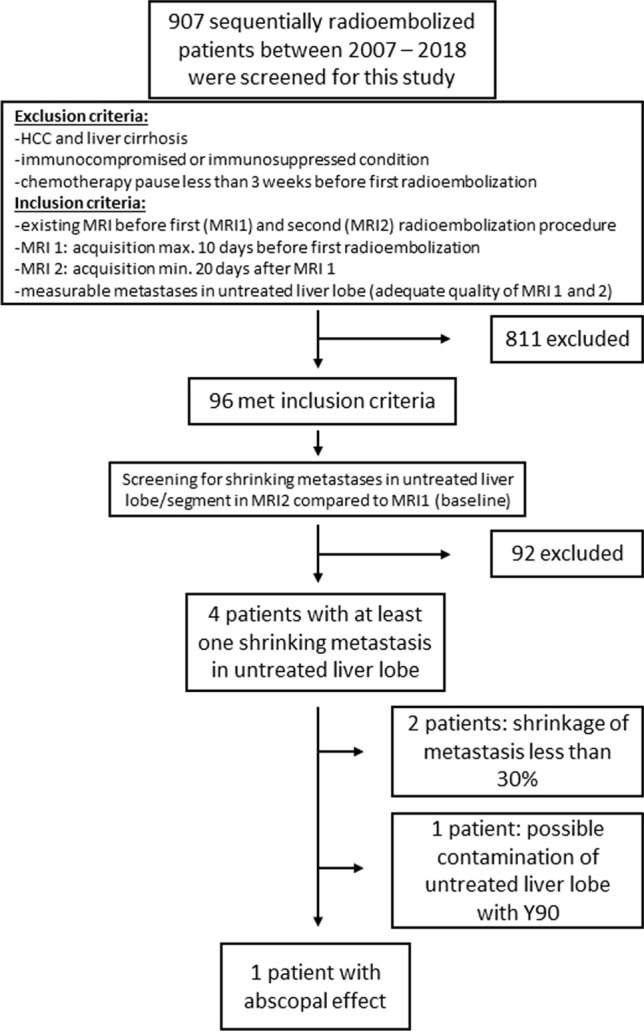
In this retrospective analysis, all patients treated by RE between 2007 and 2018 (n = 907) were screened for the following setting/conditions: sequential RE of left and right liver lobe in two sessions, liver-specific MRI (MRI1) acquired max. 10 days before or after first RE (RE1), liver-specific MRI (MRI2) acquired with a minimum time interval of 20 days after MRI1, but before second RE (RE2). No systemic tumor therapies between MRI1 and MRI2. No patients with liver cirrhosis. Metastases > 5 mm in untreated liver lobes were compared in MRI1 and MRI2 and rated as follows: same size or larger in MRI2 = no abscopal effect (NAE); > 30% shrinkage without Y-90 contamination in SPECT/CT = abscopal effect (AE).
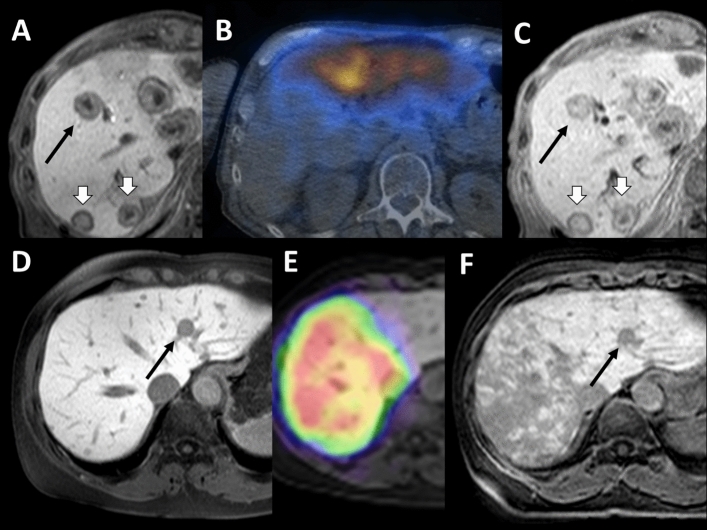
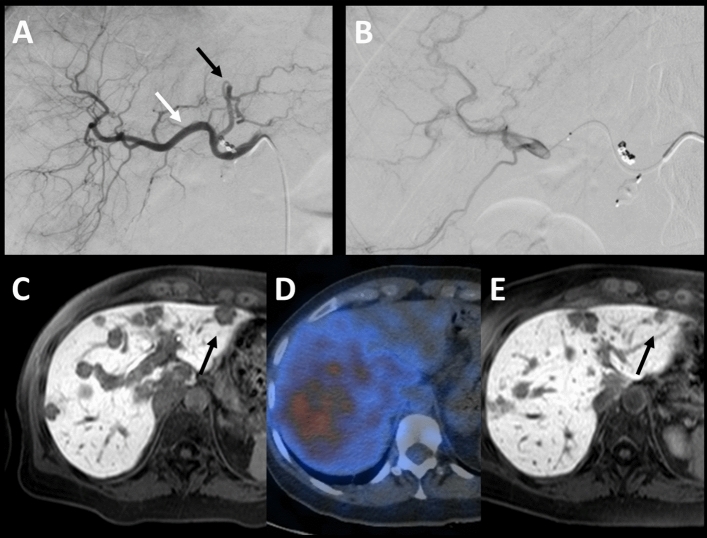
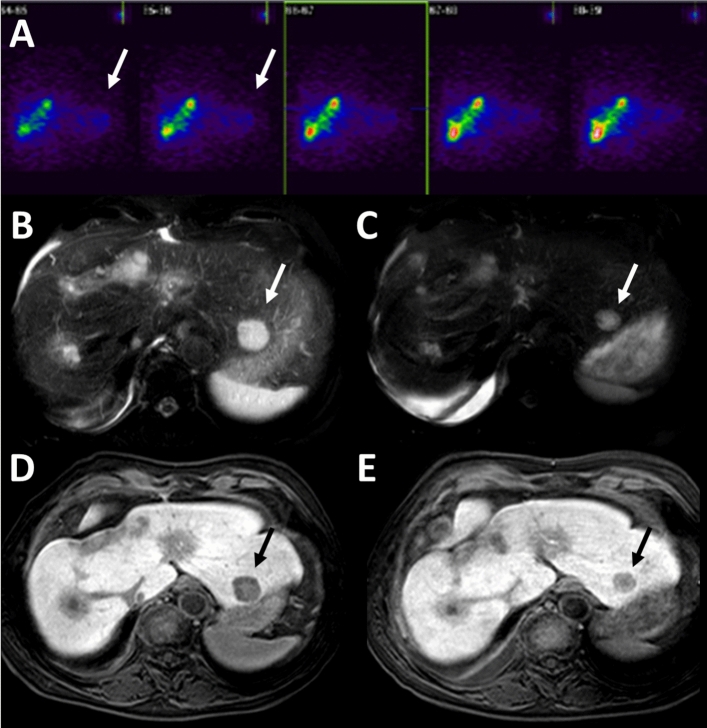
Ninety six of 907 patients met aforementioned criteria. Median time-frame between RE1 and MRI2 was 34 (20-64) days. These 96 cases had 765 metastases which were evaluable (median 5(1-40) metastases per patient). Four patients could be identified with at least one shrinking metastasis of the untreated site: one patient with breast cancer (3 metastases: 0 NAE; 3 AE), one patient with prostate cancer (6 metastases: 3 NAE; 3 metastases > 30% shrinkage but possible Y-90 contamination) and two patients with shrinkage of one metastasis each but less than 30%.
Our retrospective study documents AE after RE of liver tumors in 1 out of 96 cases, 3 other cases remain unclear.
在顺序钇-90(Y-90)放射性栓塞(RE)治疗肝脏恶性肿瘤后,寻找辐射部位以外的远隔效应(AE)。
在这项回顾性分析中,对 2007 年至 2018 年间接受 RE 治疗的所有患者(n=907)进行了筛查,设定了以下条件/情况:左右肝叶分两次进行序贯 RE,第一次 RE 前后最大 10 天内进行肝脏特异性 MRI(MRI1),第一次 RE 后至少 20 天但在第二次 RE 之前进行肝脏特异性 MRI(MRI2),MRI1 和 MRI2 之间无系统肿瘤治疗,无肝硬化患者。对未治疗肝叶的 MRI1 和 MRI2 中>5mm 的转移灶进行比较,并按如下标准进行评分:MRI2 中大小相同或更大=无远隔效应(NAE);SPECT/CT 中>30%缩小且无 Y-90 污染=远隔效应(AE)。
907 例患者中符合上述标准的有 96 例。RE1 和 MRI2 之间的中位时间间隔为 34(20-64)天。这 96 例患者共有 765 个可评估转移灶(中位数每个患者 5(1-40)个转移灶)。有 4 例患者可识别出至少一个未治疗部位的缩小转移灶:1 例乳腺癌患者(3 个转移灶:0 个 NAE;3 个 AE),1 例前列腺癌患者(6 个转移灶:3 个 NAE;3 个转移灶>30%缩小但可能有 Y-90 污染)和 2 例各有一个转移灶缩小但小于 30%。
我们的回顾性研究记录了 96 例患者中有 1 例在接受肝脏肿瘤 RE 后出现 AE,其他 3 例仍不清楚。